
Bella’s on Tour – Sicily – Erice
And the journey continues….
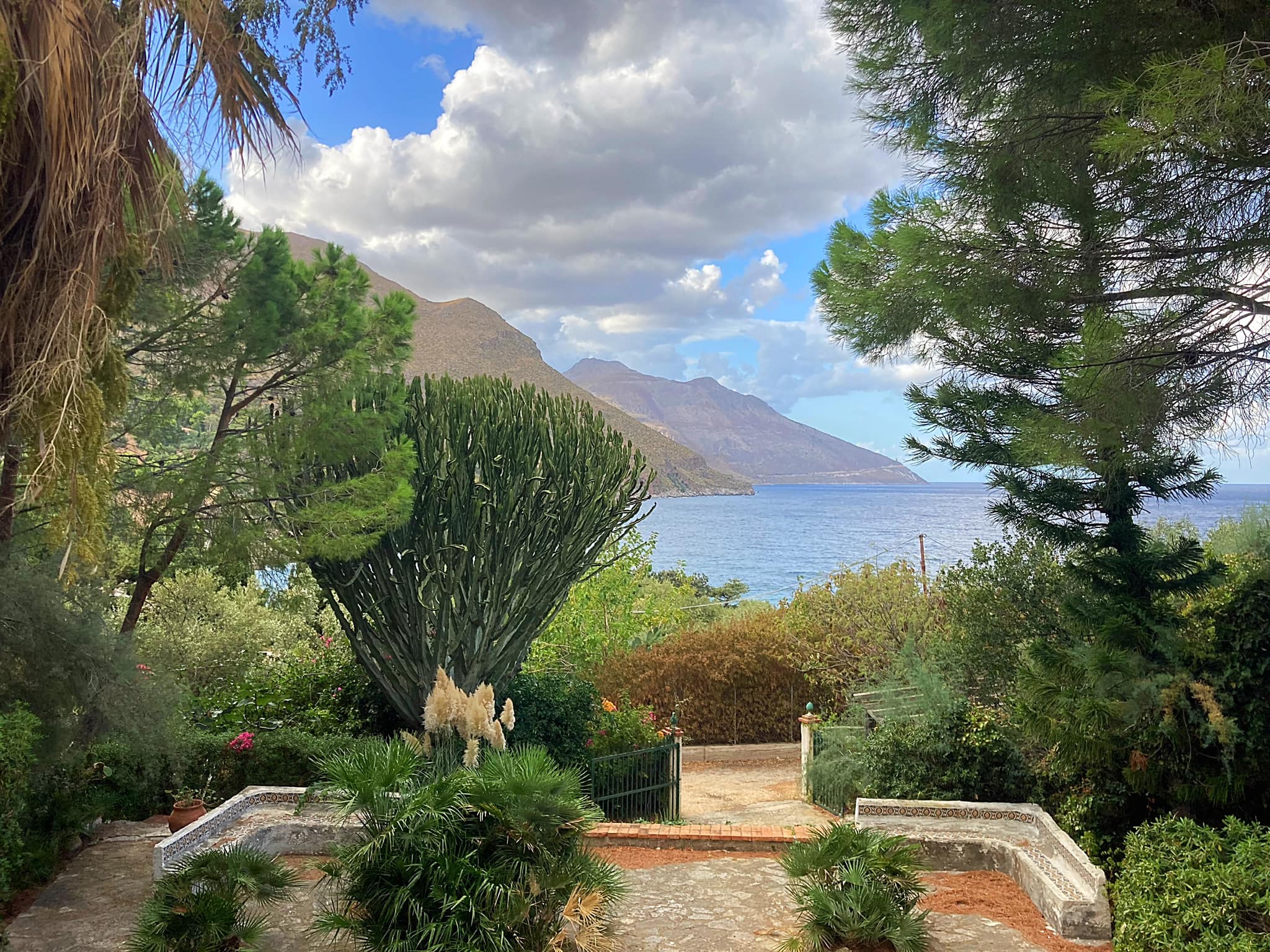
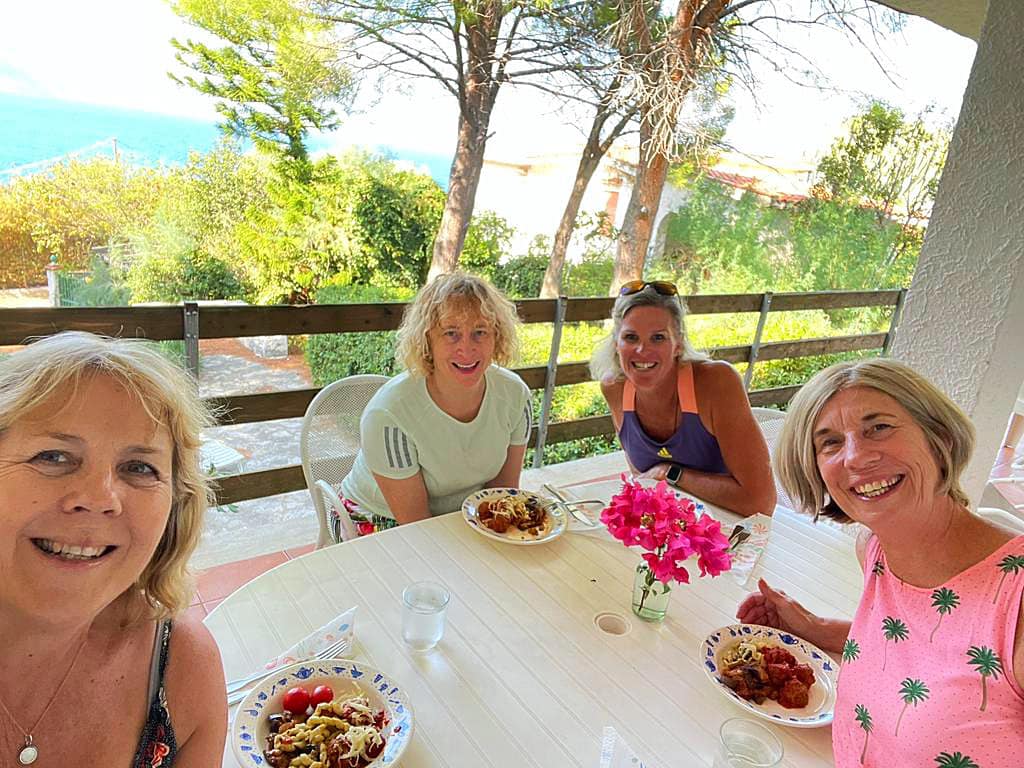
From Bucharest I flew to Sicily to join my dear friends Jo, Kaye and Debs on a Sicilian sojourn. We are staying in a rustic villa near the village of Scopello. It is perfect for our first week in Sicily and has a lovely view out to the ocean and a beautiful beach about 500 metres away.
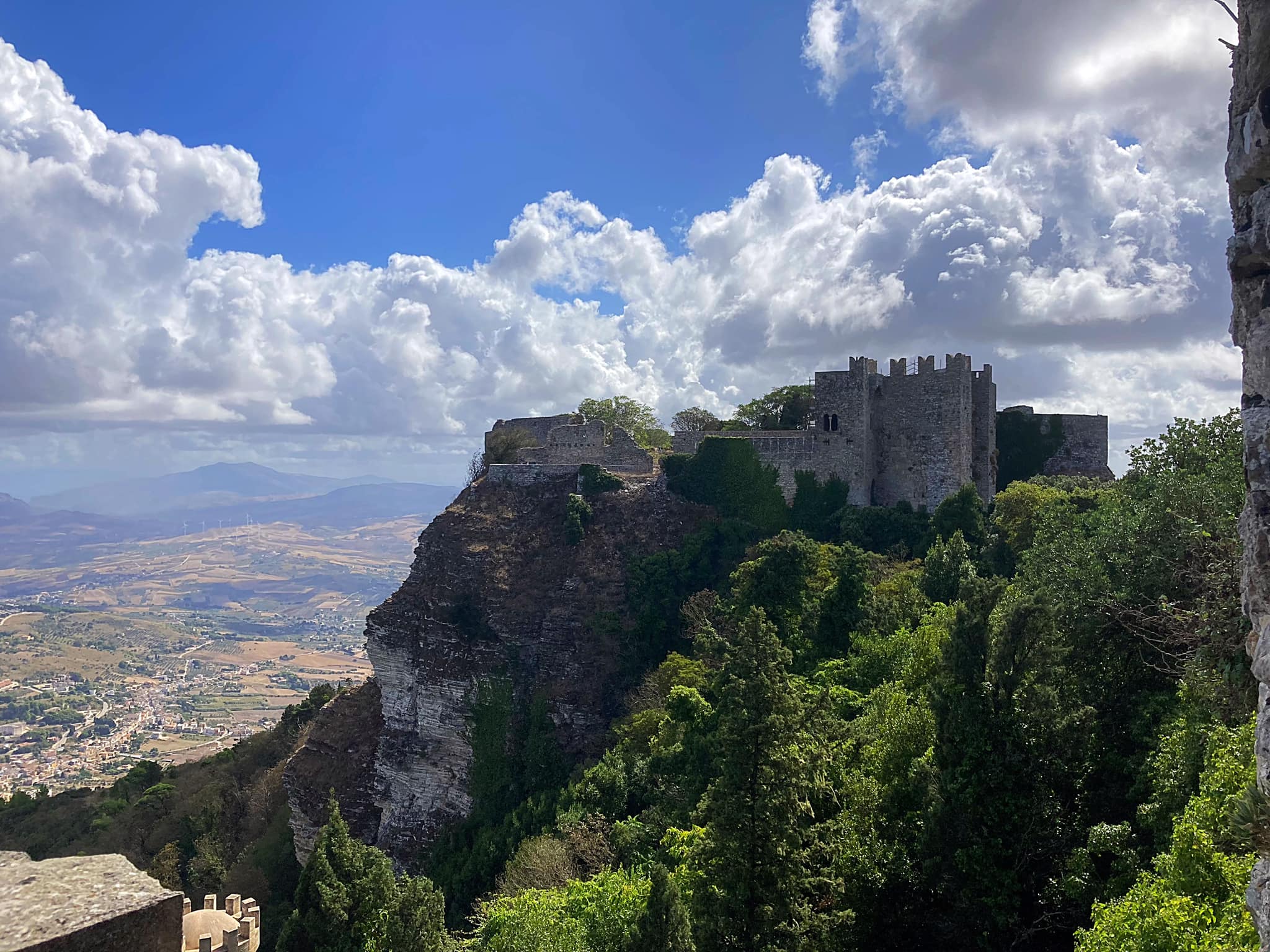
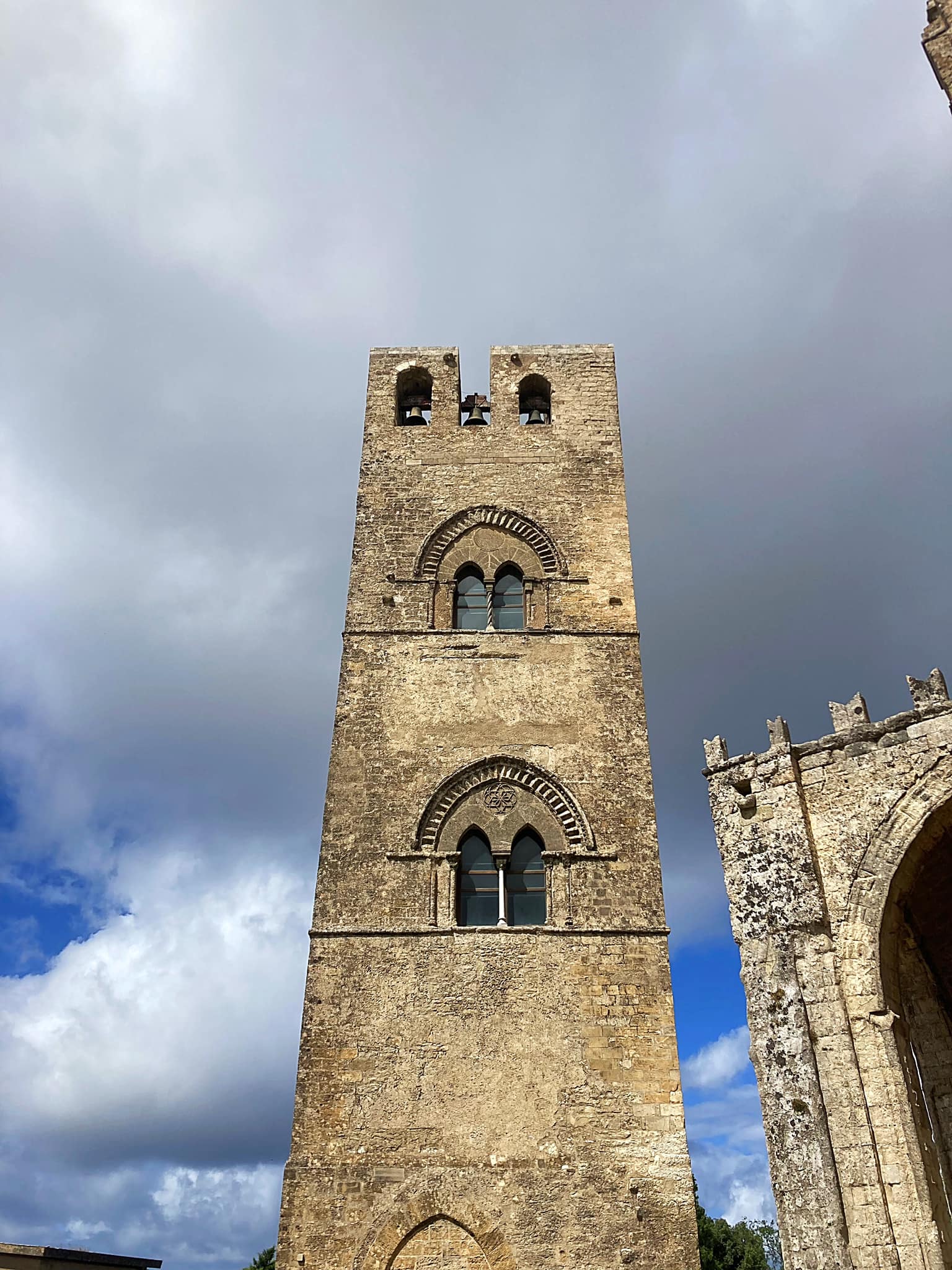
On our first day of exploring we went to the village of Erice. Unfortunately the weather was a bit hit and miss. Erice is a historic town and comune in the province of Trapani, Sicily, in southern Italy. It is a member of the I Borghi più belli d’Italia (“The most beautiful villages of Italy”) association.
In the northeastern portion of the city there are the remains of ancient Elymian and Phoenician walls (Cyclopean masonry) indicating different stages of settlement and occupation in antiquity.
There are two castles that remain in the city: Pepoli Castle, which dates from Saracen times, and the Castello di Venere (“Venus Castle”), dating from the Norman period, built on top of the ancient Temple of Venus, where Venus Ericina was worshipped.
During the Second World War a Luftwaffe Operations Centre (main support weapon of the German Army) was located on the slopes of Monte Erice from early 1943 until they were forced by Allied air raids to relocate.
Erice is about 750 metres above sea level up narrow and winding roads so it was a good introduction to driving and parking in Italy  .
.






Bella’s on Tour – Sicily – Palermo
Italy is all about the food so what better way to spend half a day than doing a walking street food tour.
We navigated our way to Palermo and managed to find a carpark building – we weren’t keen on parking like the Italians which appears to be any which way but upside down 
We met our guide, Justyna, who was so lovely. Our group consisted of the Bella’s, three American girls and an American couple. The three American girls were a real laugh and we enjoyed their company. They actually thought we were quite cool and told us they wanted to be like us when they grew up – the ultimate compliment 
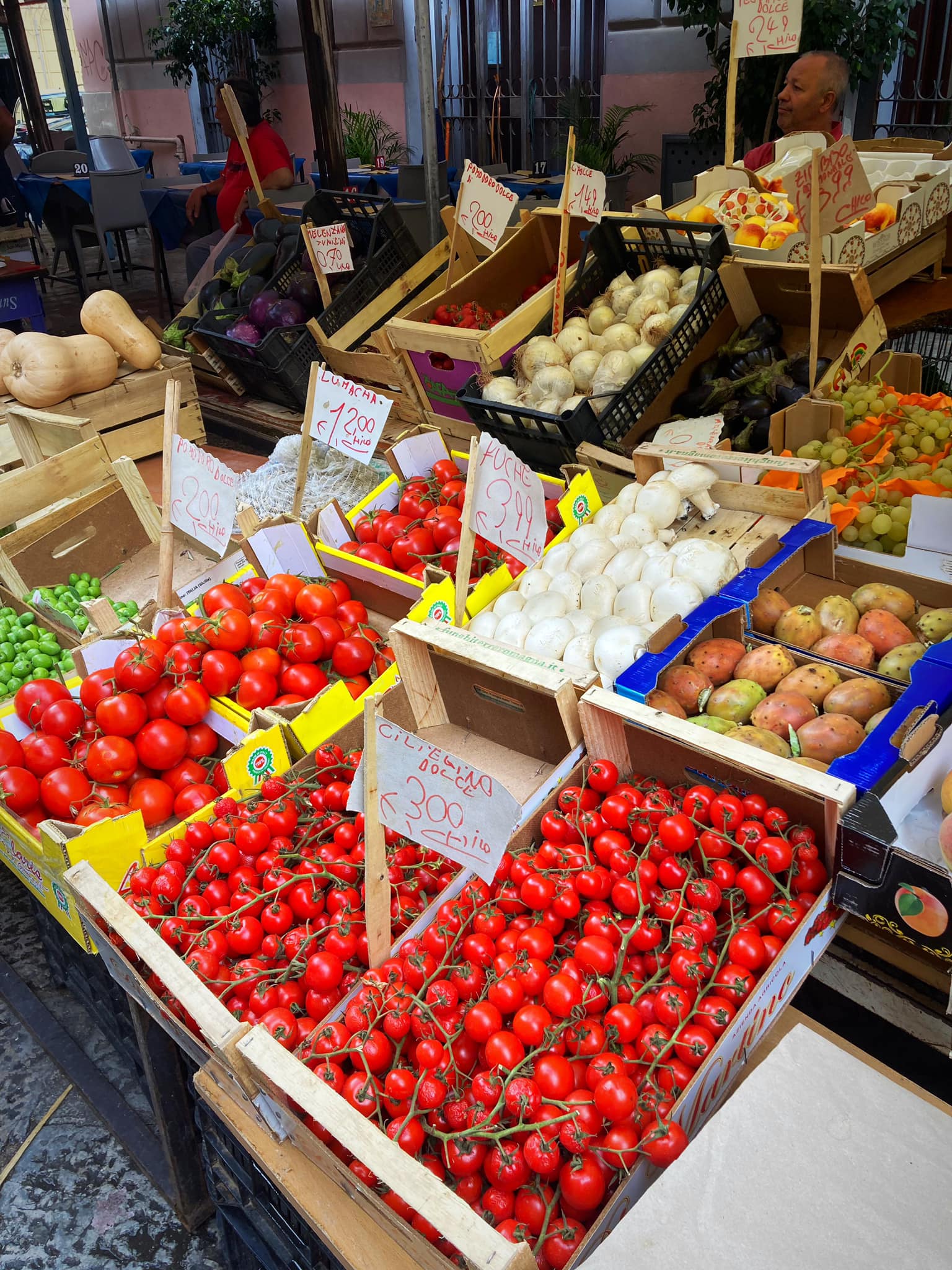
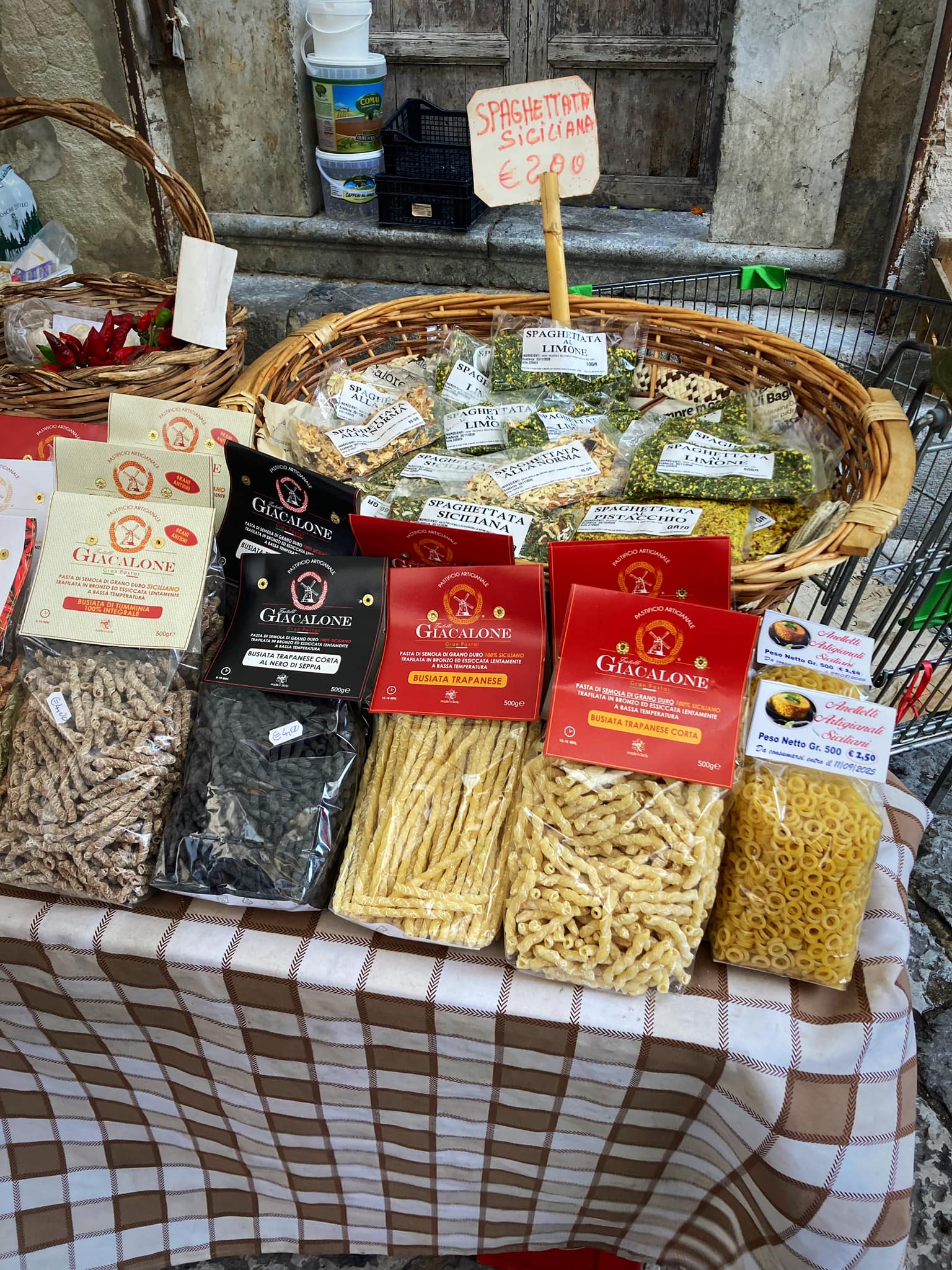
The food market, Mercato Ballaro, operates seven days a week from 7am to 2pm and has everything from fresh fish to pasta to cheese and olives.
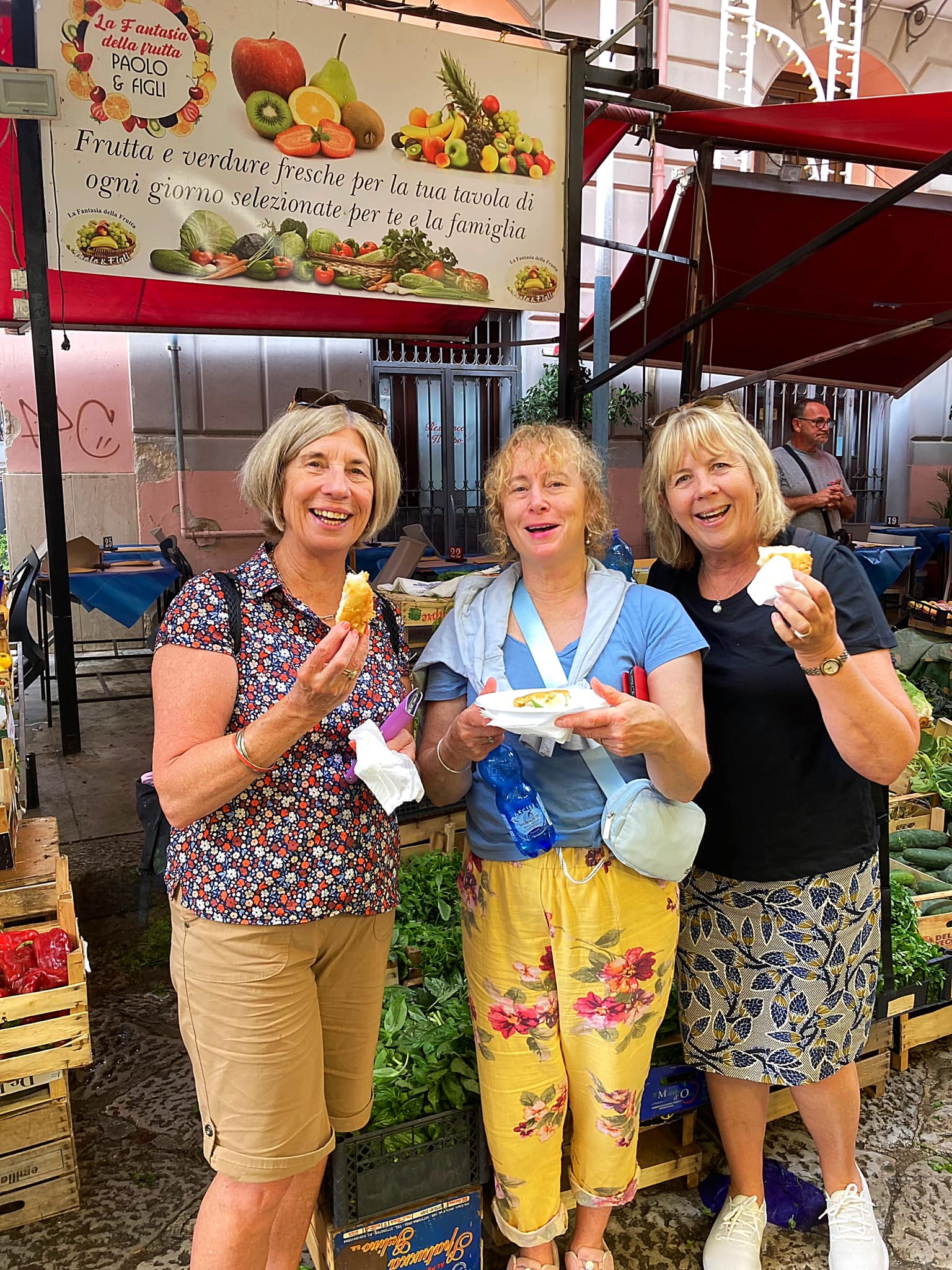
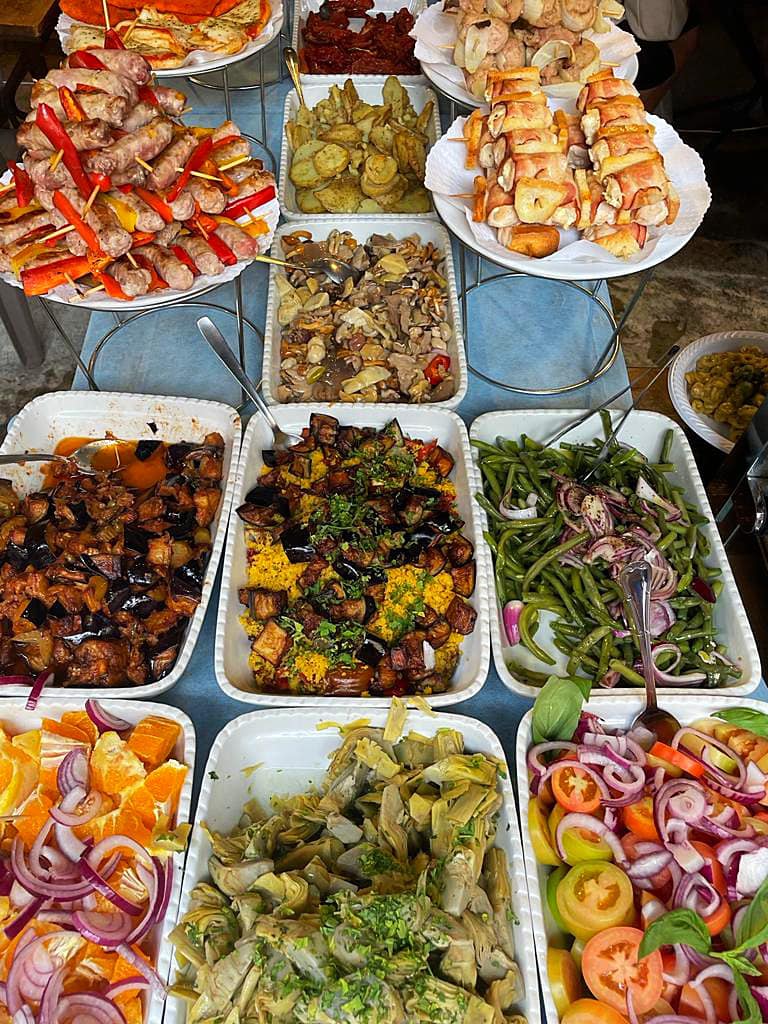
Street food in Palermo goes back many centuries and is influenced by the many cultures that have occupied Sicily. We started off with Panelle (chickpea flour fritters), Arancina or Arancini (fried rice balls), Crocchè (potato fritters) and Caponata (chopped fried aubergine and other vegetables, seasoned with olive oil, tomato sauce, celery, olives, and capers, in an agrodolce sauce).
As you can imagine we were pretty full by then but wait there’s more.
Justyna pointed out the Bello Bello Sfincione food cart which has been going since the 1950’s. Sfincione is a fluffy Sicilian pizza traditionally made with thick dough that is left to rise for several hours or even overnight. The thicker crust, similar to focaccia, is typically topped with tomato sauce, onions, anchovies, oregano and caciocavallo cheese.
We then started making our way through the market stalls. As soon as we pointed at something, Justyna was getting us a sample – we were about to be rolling out of that place.
I especially liked the Pecorino cheeses which are hard Italian cheeses made from sheep’s milk. The name “pecorino” derives from pecora, which means sheep in Italian. There were also a lot of pistachio products – a creamy mixture used in sweet treats and a salty one used in pastas and the like.
We finished off with a Limoncello Spritz  before heading into the shopping streets. Wow it was a busy place. We then stopped off for some Granita which is a semi-frozen dessert made from sugar, water and various flavorings. Originally from Sicily, it is available throughout Italy in varying forms. It is related to sorbet and Italian ice; however, in most of Sicily, it has a smoother, more crystalline texture.
We then visited Quattro Canti which is a baroque square which is officially known as Piazza Vigliena. It has a four corner building which has been perfectly created and decorated with statues of Spanish Kings and fountains.
Next stop was Piazza Pretoria Pretoria is regarded as probably, the most beautiful square in the whole of Palermo. The grand square features a magnificent fountain, with sixteen statues of nymphs, humans, mermaid, and other creatures. It was constructed during the time of the inquisition.
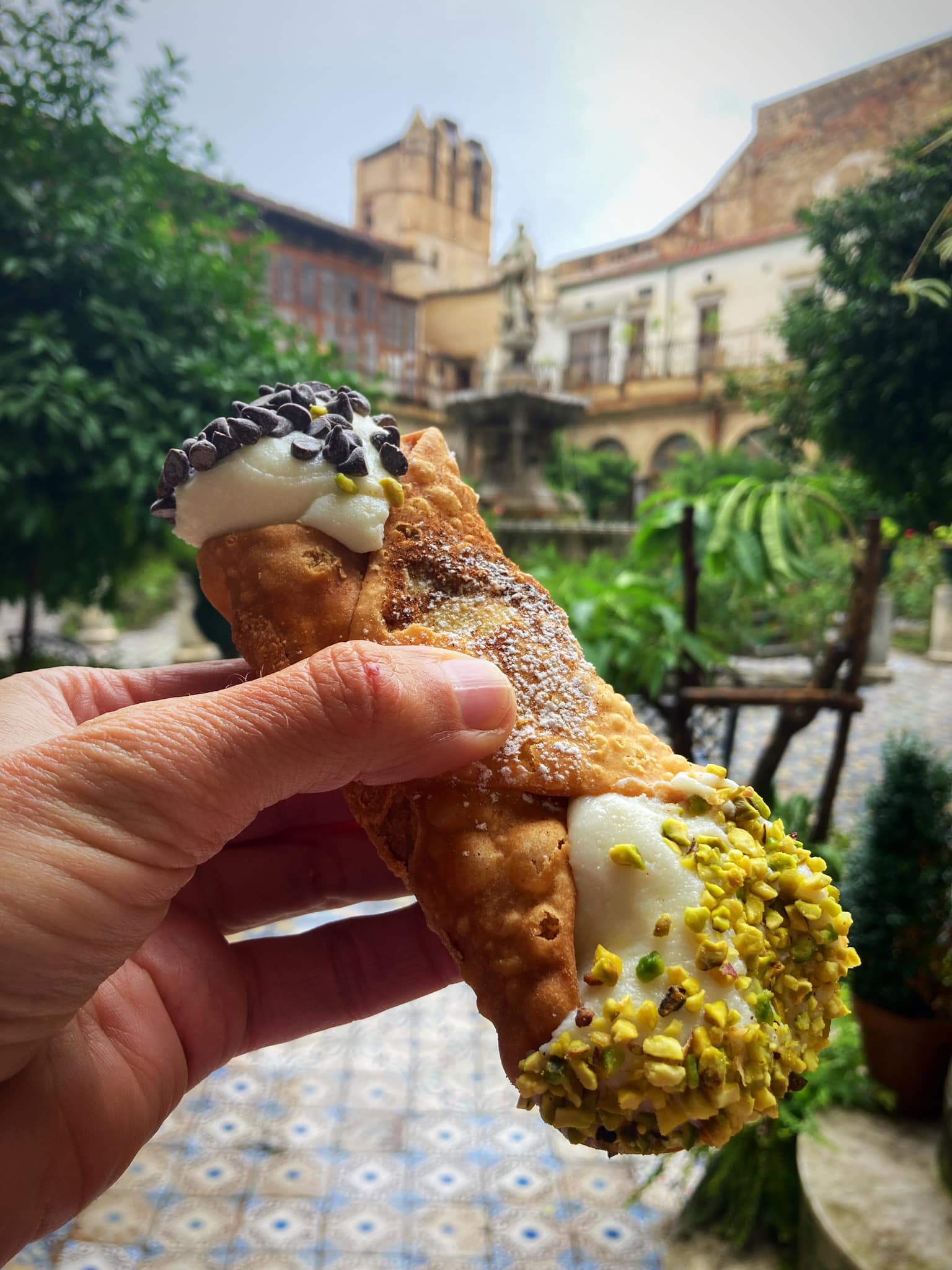
Justyna then went off to get us a cannolo.
The Sicilian cannolo or cannoli for plural is the King among Italian desserts. Famous worldwide, the only original and authentic cannolo comes from the island of Sicily.
This tube shaped fried crispy and flaky shell filled with classic sweet ricotta, garnished with candied orange peel or chopped pistachio. They are believed to have originated from the Palermo and Messina area before spreading to the rest of Italy and around the world.
Holy smoke, we were about to burst.
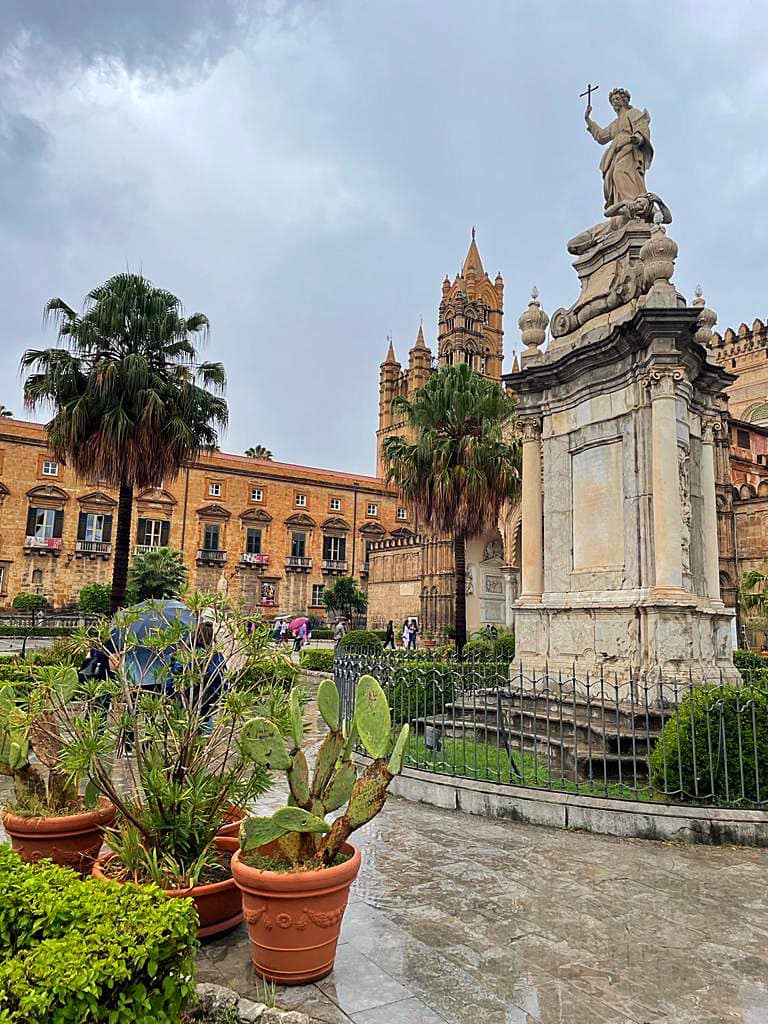
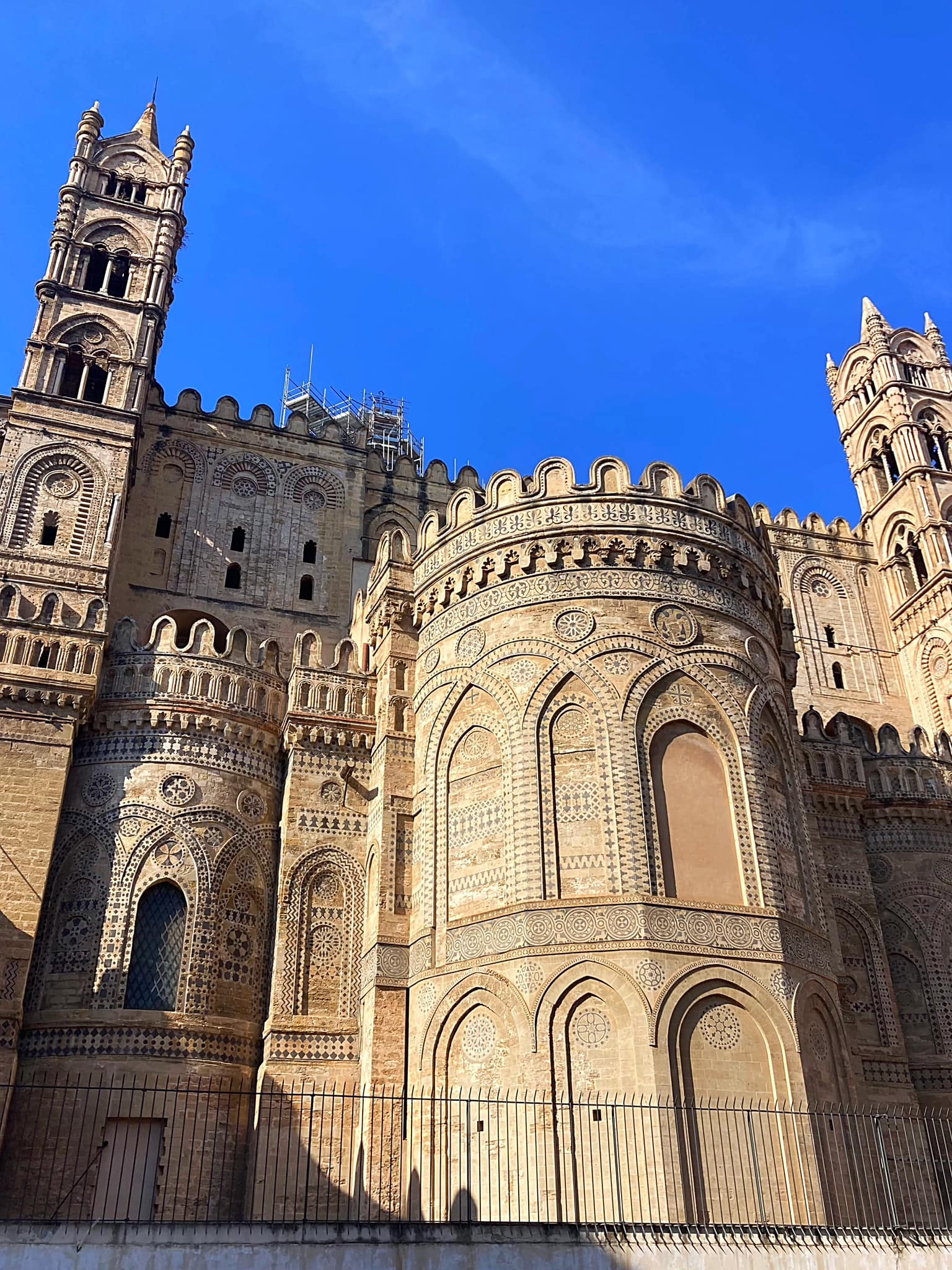
Thankfully our next stop was the Palermo Cathedral which was originally built in 1185. It is dedicated to the Assumption of the Virgin Mary. As an architectural complex, it is characterized by the presence of different styles, due to a long history of additions, alterations and restorations, the last of which occurred in the 18th century.
The statue out of the front of the Cathedral is that of Rosalia (1130–1166), nicknamed la Santuzza (“the Little Saint”), who is the patron saint of Palermo in Italy, Camargo in Chihuahua, and three towns in Venezuela: El Hatillo, Zuata and El Playón. She is especially important internationally as a saint invoked in times of plague. From 2020 onwards she has been invoked by some citizens of Palermo to protect the city from COVID-19.
Palermo is the capital of both the autonomous region of Sicily and the Metropolitan City of Palermo, the city’s surrounding metropolitan province. The city is noted for its history, culture, architecture and gastronomy, playing an important role throughout much of its existence; it is over 2,700 years old. Palermo is in the northwest of the island of Sicily, by the Gulf of Palermo in the Tyrrhenian Sea.
It has a population of about a million people and is one of the largest cities in the Mediterranean, and is now among the top tourist destinations in both Italy and Europe. It is widely known for its colourful fruit, vegetable and fish markets at the heart of Palermo, known as Vucciria, Ballarò and Capo. Roman Catholicism is highly important in Palermitan culture.










Bella’s on Tour – Sicily – Castellammare del Golfo and Scopello
There are so many villages and settlements on Sicily to explore.
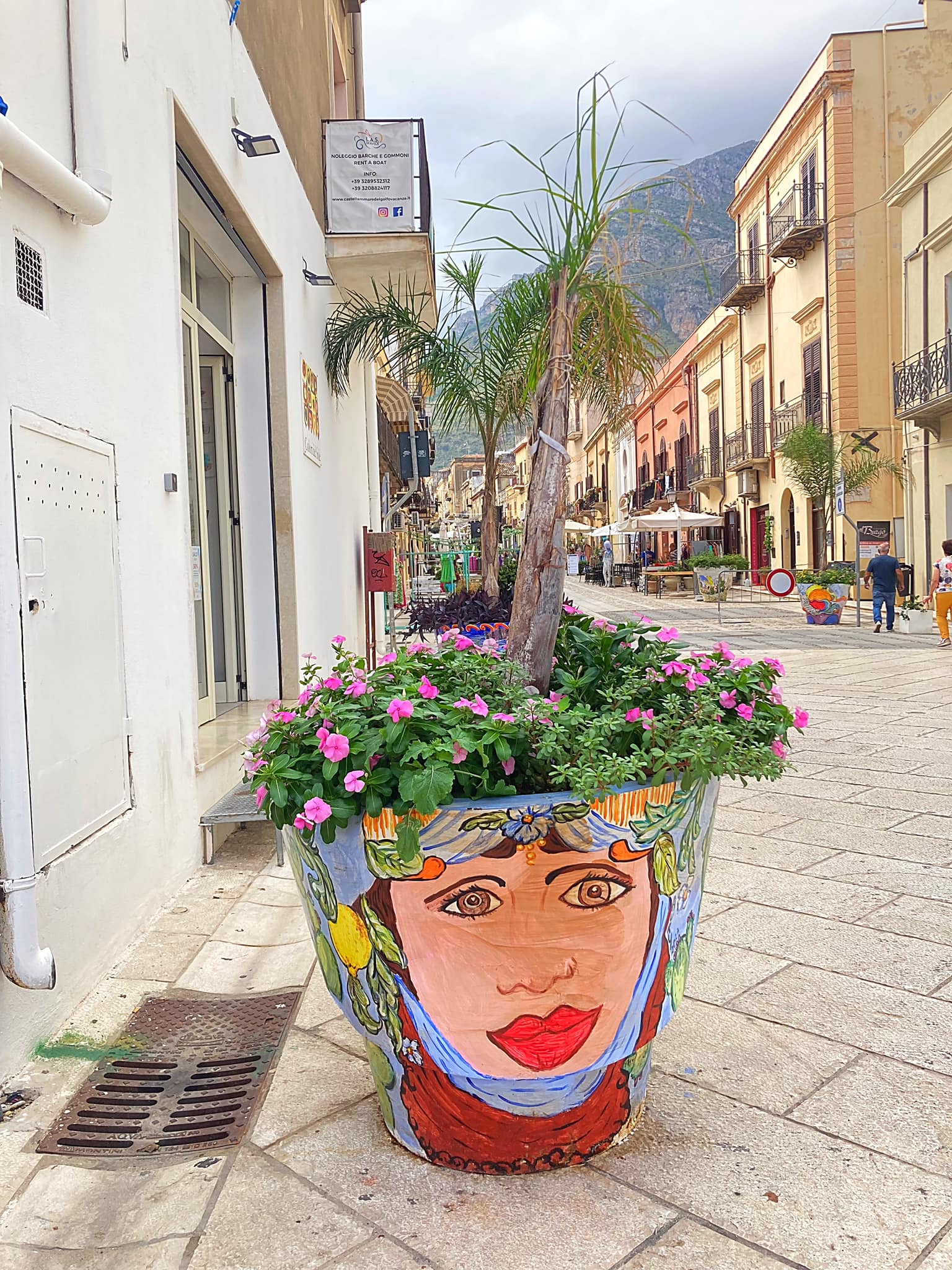
We visited Castellammare del Golfo. The name can be translated as “Sea Fortress on the Gulf”, stemming from the medieval fortress in the harbor.
Fishing has been important in Castellammare del Golfo since ancient times. Today the town’s economy continues to be based on fishing with the addition of tourism.
The small town is also noted for having been the birthplace of many Sicilian-American Mafia figures. This is the origin of the Castellamarese war, fought by the Masseria clan against the Maranzano clan for control of the Underworld in New York City.
During the height of Italian immigration to the United States, many residents from Castellammare del Golfo immigrated to New York City. After World War II, this immigration continued but to different parts of New York City.
Debbie has a small obsession with the groups of old Italian men that seem to gather in the middle of these villages. I believe she’s looking for the Godfather .
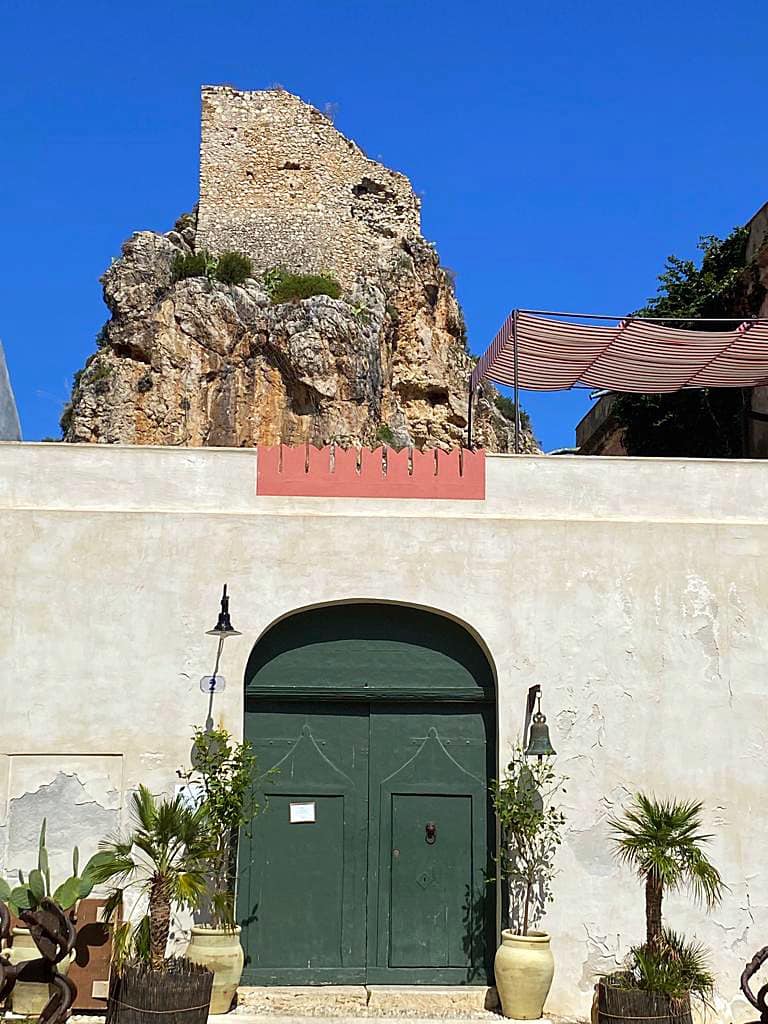
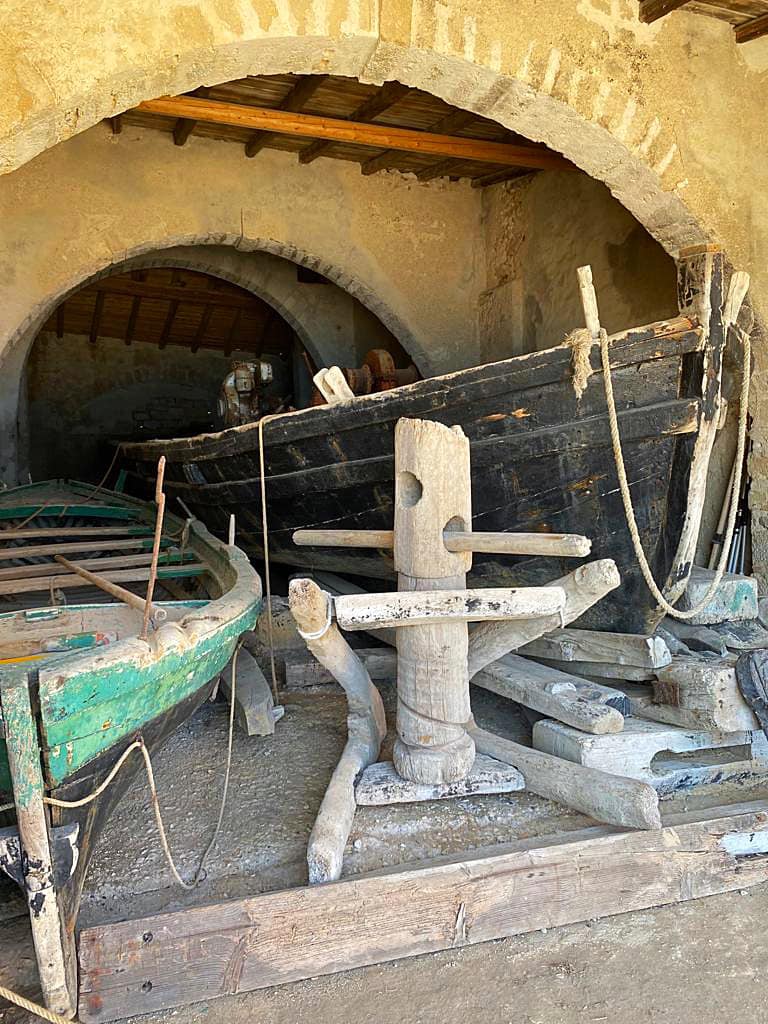
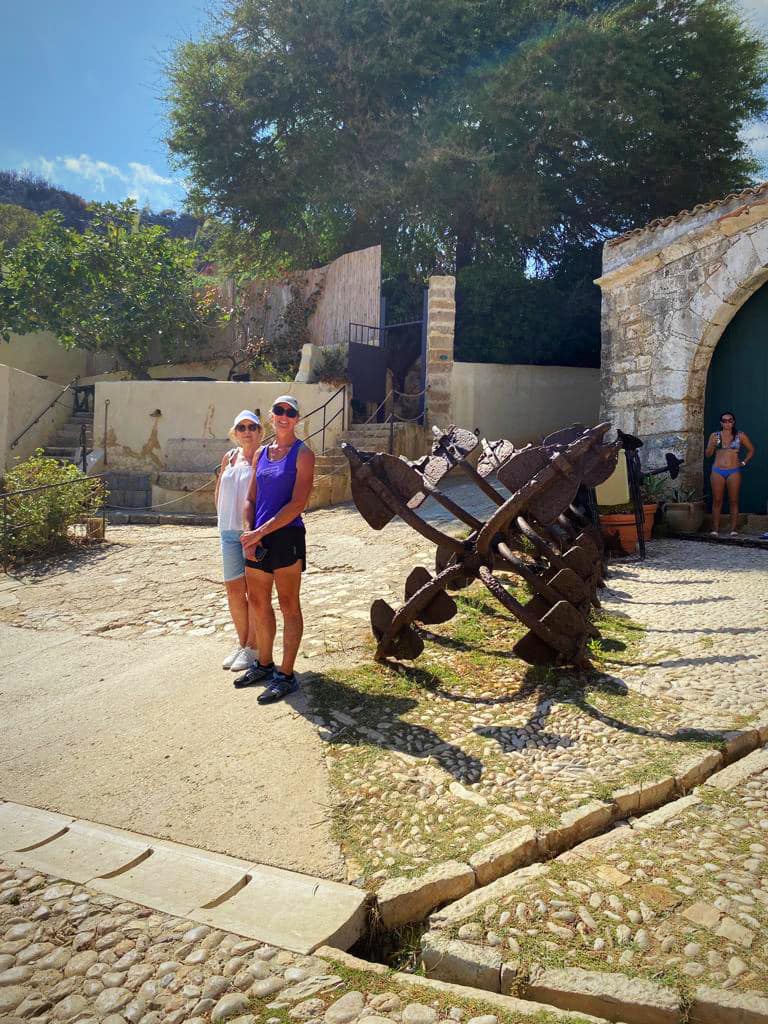
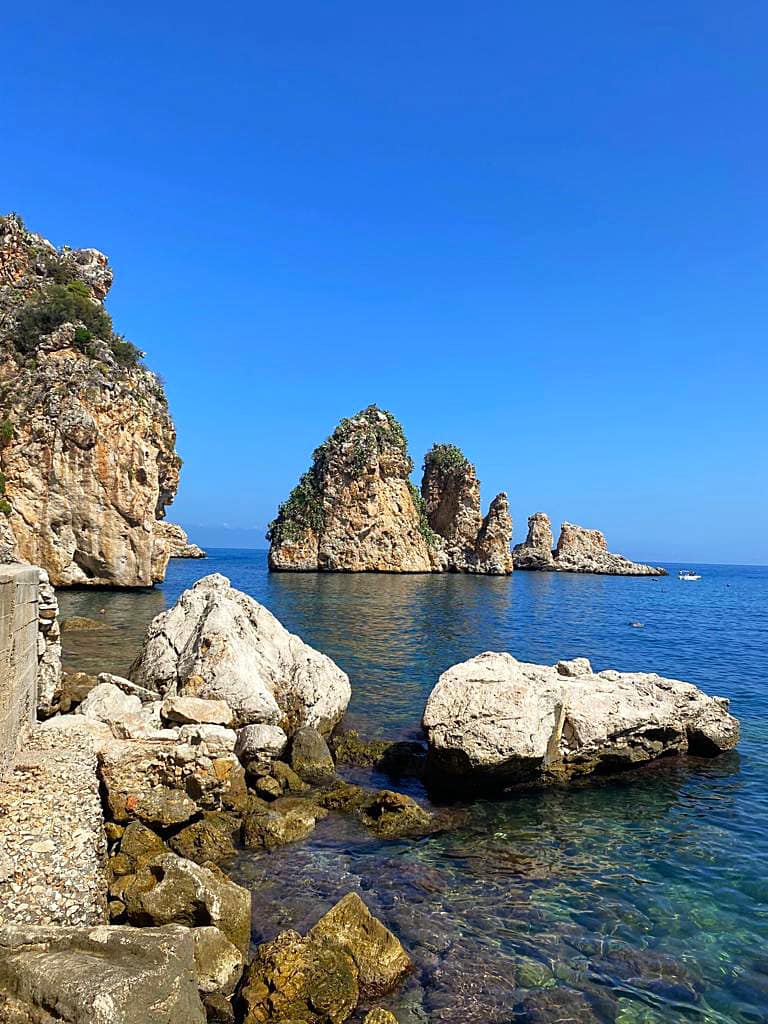
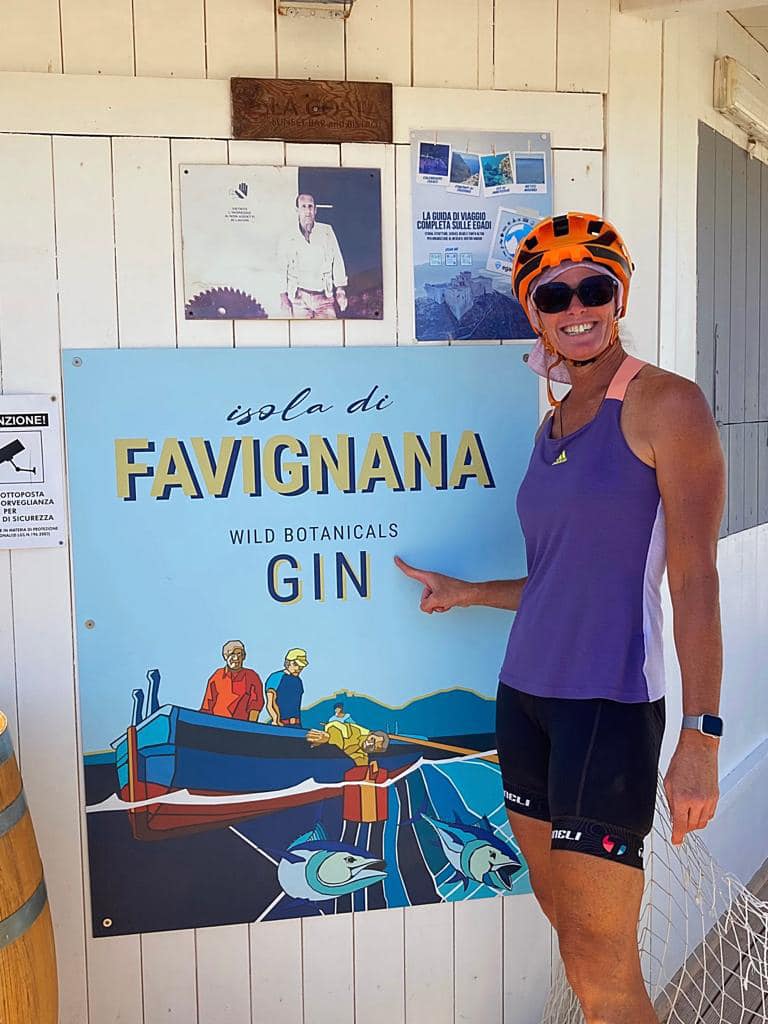
We also visited Tonnara di Scopello which is one of the oldest and most important in Sicily. This complex contains a museum that is a historical testimony of the fishing economy (namely tuna) which for centuries has represented one of the main sources of income for the local people, still preserving intact today, all the equipment and tools used for tuna fishing.
The tonnara (tuna factory) was in operation from the 13th century until its closure in 1984. The complex was greatly developed in the 15th and 16th centuries. The museum was really interesting and included a lot of photos which put in context how hard these fishermen worked. It is now owned by the Florio family and has accomodation and a restaurant onsite. No photos were allowed to be taken inside the premises.
The Florio family is a prominent entrepreneurial Italian family who started many lucrative activities in Sicily involving the export of Sicilian products (such as Marsala wine) in the nineteenth century. The family extended its interests to shipping, shipbuilding, fisheries, mining, metallurgy and ceramics.
In 1906, Vincenzo Florio created the Targa Florio, one of the oldest car races in the world. The first Targa Florio covered 277 miles through multiple hairpin curves on treacherous mountain roads where severe changes in climate frequently occurred and racers even faced bandits and irate shepherds. The race passed through many small villages, and fans lined up along the roads with no protection from the race cars. It was suspended in 1978 because of safety concerns. Today, the race continues with a different circuit as a minor racing event.
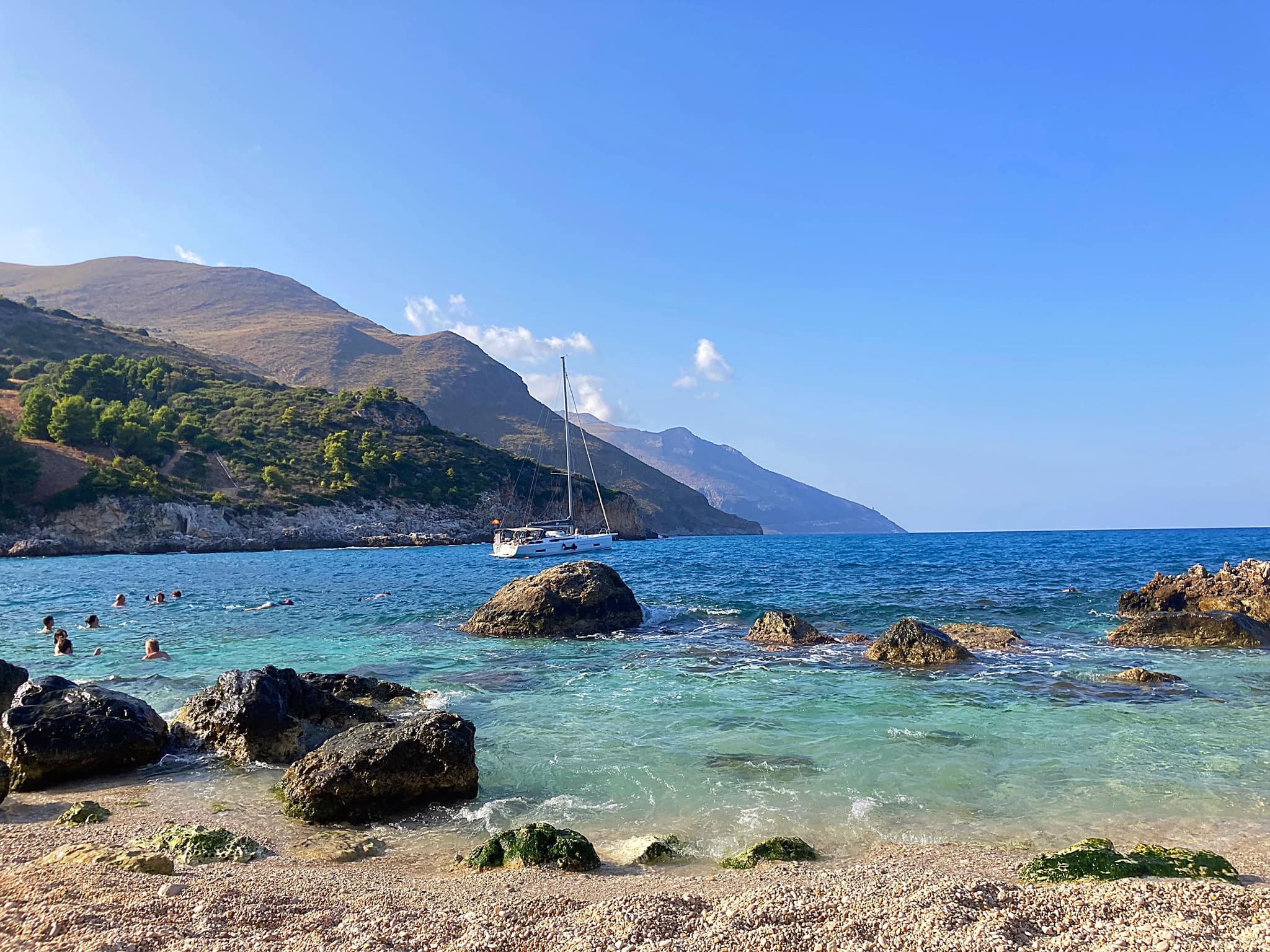
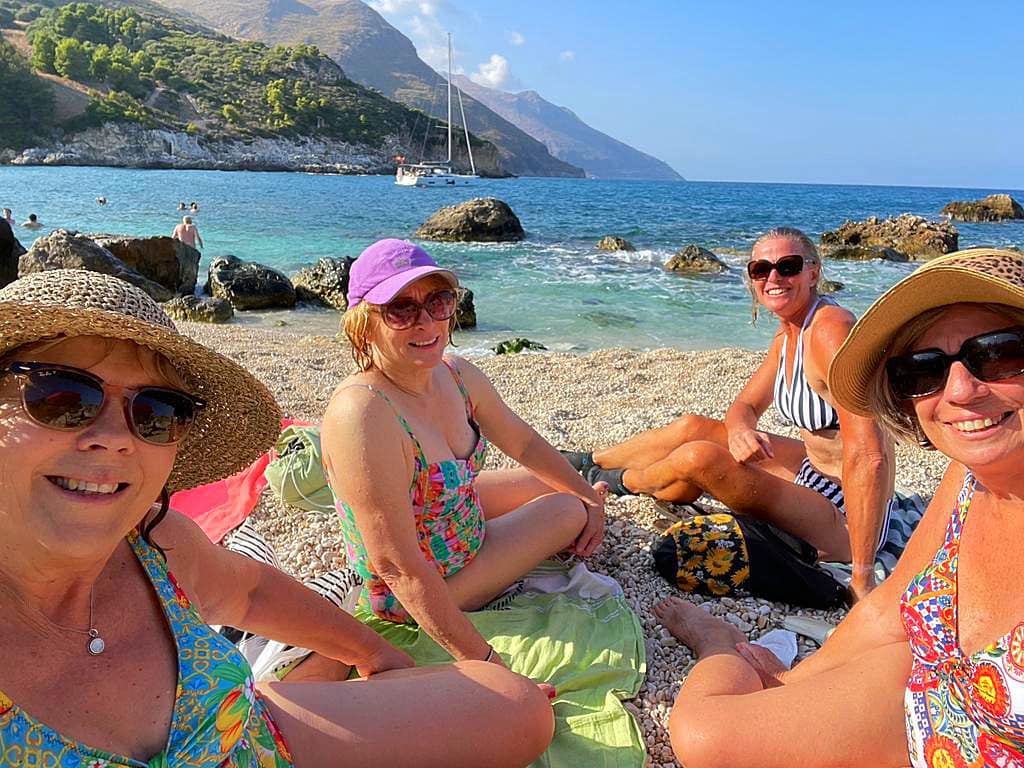
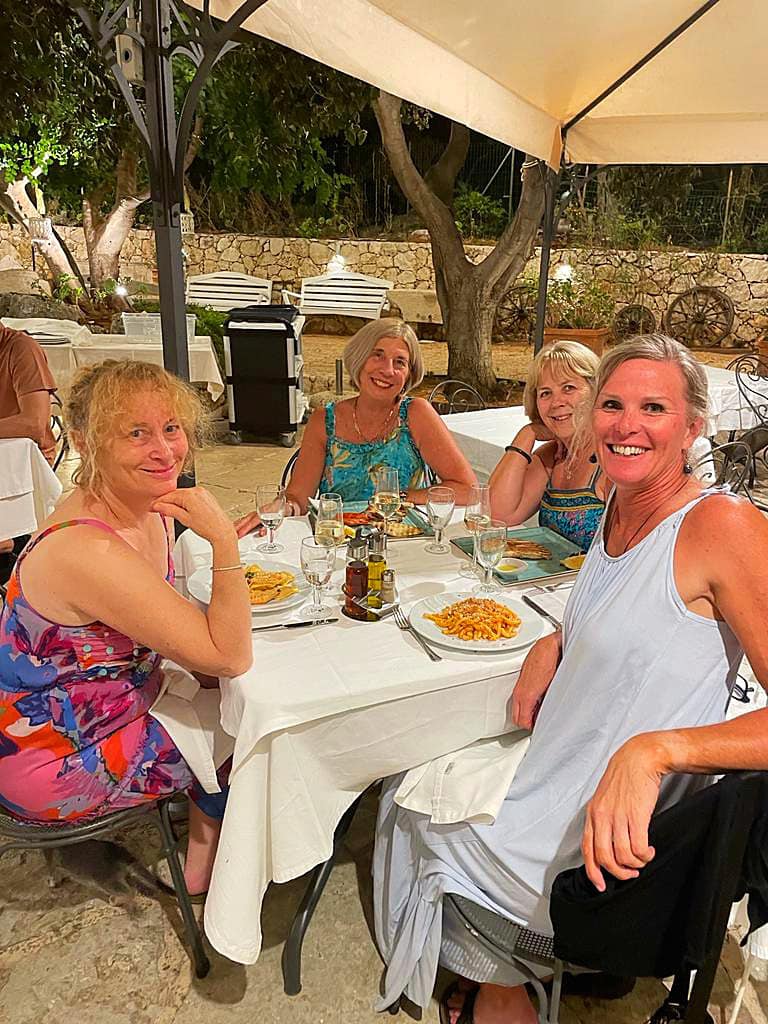
We enjoyed a lovely afternoon on Cala Mazzo di Sciacca, the beach about 500 metres from our villa before heading into Scopello for dinner.



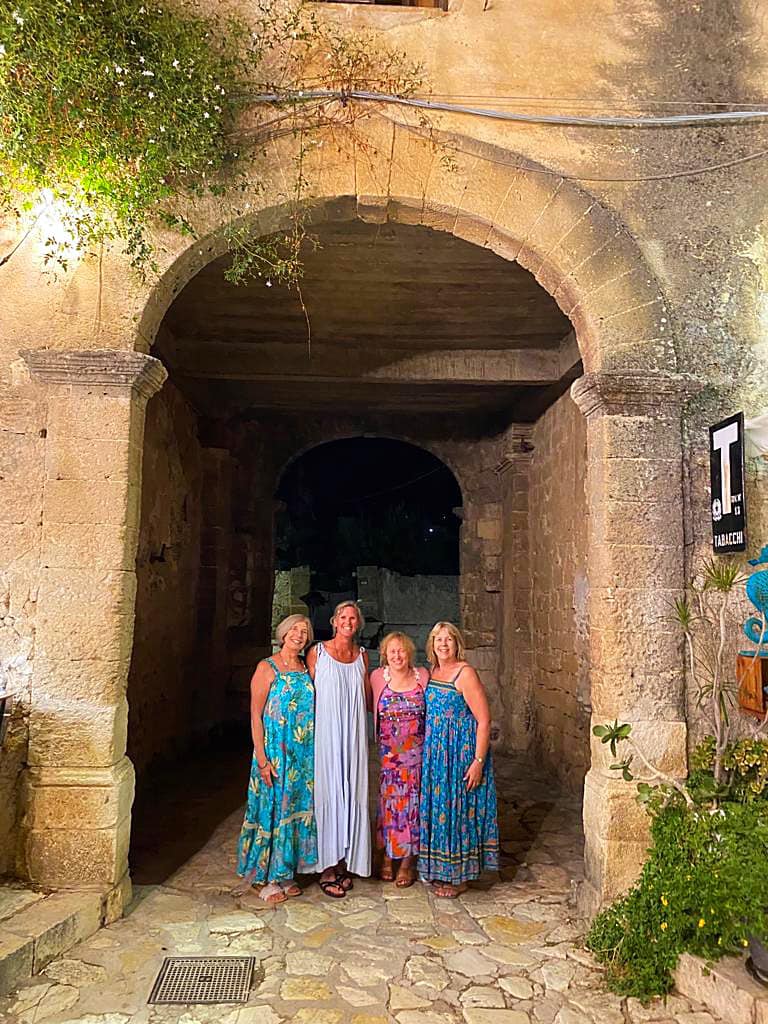


Bella’s on Tour – Sicily – Vini Cassara
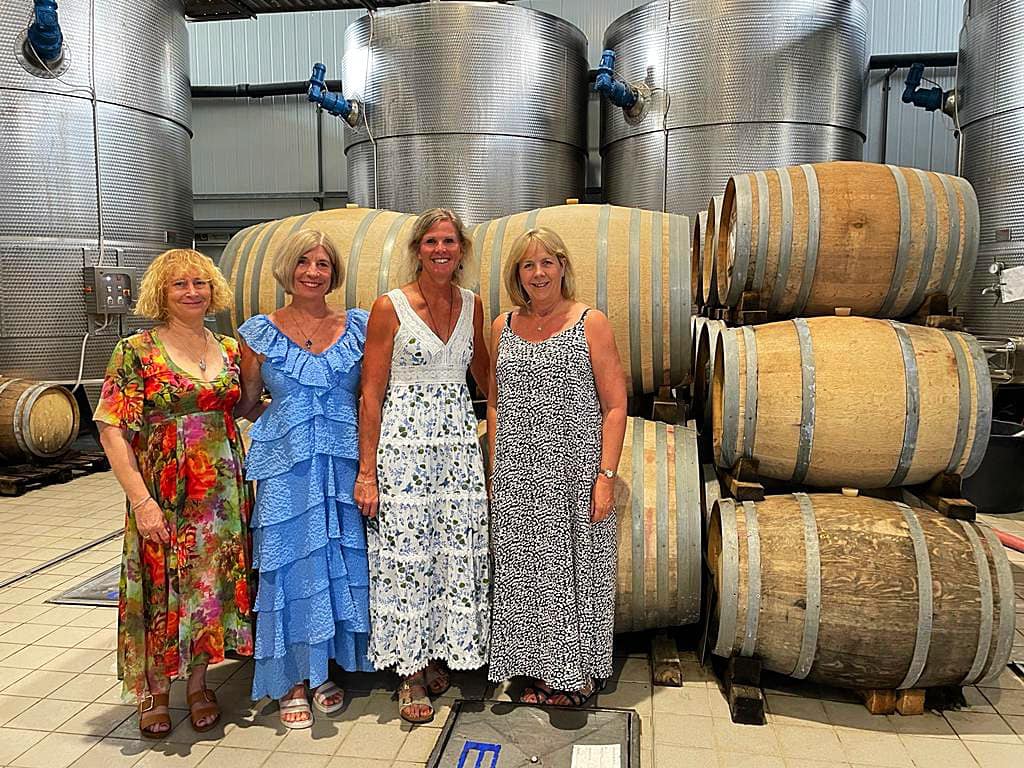
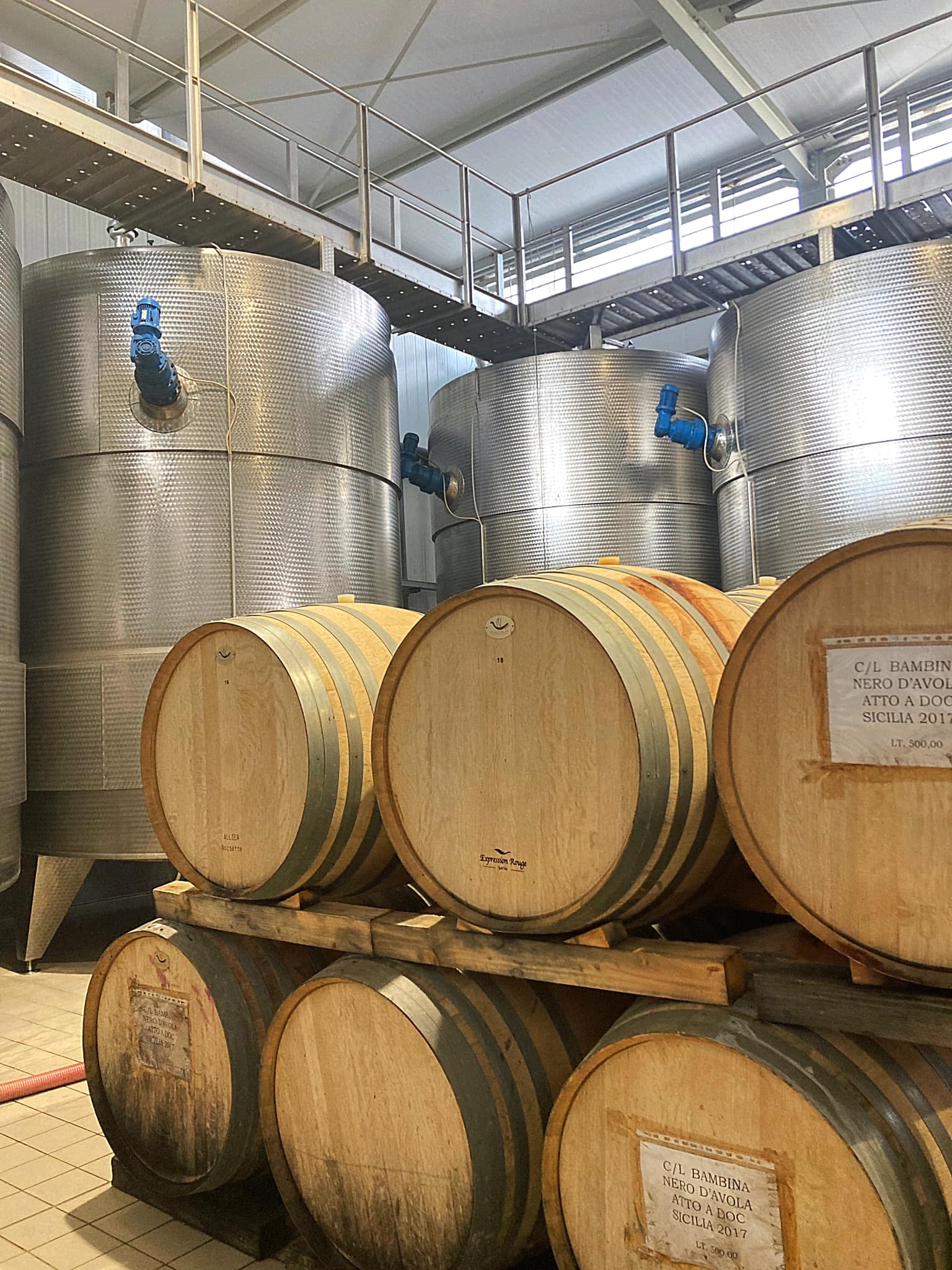
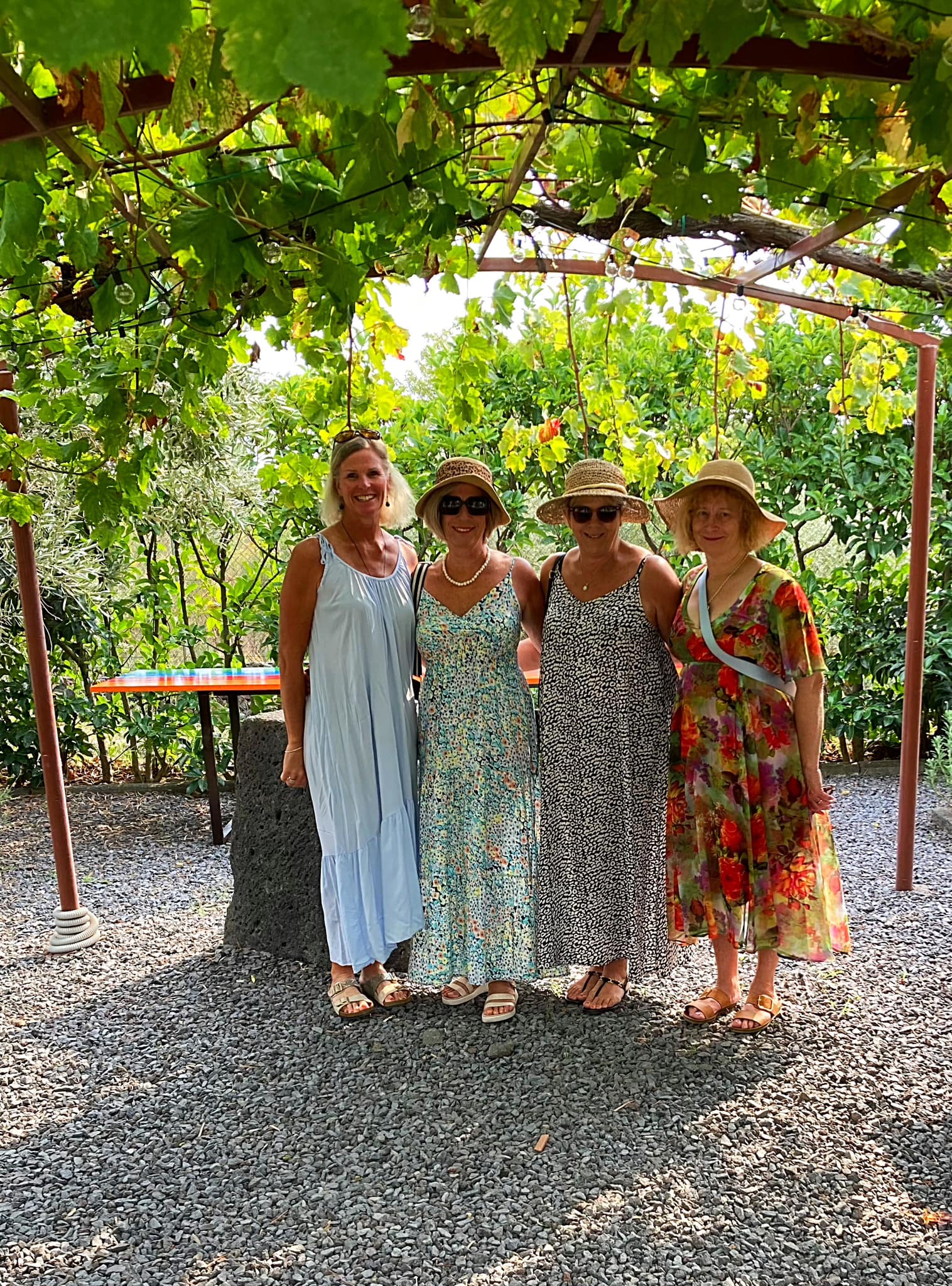
We booked a wine tour at Vini Cassara expecting to turn up at a rustic vineyard where we would try a few wines in amongst the vines. We were all decked out in our pretty dresses looking the part.
When google maps told us we had reached our destination we thought there had been a mistake. We were sitting outside a very industrial looking winery. After driving down a few hairy roads around the vineyard we decided to go and ask for directions at the office.
We were greeted by the lovely Lucia who told us we were in the right place. OK, not quite what we expected but we rolled with it.
Lucia explained the history of the winery and proceeded to take us for a tour inside the production / bottling facility.
A dream in the Mediterranean that spans four generations. In 1860 Pietro Cassarà launched wine production and handed down the passion to Rocco and then to his nephew Nicolò who in the 1980s with his young son Antonello wrote a new page in the history of Sicilian wine.
In 2007 the most sophisticated technologies arrived in the modern company, allowing Antonello to create his own brand and start a larger production intended for the whole world. Only a few years later Cassarà wines delighted the palates in Japan, China, Australia and Canada.
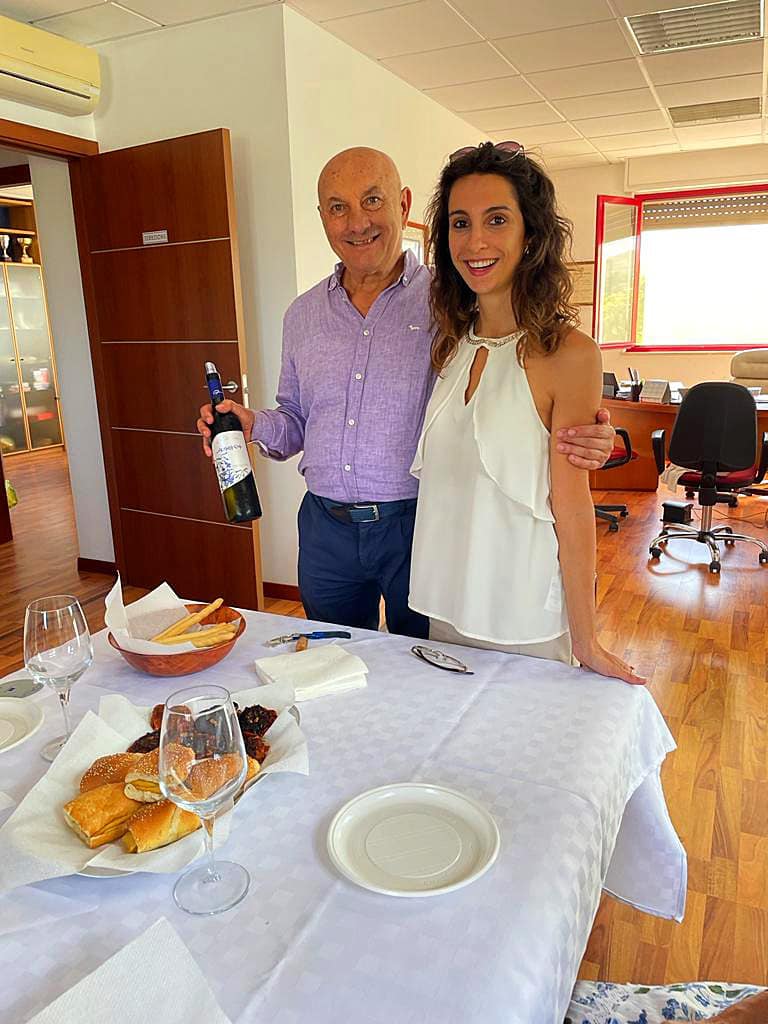
After the tour, we then went back to the “office” where we were greeted by Lucia’s father, Antonello and Lydia, the office manager. They had organised some traditional Sicilian food and we sat down to try the wines. Antonello didn’t speak English but was very engaging and Lucia interpreted for him. Lydia’s parents were originally from Alcamo, where the winery is, but had immigrated to the US where she was born. She came back to Alcamo when she was 21 and has worked at the winery for 15 years. She spoke great English and we really enjoyed chatting to her.
Lucia is an only child and is helping with the marketing for the vineyard. She is a classical pianist with a degree in Pianoforte and Cinema Studies. She has also written a book – Mozart, Disney and Co. So, so interesting to talk to.
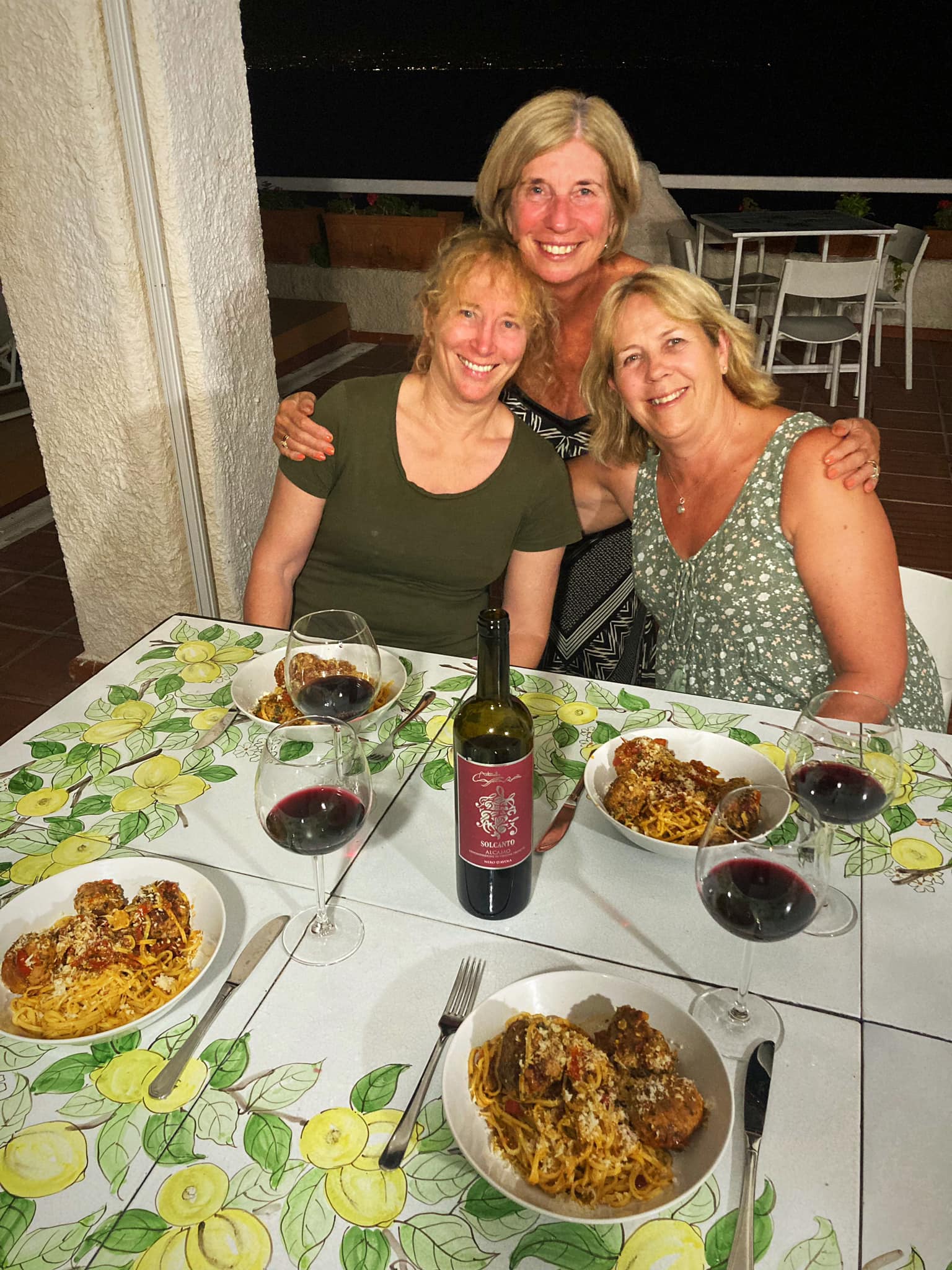
We tried their Sauvignon Blanc called Jacaranda. It is a lot more floral than the NZ Sauvignon Blanc which is more grassy. We then tried the Nero D’Avola called Solcanto. Absolutely delicious. The winemaker also joined us but had limited English.
They had also organised a Sicilian Cassata Cake for us – a visual masterpiece. It is made from sweetened ricotta, iced with marzipan and decorated with candied fruit. Very rich and sweet but a perfect finish to our visit.
Again, the best experiences come from the least expected things. We were welcomed so warmly by Antonello, Lucia and Lydia and given a genuine insight into their wines and how they operate as a family business.
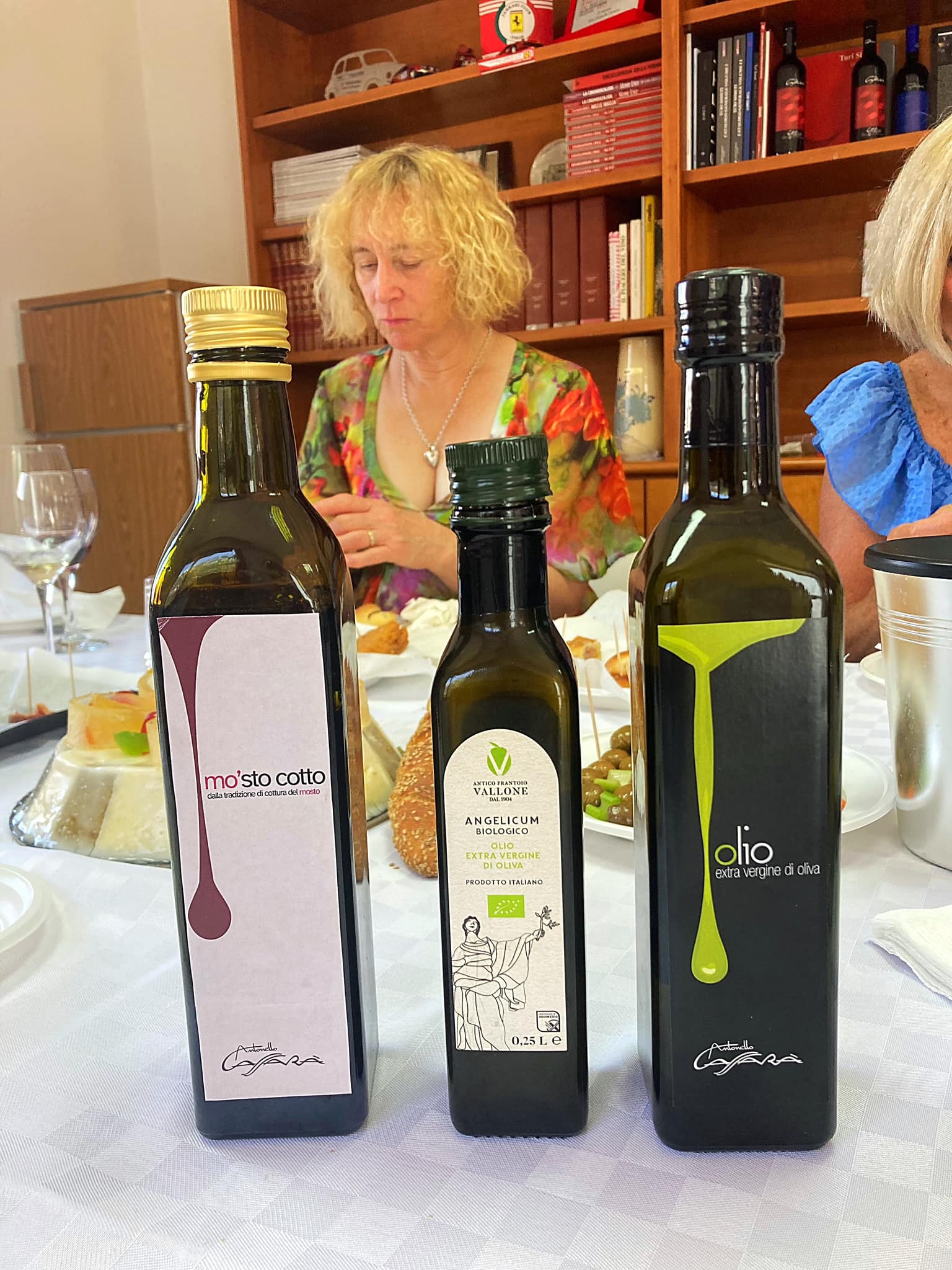
They follow organic practices and most of their wine is exported. They also make some by-products – Mosto cotto, also called vino cotto or saba, is made by cooking the liquid that results from initial whole grape pressings — seeds, skin, stems and all. By reducing it down to a syrup, the complex flavors that give wine its unique, distinctive notes are amplified. The resulting product is a sweet, tangy addition to savory dishes as well as desserts. We tried some with pecorino cheese and it was a hit.
They are also one of the only wineries producing grape sugar which is a syrup obtained from grapes through the clarification, deionization — also known as rectification (RCM) — and final concentration of grape juice. This process removes non-sugar compounds from the liquid, resulting in simpler syrups that contain only water and grape sugars glucose and fructose, in roughly equal parts. More recently, RCM has found favor with food and beverage manufacturers, which use it in fruit juices and preserves, yogurts, baby foods and other products.
Rising interest in grape sugar is part of a broader trend toward greater use of sugars of fruit and plant origin, such as sweeteners obtained from apple, agave and maple plants. These sugars are a better fit with consumer demands for “natural” products than sugars extracted from sugarcane and corn, which dominated the market in the past.
They also produce olive oil from a different location.



Bella’s on Tour – Sicily – Favignana
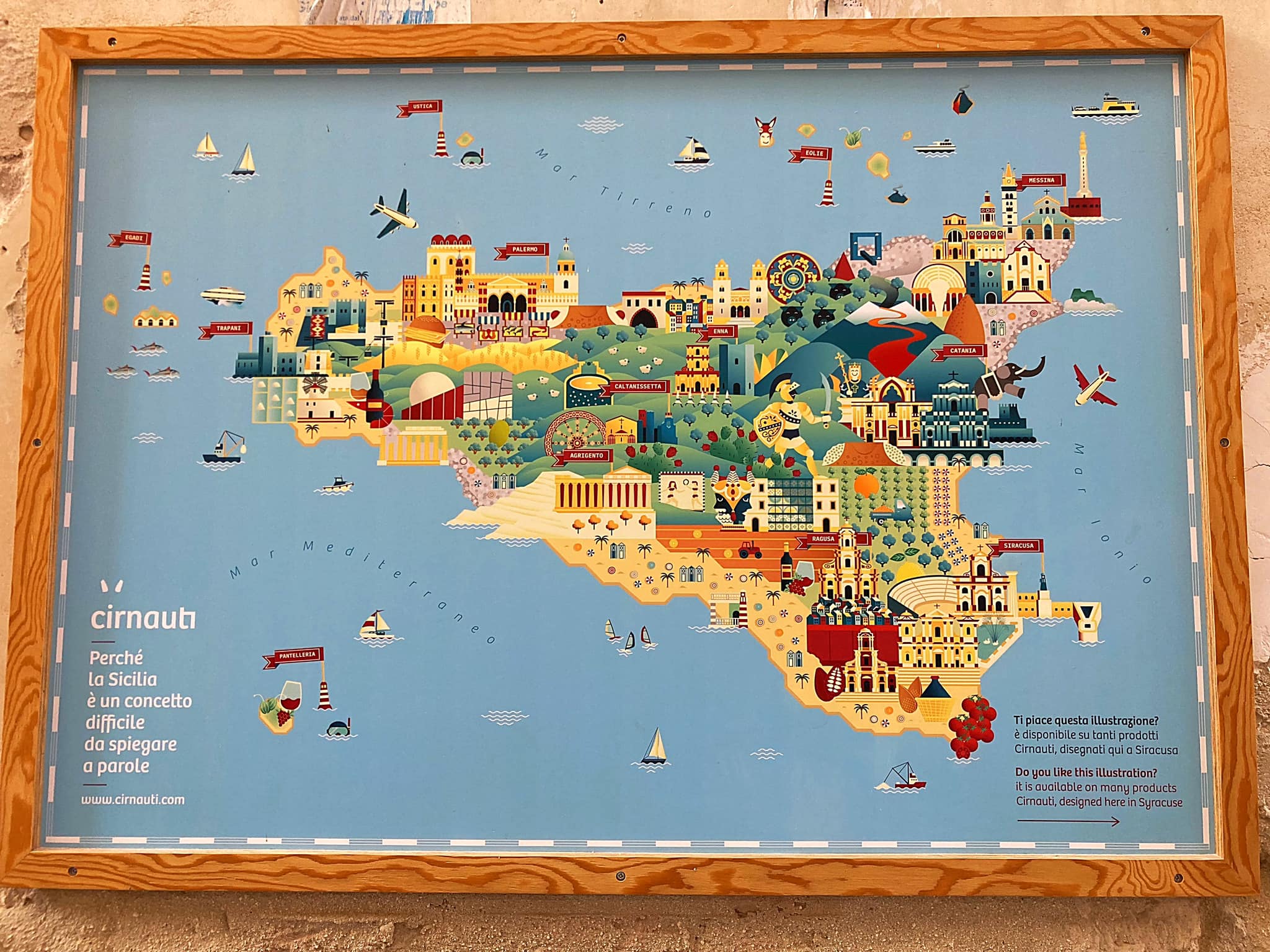
Sicily is the largest and most populous island in the Mediterranean Sea and one of the 20 regions of Italy. Sicily itself is also surrounded by some smaller islands.
On Saturday we took a ferry from Trapani to Favignana (30 minutes) which is one of three islands in the Egadi Islands, Levanzo and Marettimo being the other two.
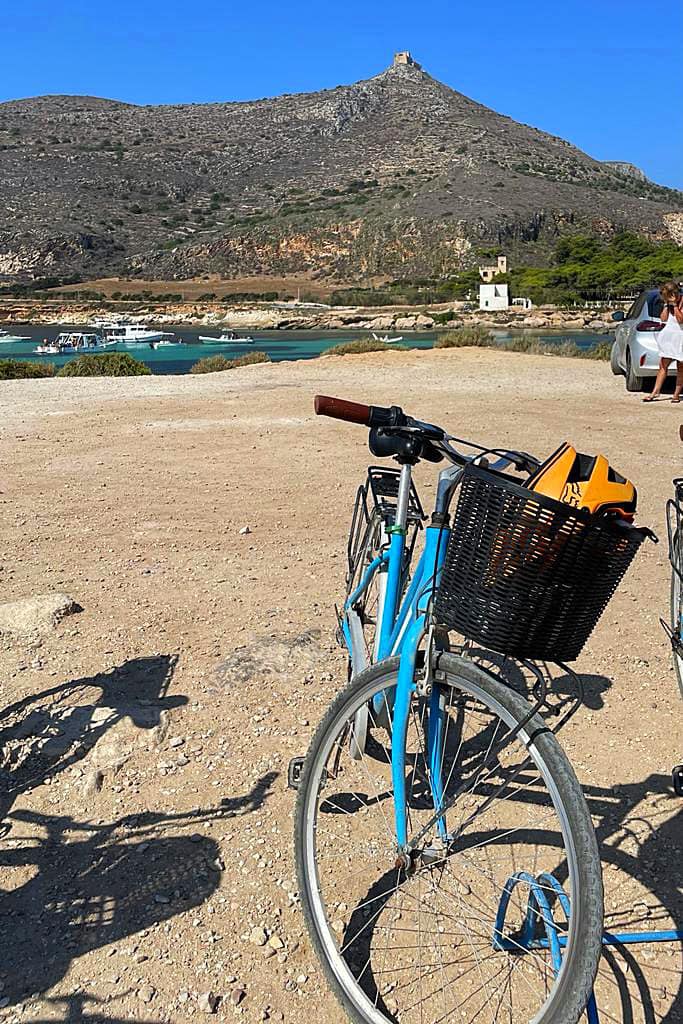
As you approach Favignana you see a fort perched high up on the hill. For centuries, Favignana was protected by the Fort of Santa Caterina. Originally built by the Arabs as a watchtower, subsequently enlarged by the Normans, and later used as a prison by the Bourbon Kings.
Ignazio Florio one of Italy’s richest and most powerful industrialists purchased the whole island in 1874, along with all commercial fishing rights. Florio quickly began work on enlarging and beautifying an existing tuna processing plant (tonnara).
The tonnara on Favignana was one of several owned by the Florios in Sicily, but arguably their most important, for it was here that they trialled and perfected new industrial processes, including a groundbreaking technique for preserving tuna in olive oil, and the invention of a key-opened tin can.
Long before the Florios came to exploit the island’s resources, Favignana had been a Roman outpost. During the First Punic War, several naval battles were fought off the coast of Favignana, including one sanguinary clash which turned the water red – hence the name of Cala Rossa, one of the island’s most picturesque bays. The spoils of the Roman victory included Favignana, which provided the Roman Empire with a rich source of tuff stone. Quarries were dug all over the island and these angular depressions are very much part of the topographical make-up of Favignana today.
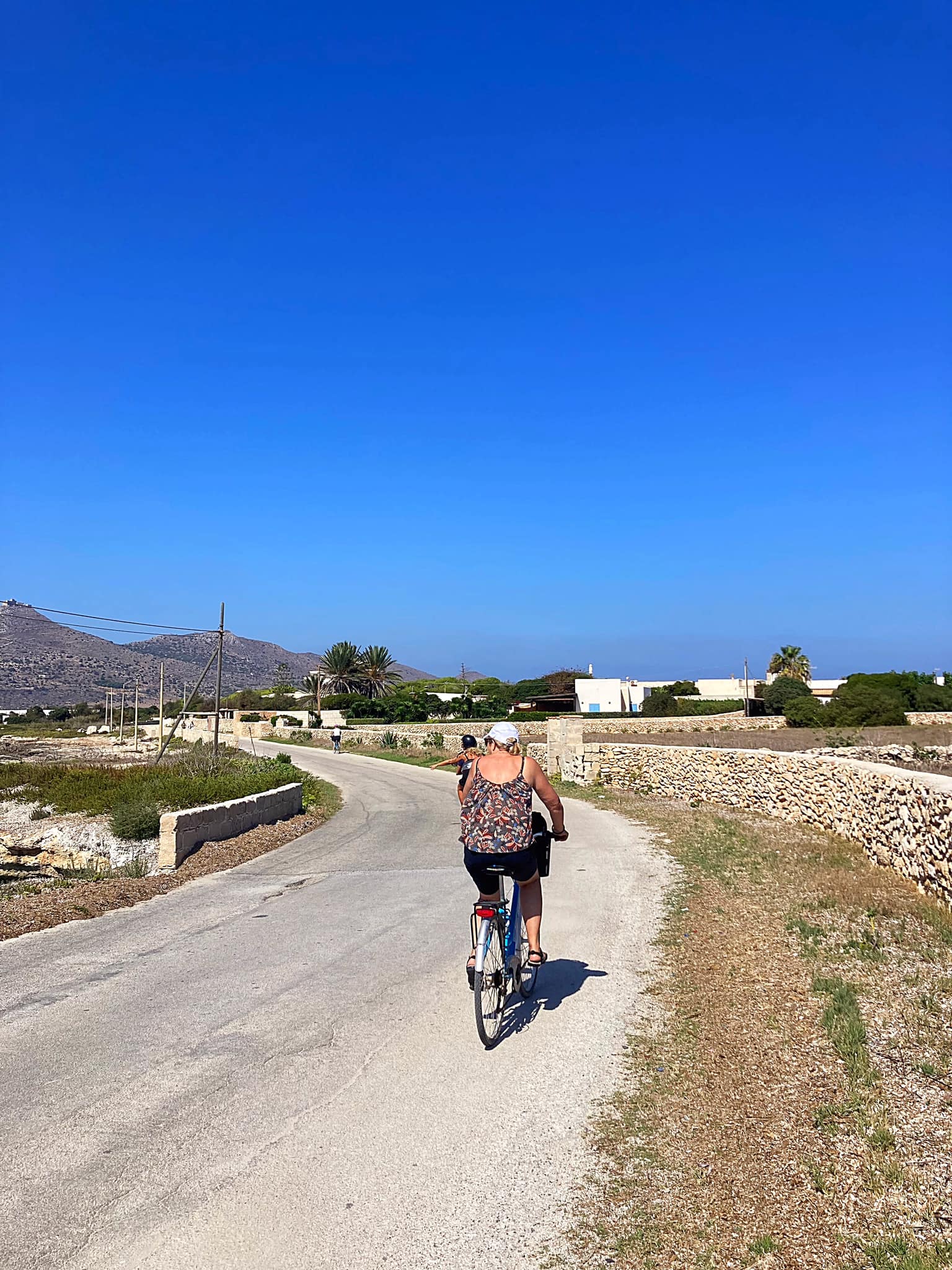
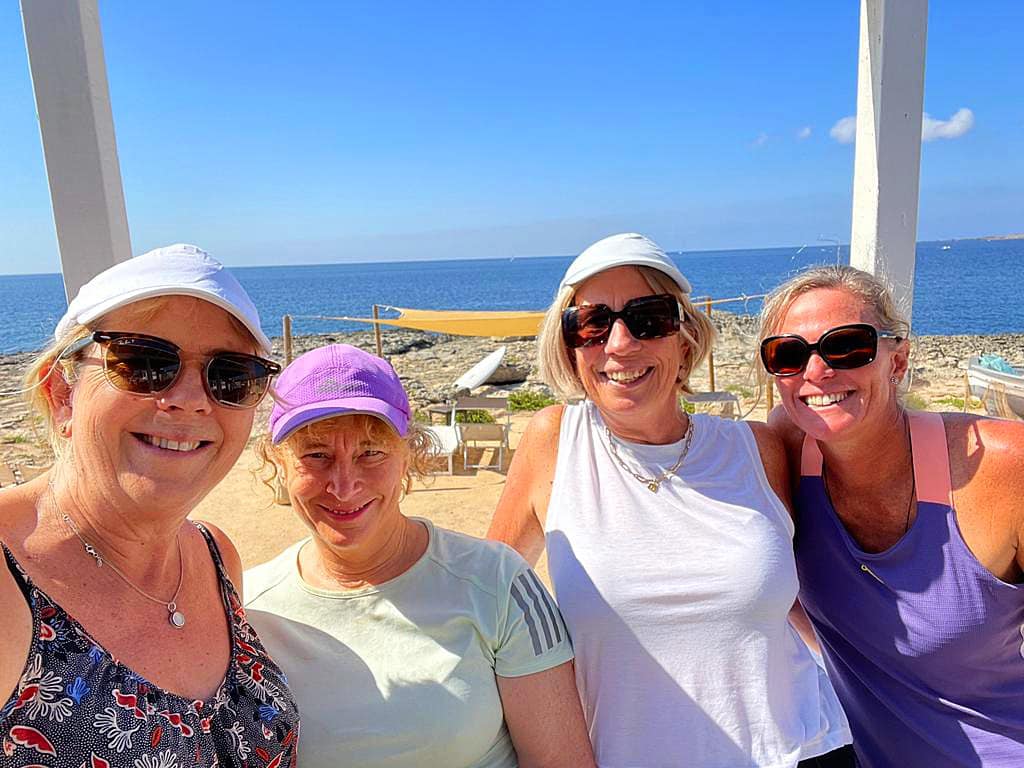
Favignana measures 9km from east to west and the most popular form of transport is by bicycle so we hired some bikes at the port and set off to explore the island.
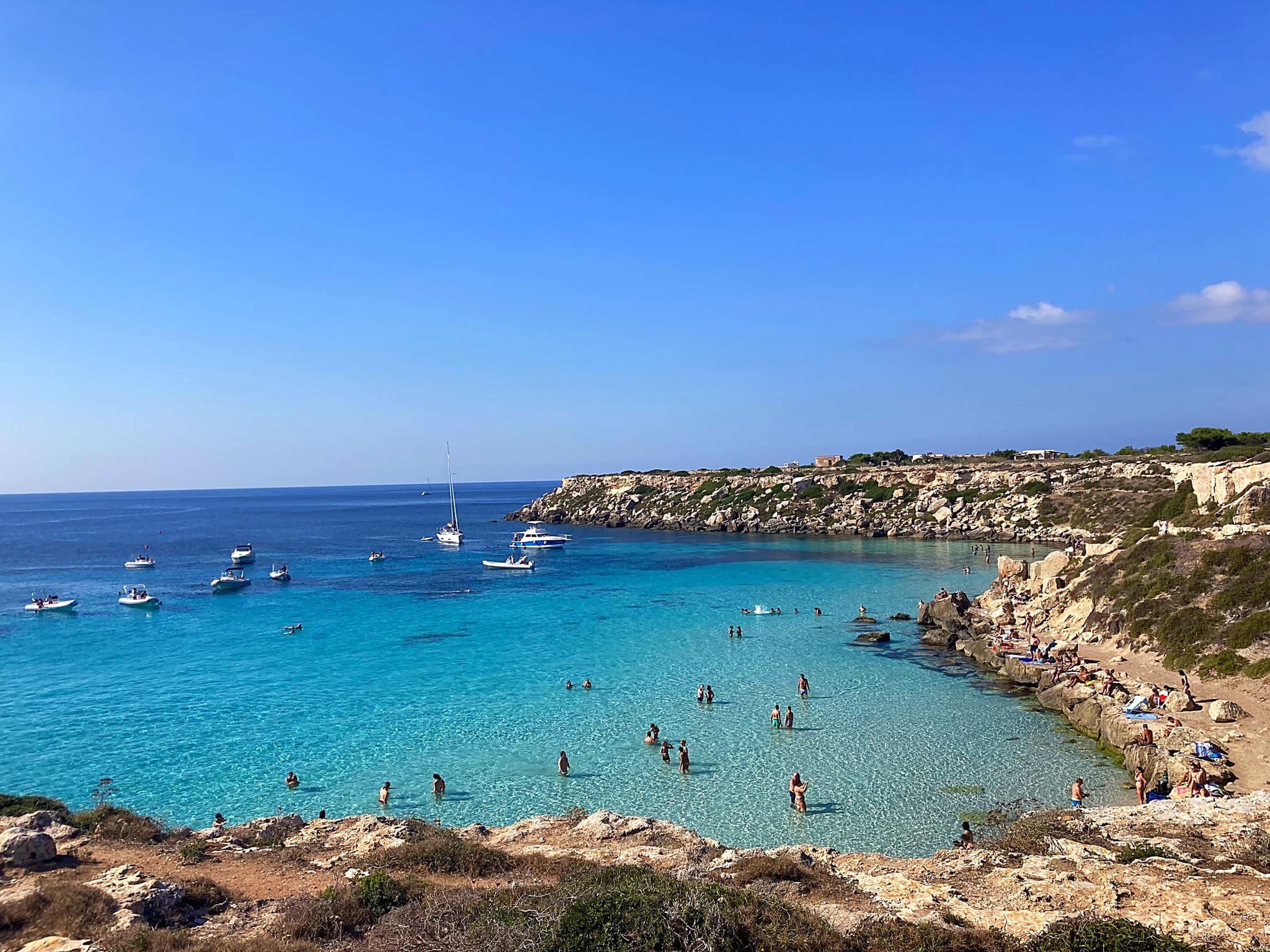
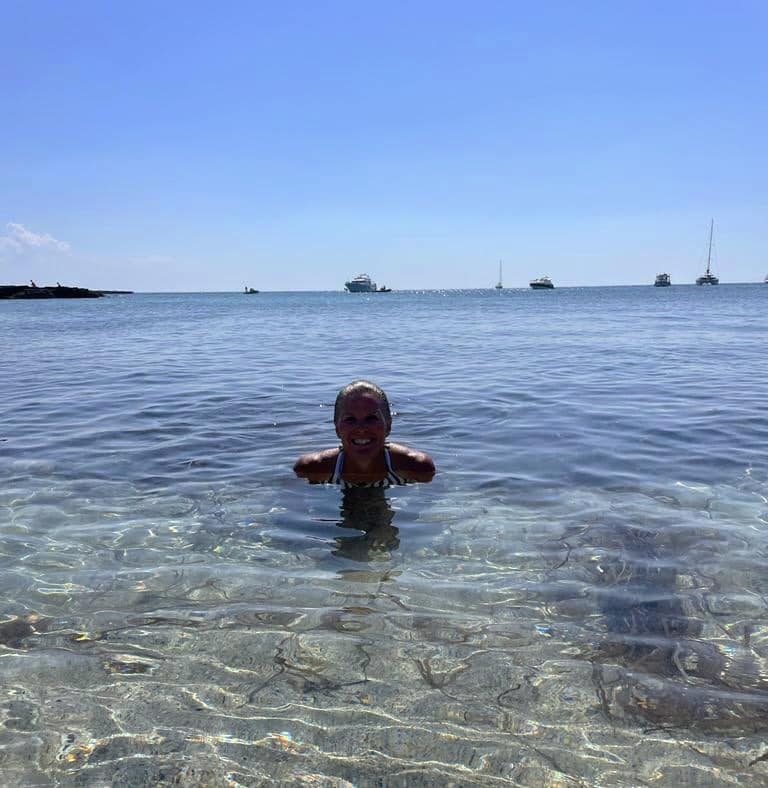
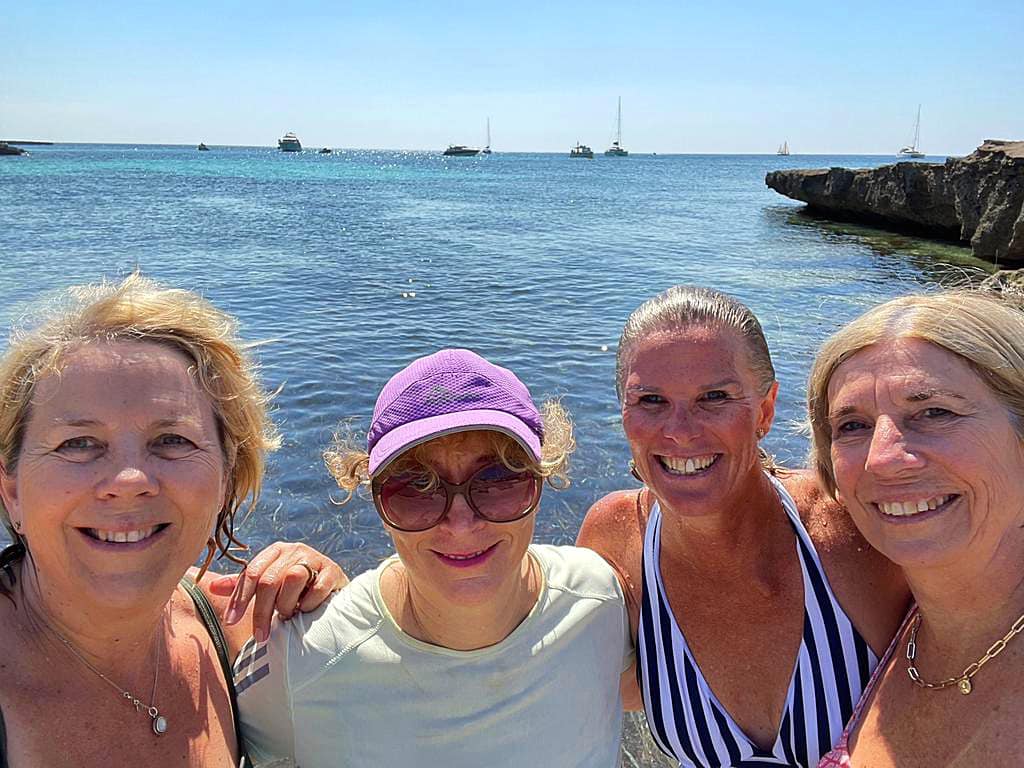
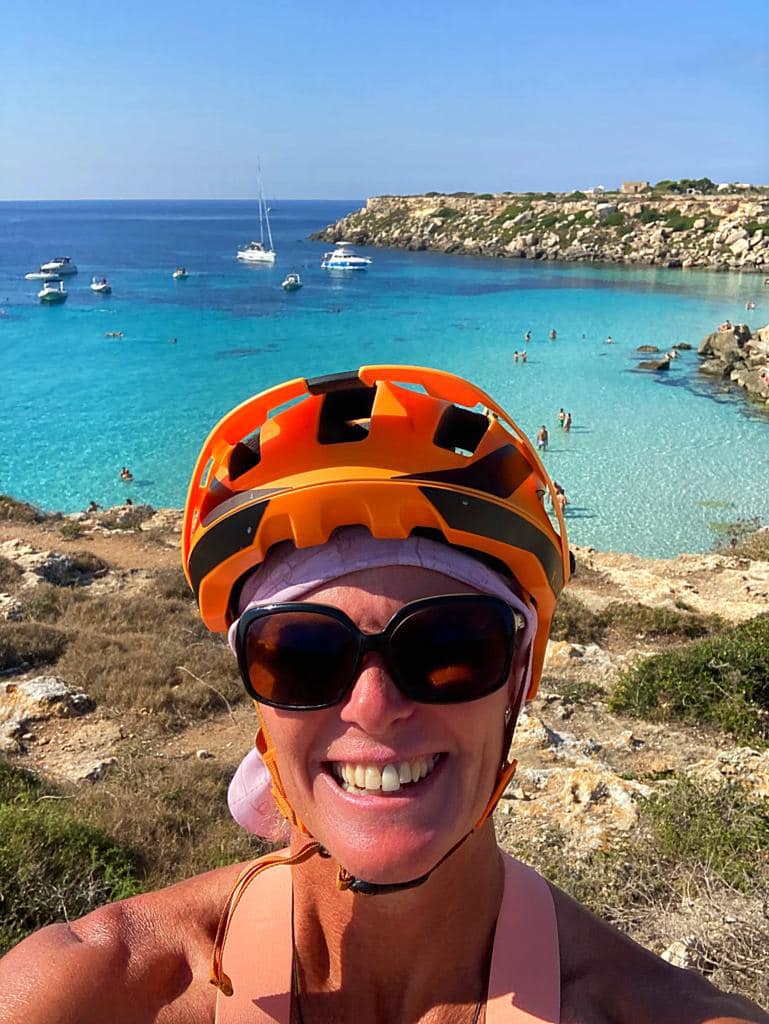
The bays and beaches have transparent and electric blue waters – so gorgeous. We had a swim halfway round before stopping for lunch. On the way back to the old town we stopped at Cala Rossa for a swim. Unfortunately it was a little difficult to actually get into the water without clambering over some sharp looking rocks. It was worth a visit though – the colour of the water was amazing.
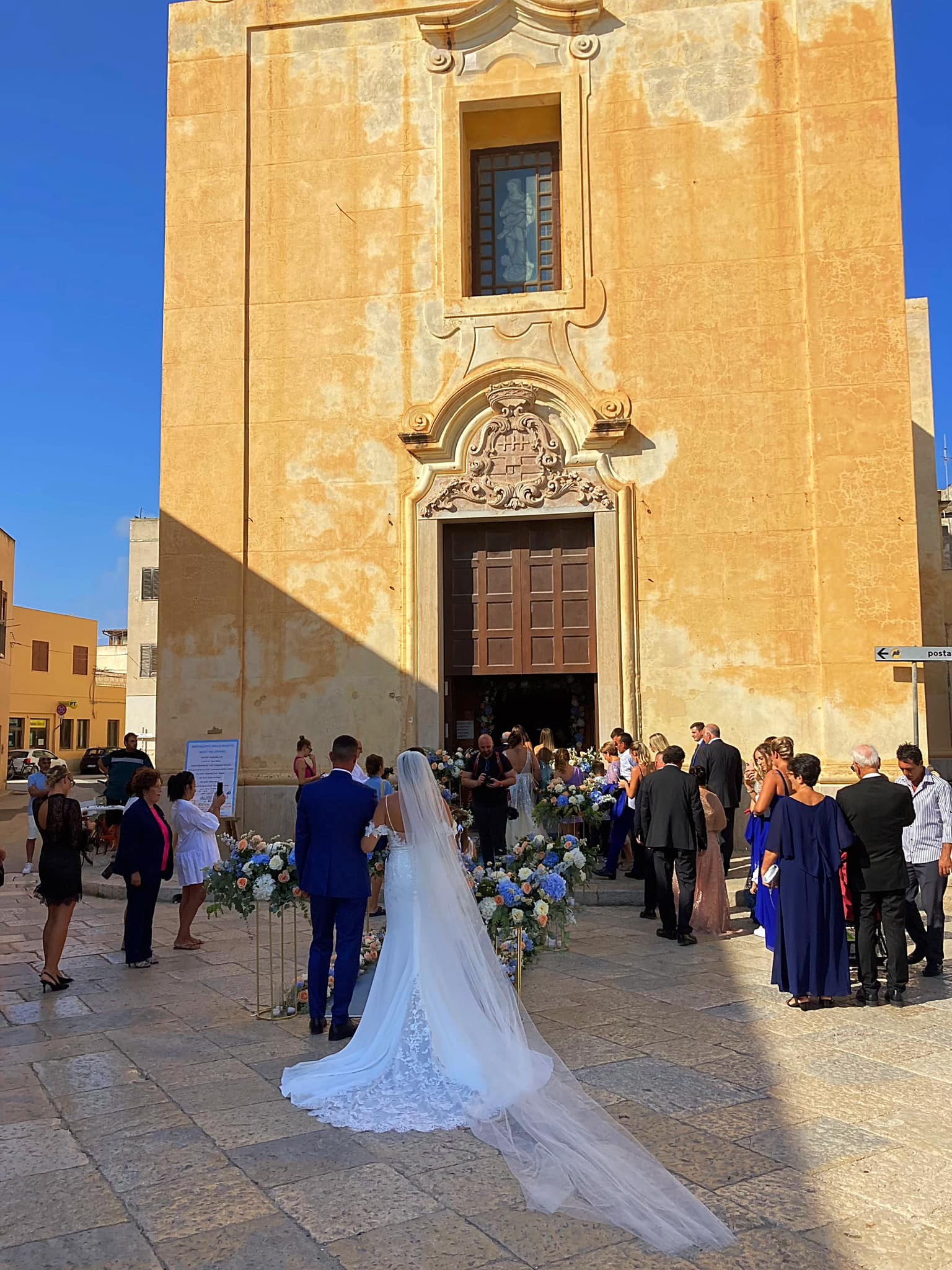
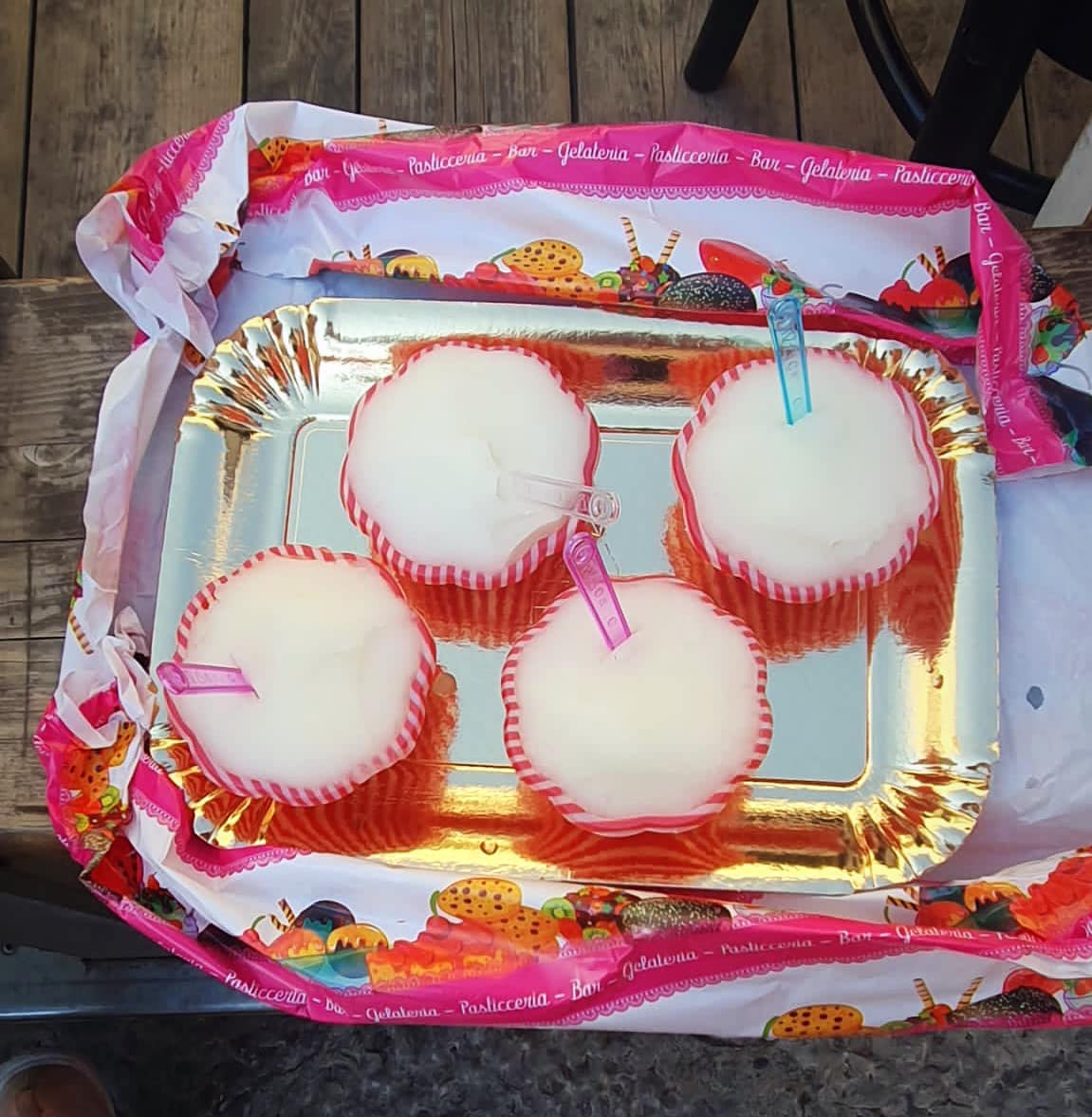
We headed back to the old town for some lemon granita. While we were there we saw a wedding party – the bride and all her family were walking through the old town to the church. Everyone clapped as they walked past.
It was then back on the ferry to the mainland.








Bella’s on Tour – Sicily – Palermo revisited and Syracuse
On Sunday, after a lovely week on the western side of Sicily in Scopello we shifted to the eastern side closer to Catania.
Sicily is a big island and it was going to take us about three and a half hours to cross it. We decided to stop off at the markets in Palermo on the way. It was nice going back a second time as things felt familiar.
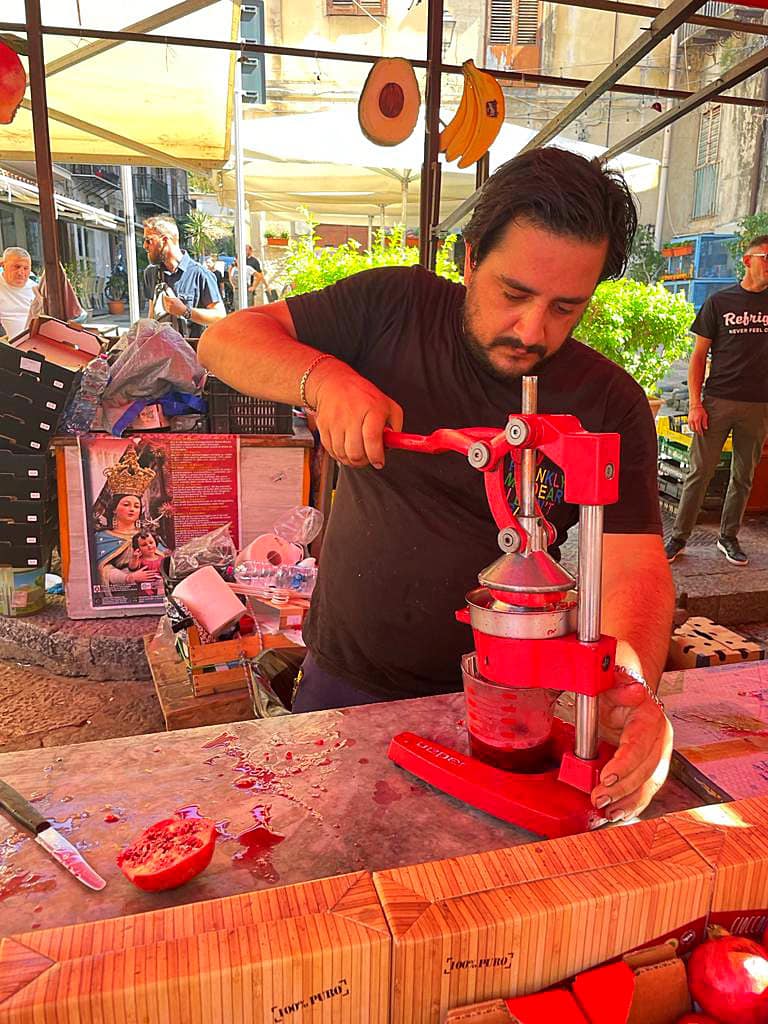
We had breakfast near the markets and then wandered down to the harbour. Limoncello tasting, a lovely coffee stop and some retail therapy were par for the course 
We then set off on our road trip, missed a turn at a detour and added forty minutes to our journey  . Our new home for the week was worth the wait though. We have a pool and great views over Mt Etna.
On Monday, we took a drive to Syracuse which is notable for its rich Greek and Roman history, culture, amphitheatres, architecture, and as the birthplace and home of the pre-eminent mathematician and engineer Archimedes. This 2,700-year-old city played a key role in ancient times, when it was one of the major powers of the Mediterranean world.
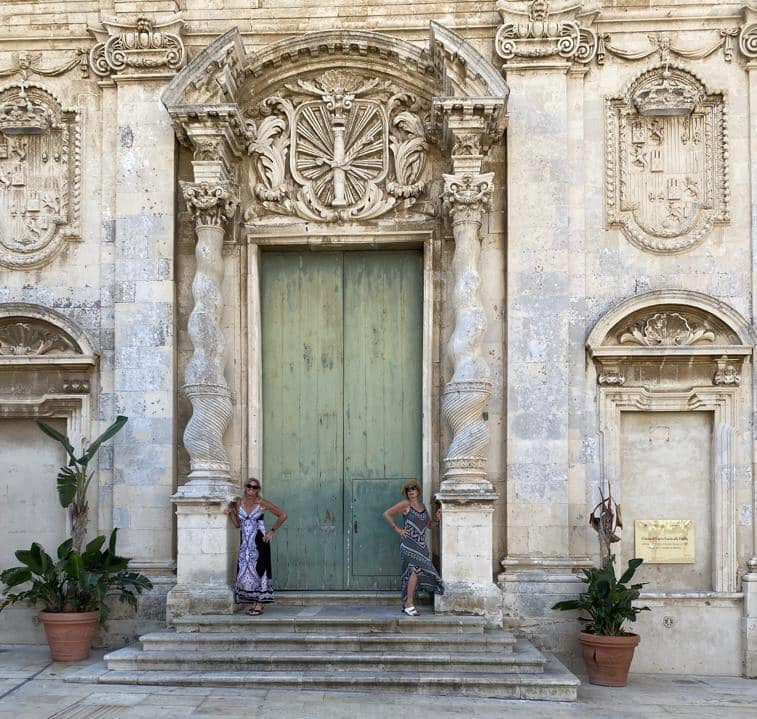
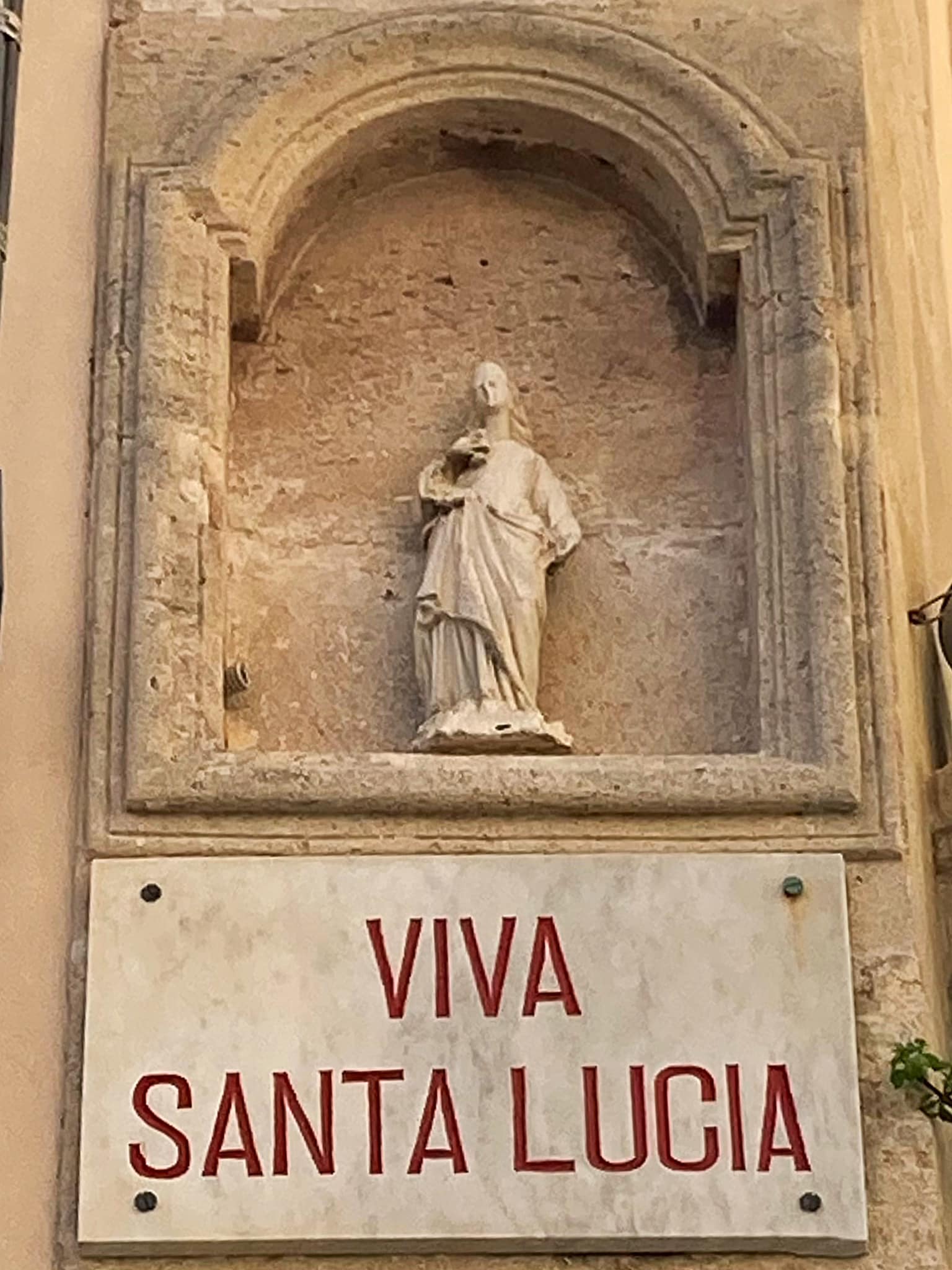
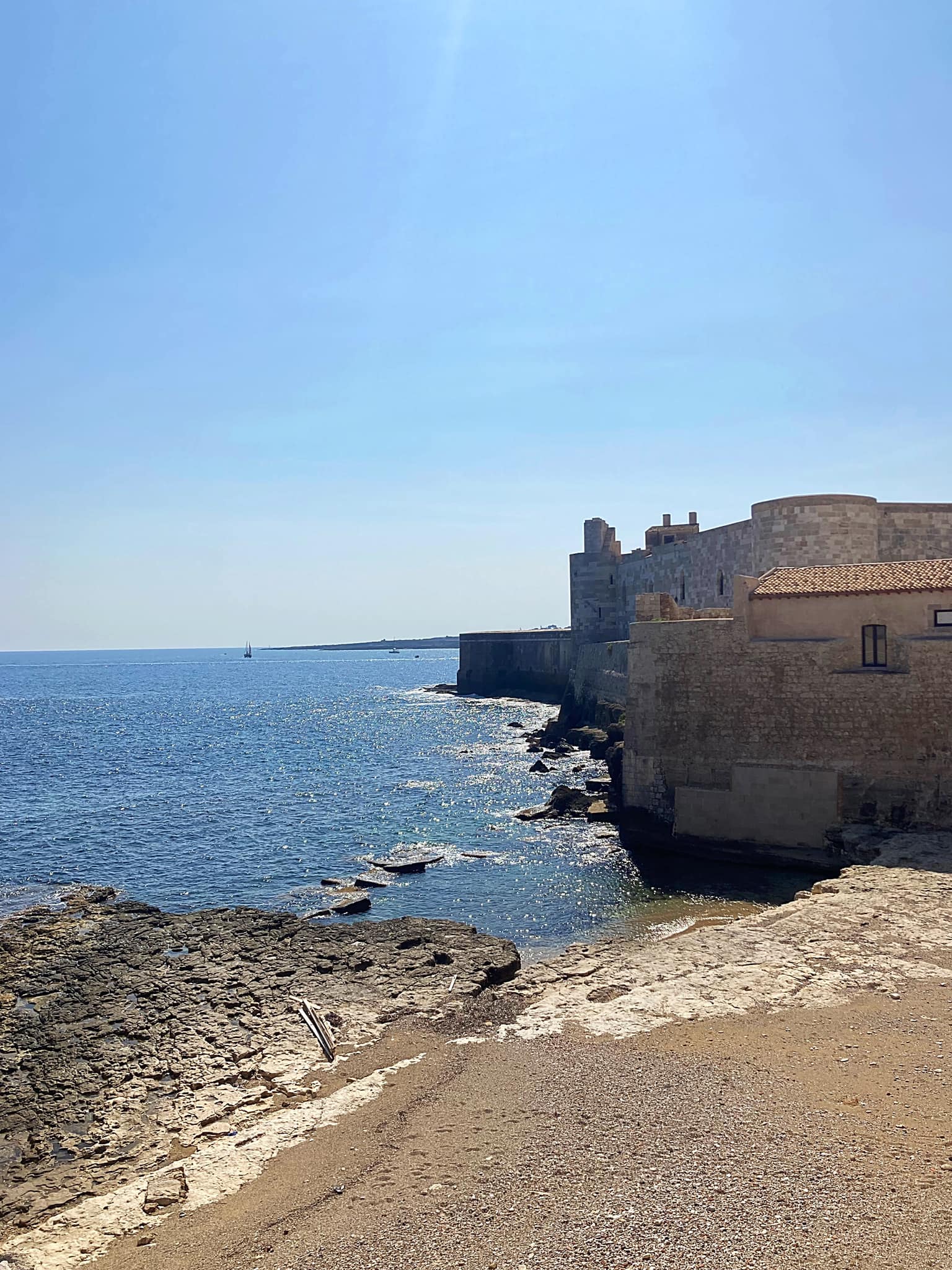
We checked out the Piazza Duomo, the cathedral, the Arethusa Spring, Castello Maniace and the Fountain of Diana.
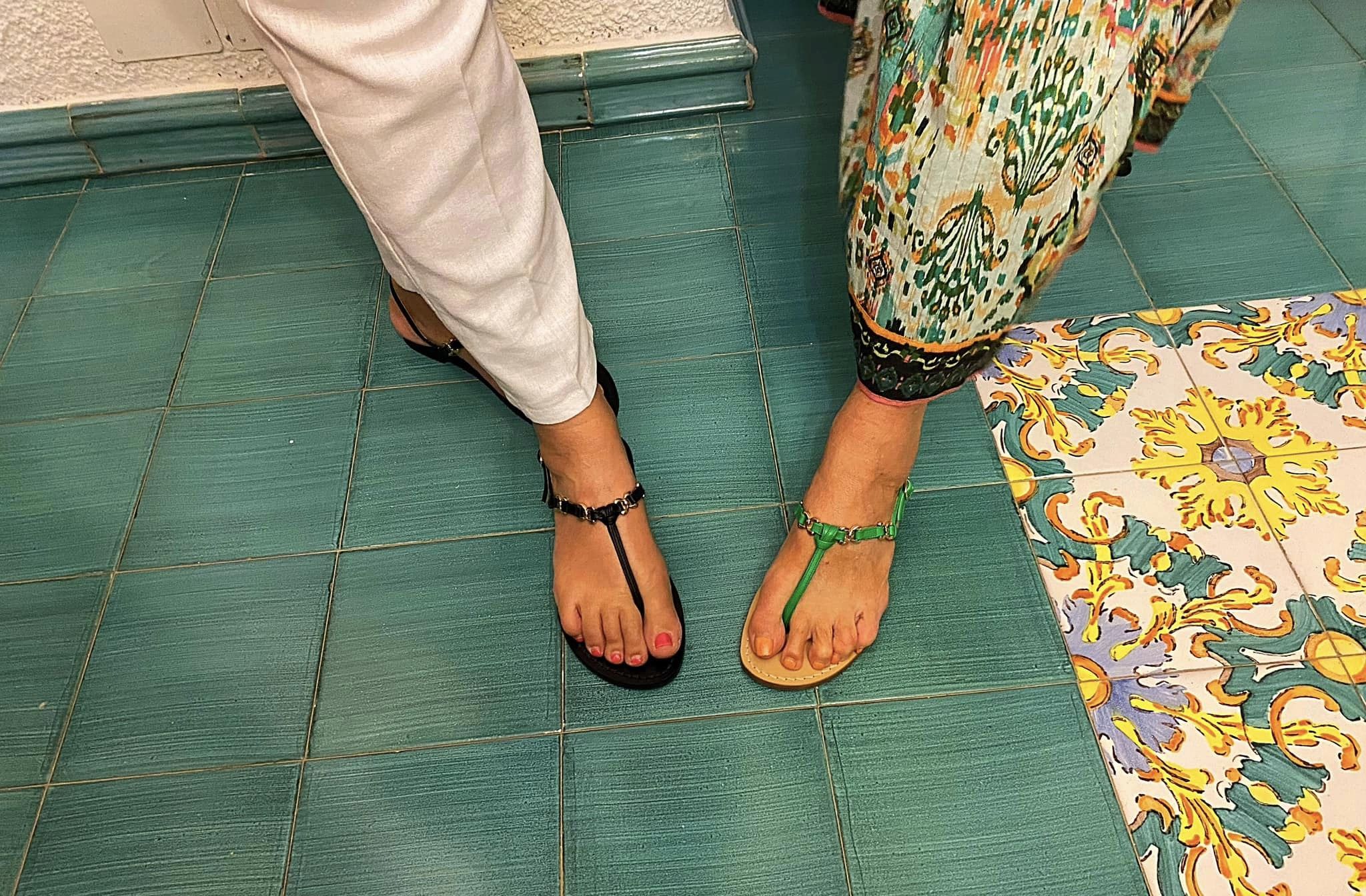
A couple of the Bella’s also got some custom made sandals while they waited which they described as a special experience. It might have helped that the sandal maker was rather cute 
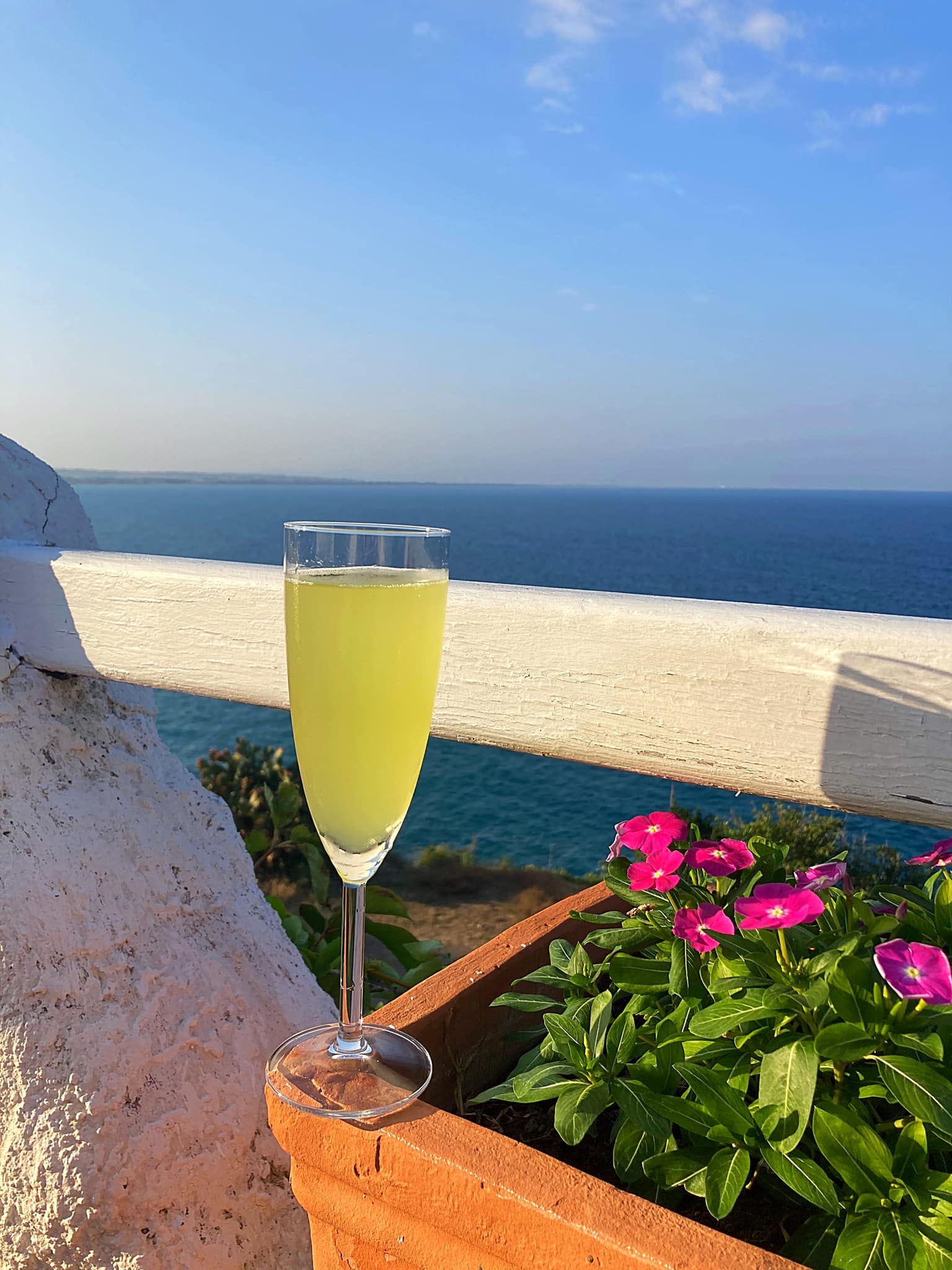
It was then home to enjoy the pool and a limoncello spritzer











Bella’s on Tour – Sicily – Catania
When we did our food tour in Palermo, our guide Justyna told us about the fierce rivalry they have with Catania which is on the east coast of Sicily. She mentioned a number of times that the various street foods in Palermo were far superior to those in Catania. Given our love for Italian food we had to check it out for ourselves.
Catania is the second largest municipality in Sicily, after Palermo, both by area and by population. Despite its reputation as the second city of the island, Catania is the largest Sicilian conurbation (a region comprising a number of metropolises, cities, large towns, and other urban areas which through population growth and physical expansion, have merged to form one continuous urban or industrially developed area), among the largest in Italy, as evidenced also by the presence of important road and rail transport infrastructures as well as by the main airport in Sicily, fifth in Italy. It is located on Sicily’s east coast, at the base of the active volcano, Mount Etna, and it faces the Ionian Sea. The population of the city proper is about 312,000 while the population of the Metropolitan City of Catania is about 1.1 million.
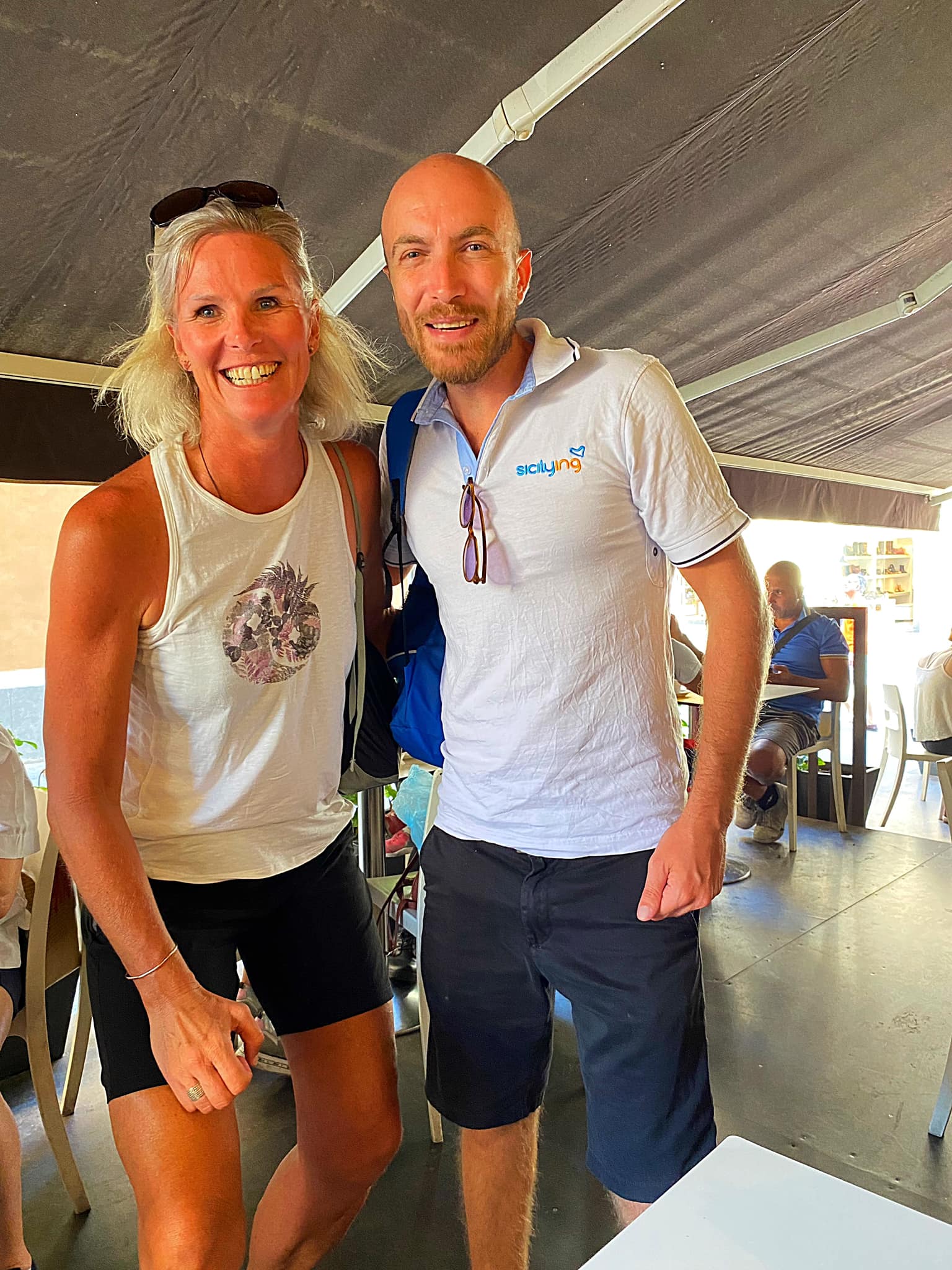
We navigated our way through rush hour traffic before walking to the Piazza Duomo to meet our guide, Francesco. There were also an English couple, an English woman who has lived in Rome for forty years and her Irish friend. The Rugby World Cup was the first topic of conversation once she knew we were from NZ. Francesco was very interested in NZ and the pacific islands due to his interest in sailing.
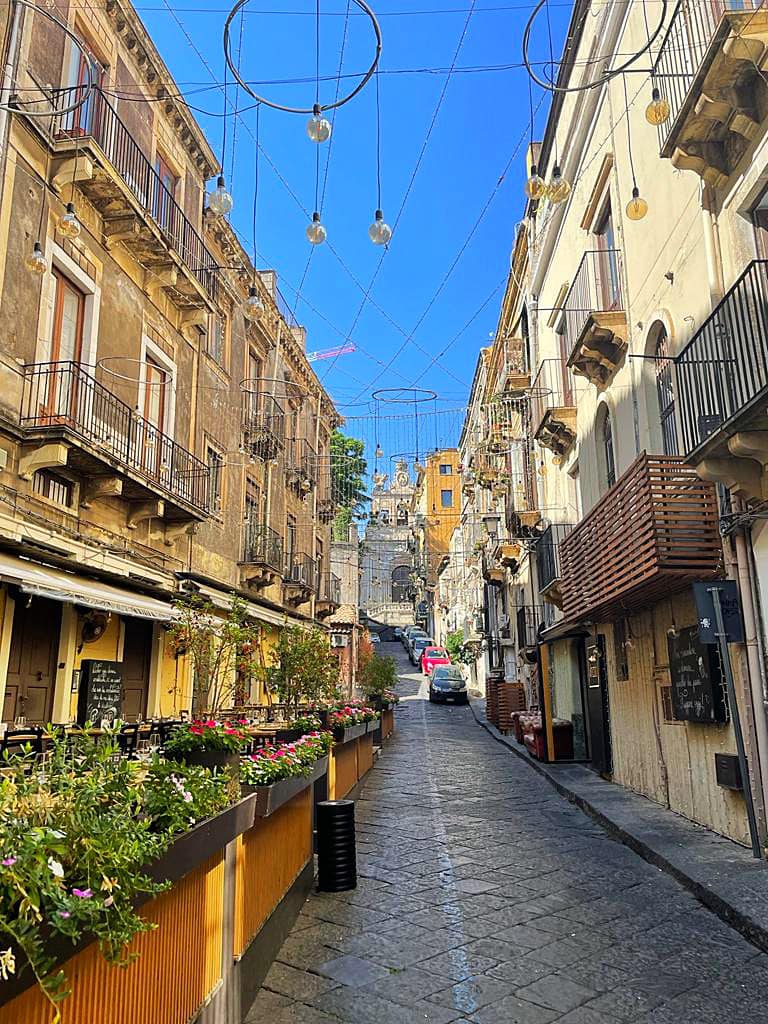
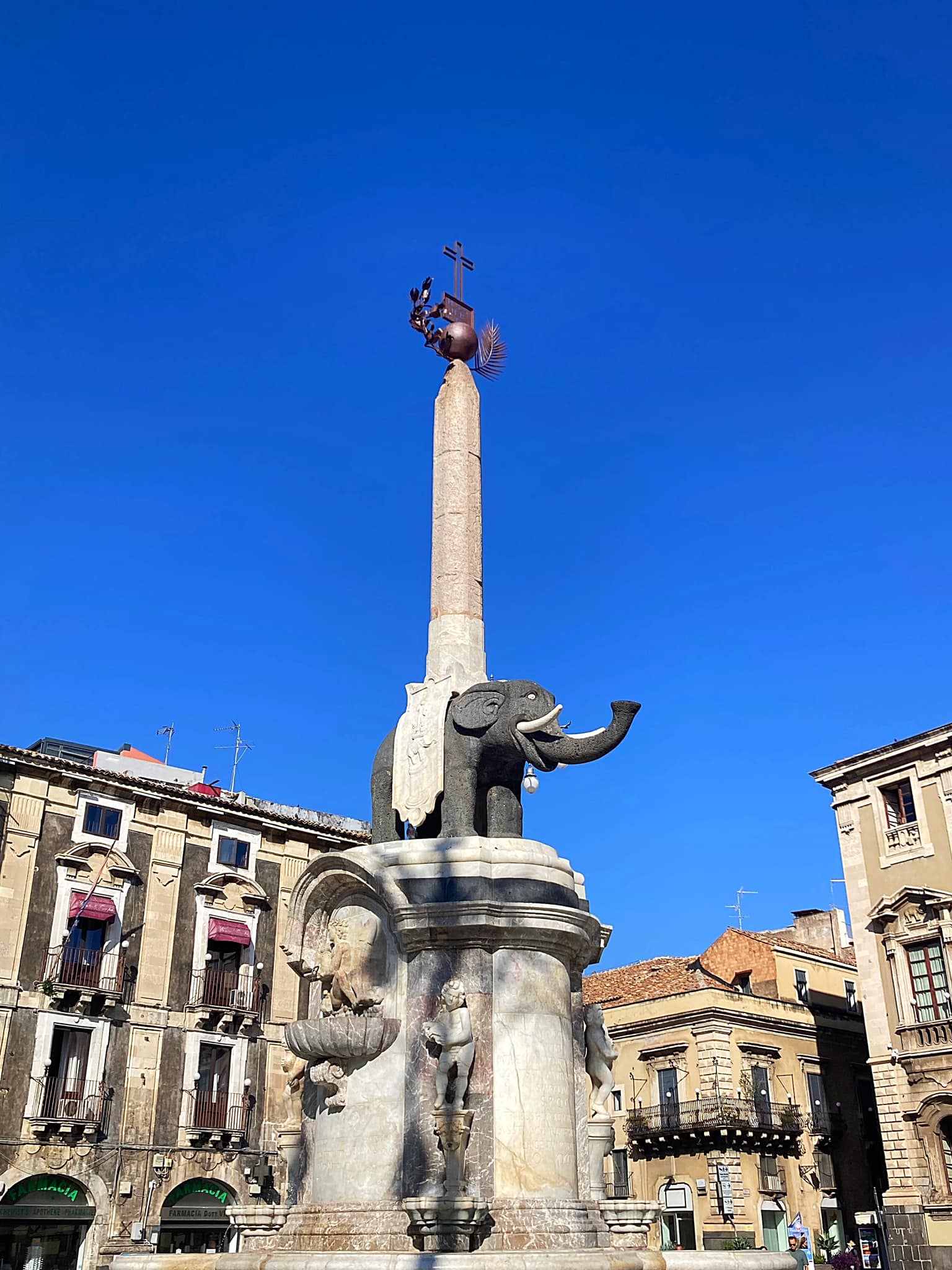
On our way to the markets, we stopped to admire a river that flows under the Piazza. There was an immaculately dressed man standing there having his picture taken with whoever wanted – Debs was front and centre
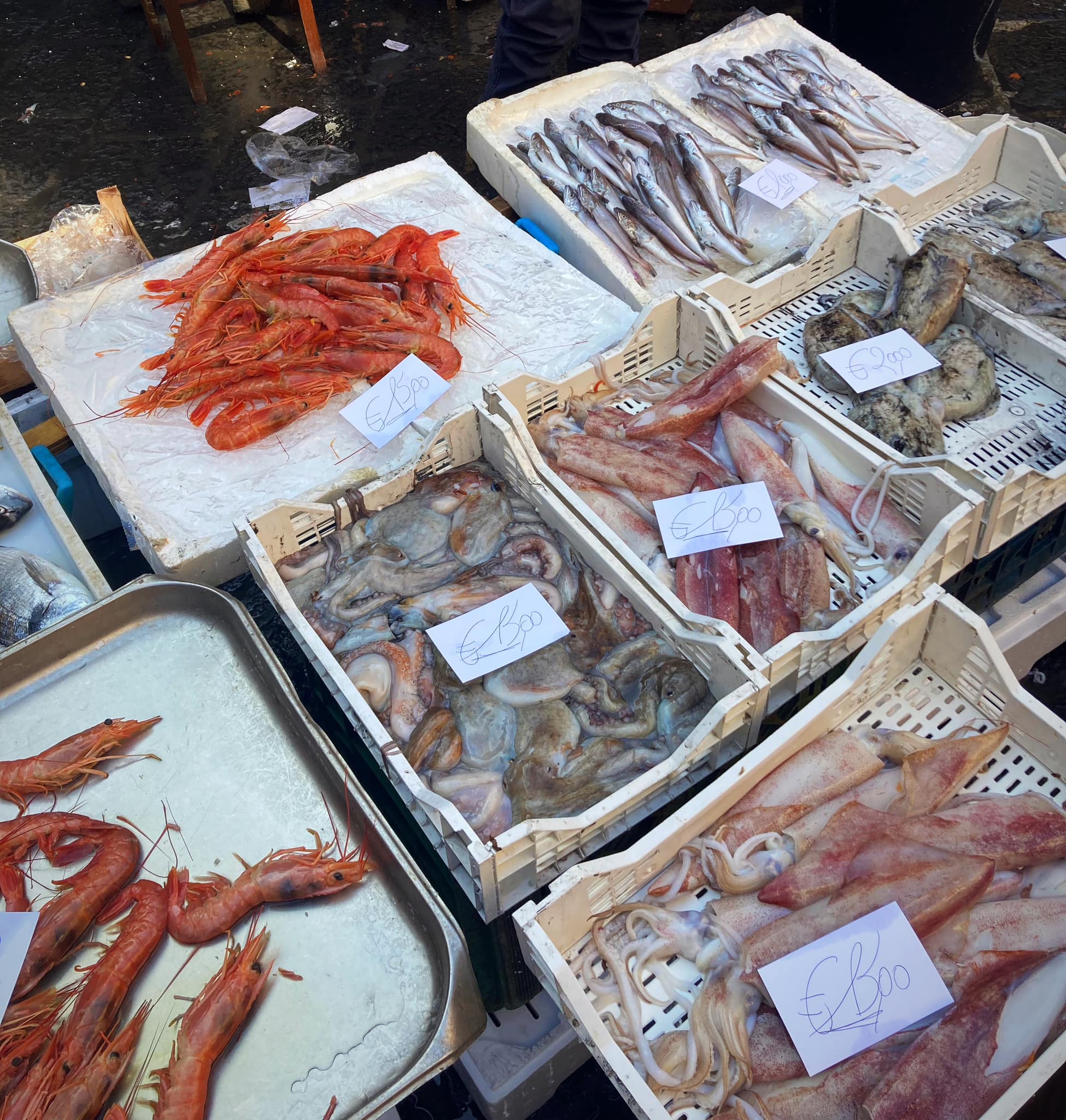
We walked through the fish market which is a very lively place. Swordfish is very popular on the menus here.
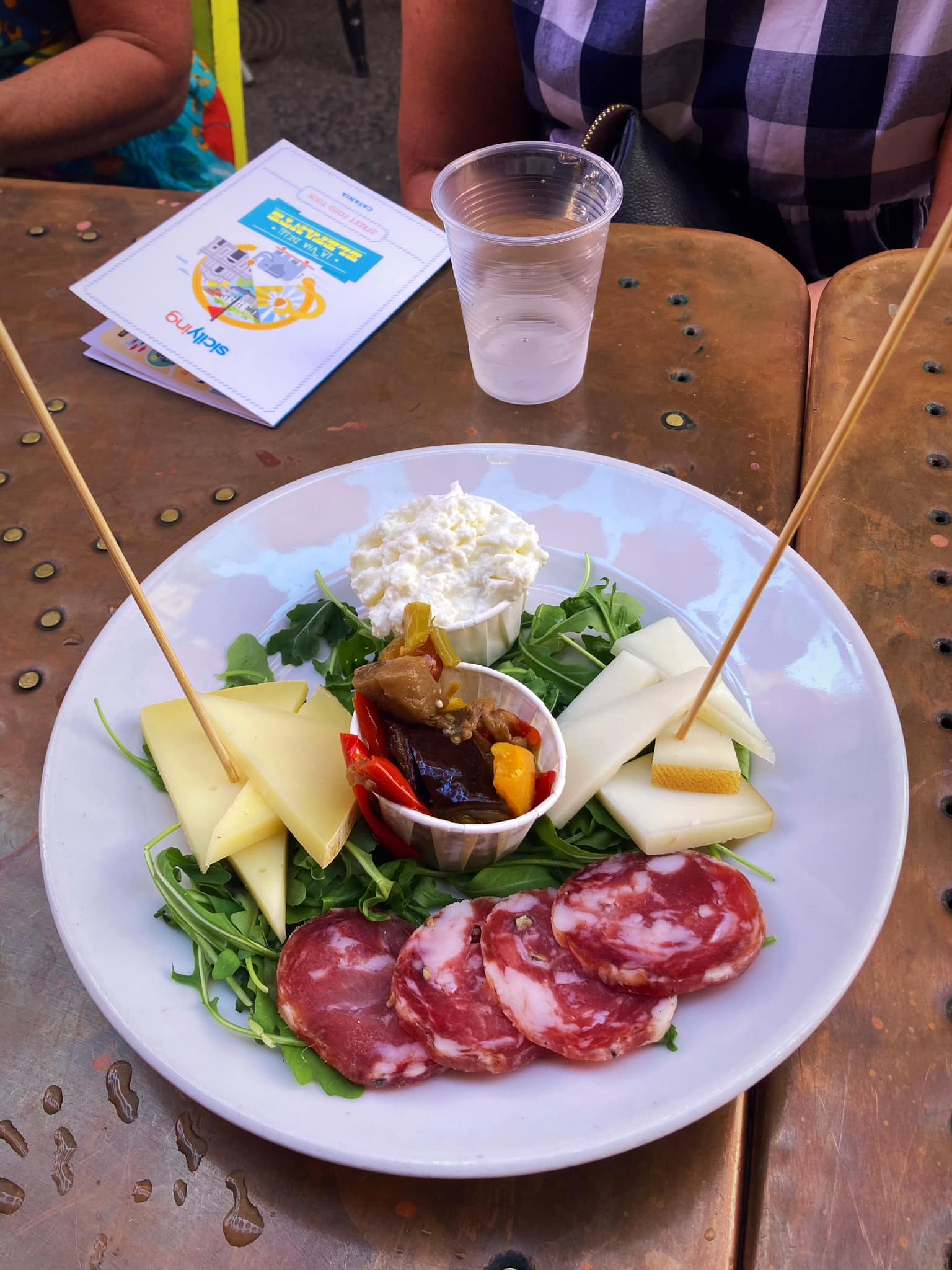
We then went to a local restaurant in the market for some tastings. We had some cheese and salami. The ricotta was absolutely delicious.
Next up we had a choice of seafood or horse meat. Given the other three are seafood lovers and none of us were keen on eating horse, we went with the seafood option. One of the others in the group tried the horse meat and said it was super salty.
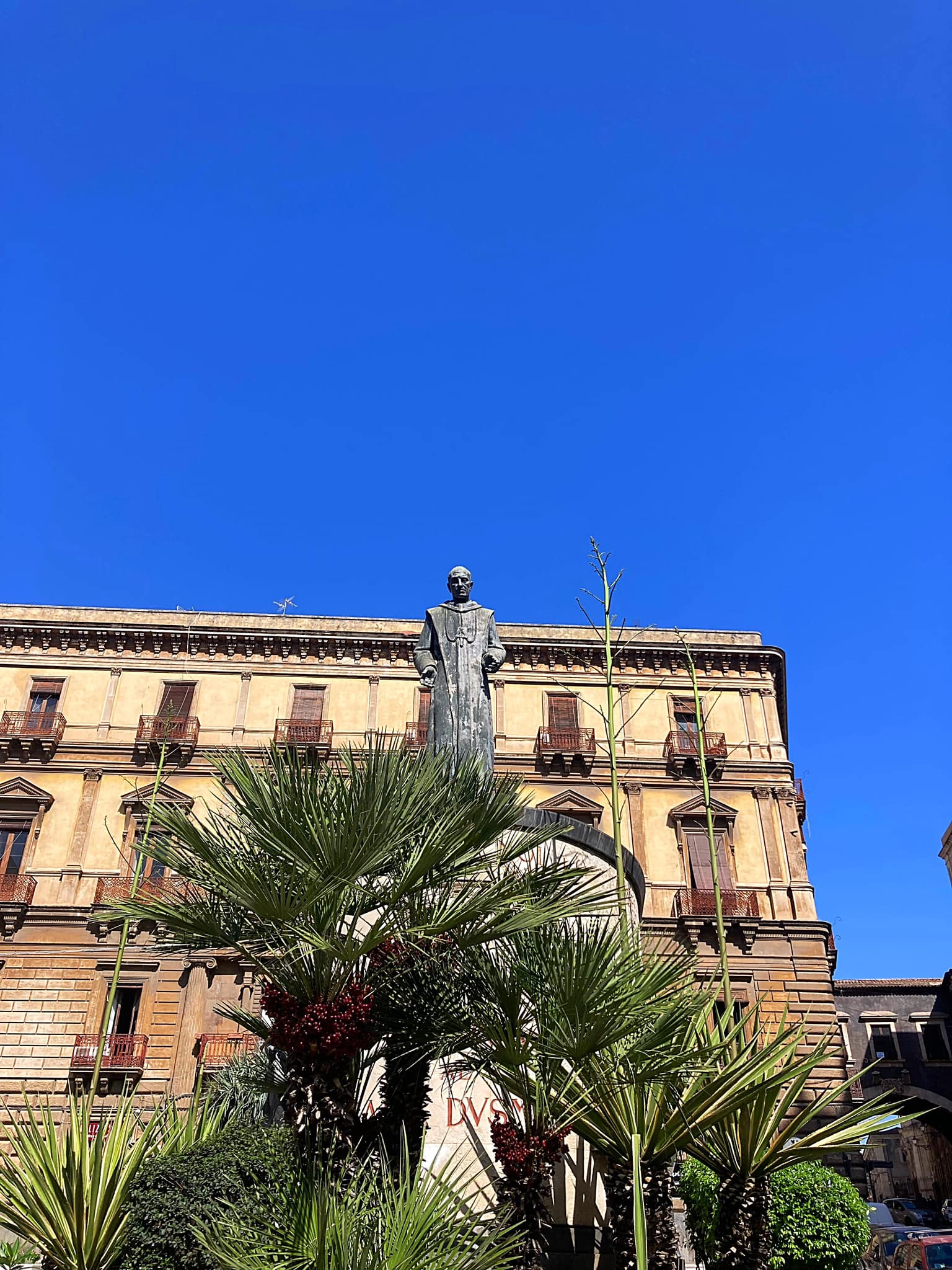
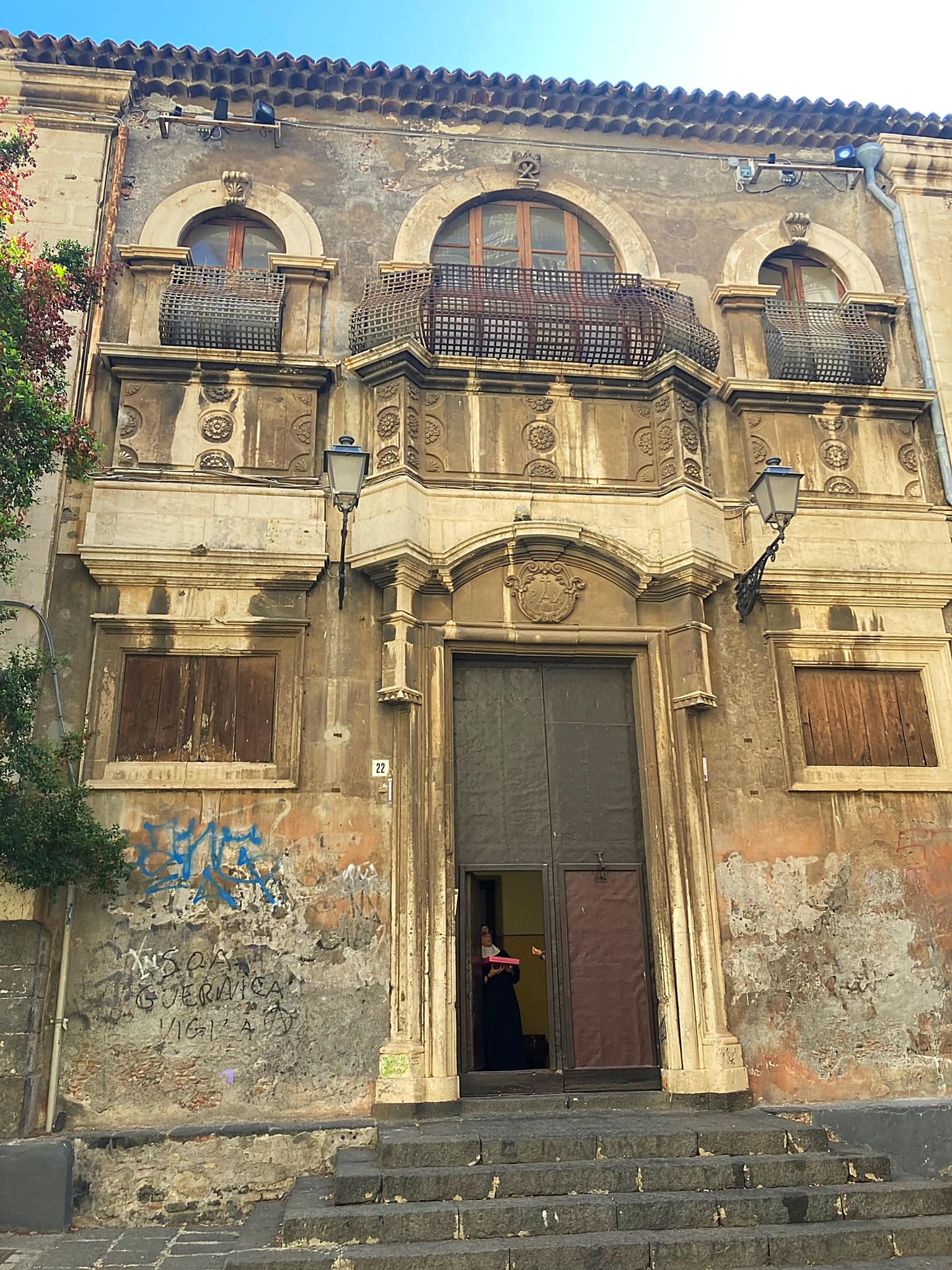
We then left the market and wandered past some churches and a convent. The buildings are dirty looking due to the ash from Mount Etna’s historic eruptions, the most recent being in August this year
Mount Etna is located above the convergent plate margin between the African Plate and the Eurasian Plate. It is one of the tallest active volcanoes in Europe, and the tallest peak in Italy south of the Alps with a current height (July 2021) of 3,357 m (11,014 ft), though this varies with summit eruptions. Over a six-month period in 2021, Etna erupted so much volcanic material that its height increased by approximately 100 ft (30 m), and the southeastern crater is now the tallest part of the volcano.
Mount Etna is one of the world’s most active volcanoes and is in an almost constant state of activity. The fertile volcanic soils produced from this activity support extensive agriculture, with vineyards and orchards spread across the lower slopes of the mountain and the broad Plain of Catania to the south. Due to its history of recent activity and nearby population, Mount Etna has been designated a Decade Volcano by the United Nations. In June 2013, it was added to the list of UNESCO World Heritage Sites.
We have a fabulous view of Mount Etna from where we are staying.
Next up on the tasting menu was Arancino given we were in Catania. The rivalry between Catania and Palermo extends to this yummy morsel. According to Palermitans there’s no doubt! It’s Arancina (Singular) and Arancine (Plural) and it has the shape of a ball. While according to Catanians it’s more correct to say Arancino (S) and Arancini (PL) and it has the shape of a cone!
But it’s not only a matter of vowels or shape but gender! In fact, according to the Italian grammar, the word arancina is feminine while arancino is masculine! Palermitans love to say “a’ arancina fimmina è!” (the arancina is a lady!”
We passed the area where they are uncovering the ruins of the Amphitheatre of Catania which was built in the Roman Imperial period, probably in the 2nd century AD.
Next up we had a Cipollina which refers to a type of small, somewhat flattened onion that has a thin skin and a sweet taste. This is typical of the province of Catania. The Cipollina is a crunchy box of puff pastry filled with stewed onions, tomato sauce, mozzarella and ham. Really, really delicious
We then went to a drinks kiosk to try a Seltz Limone e Sale which is sparkling water, juice of a lemon and a teaspoon of salt. This drink was offered for the first time in 1896 and is a good supplement of mineral salts and very refreshing after a day at the beach. They offered a mandarin version which I took – good choice as it was refreshing – the ones who chose the lemon version said it was too salty!
Next up was the Granita which we have become very well acquainted with on this trip. Granita is a semi-frozen liquid compound prepared with water, sugar and a fruit juice or other ingredient. I have had a pistachio one and a number of lemon ones. This time I went with chocolate and it was delicious – very creamy. Jo had the coffee one and was not impressed.
Two different food tours and two different experiences. We found Catania a lot more relaxed but the blackened buildings did give an impression of being a dirty city. The Sicilian food though was a hit in both places.











Bella’s on Tour – Sicily – Taormina
Today we headed to Taormina which is about an hour north of where we are staying on the east coast of the island.
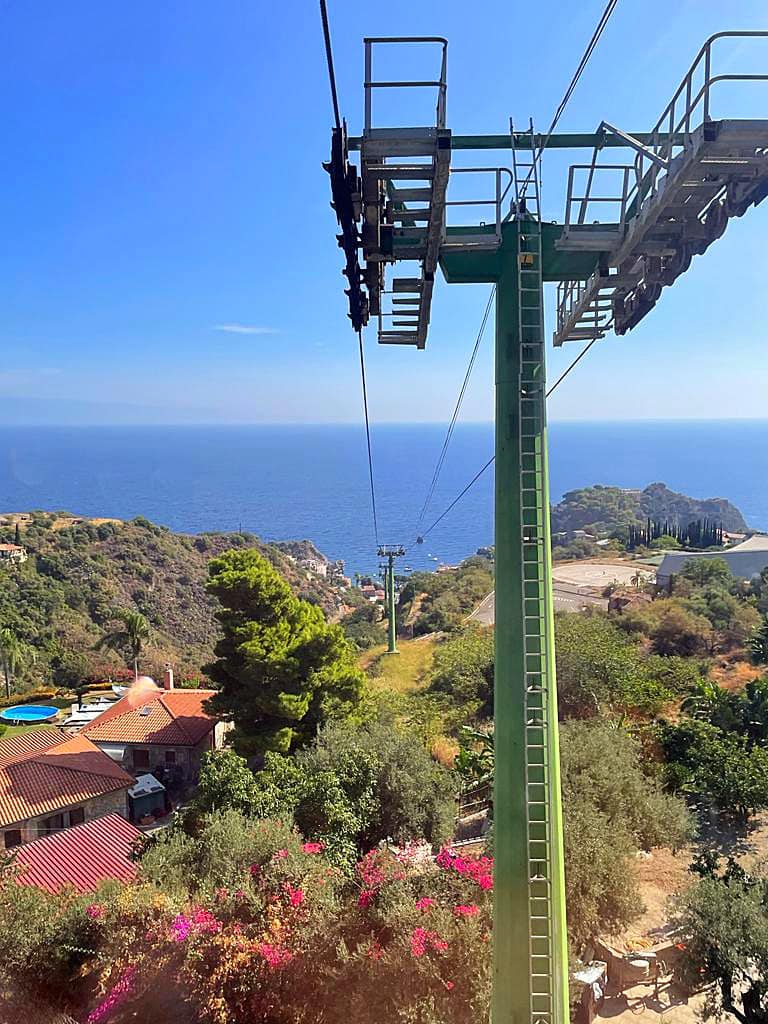
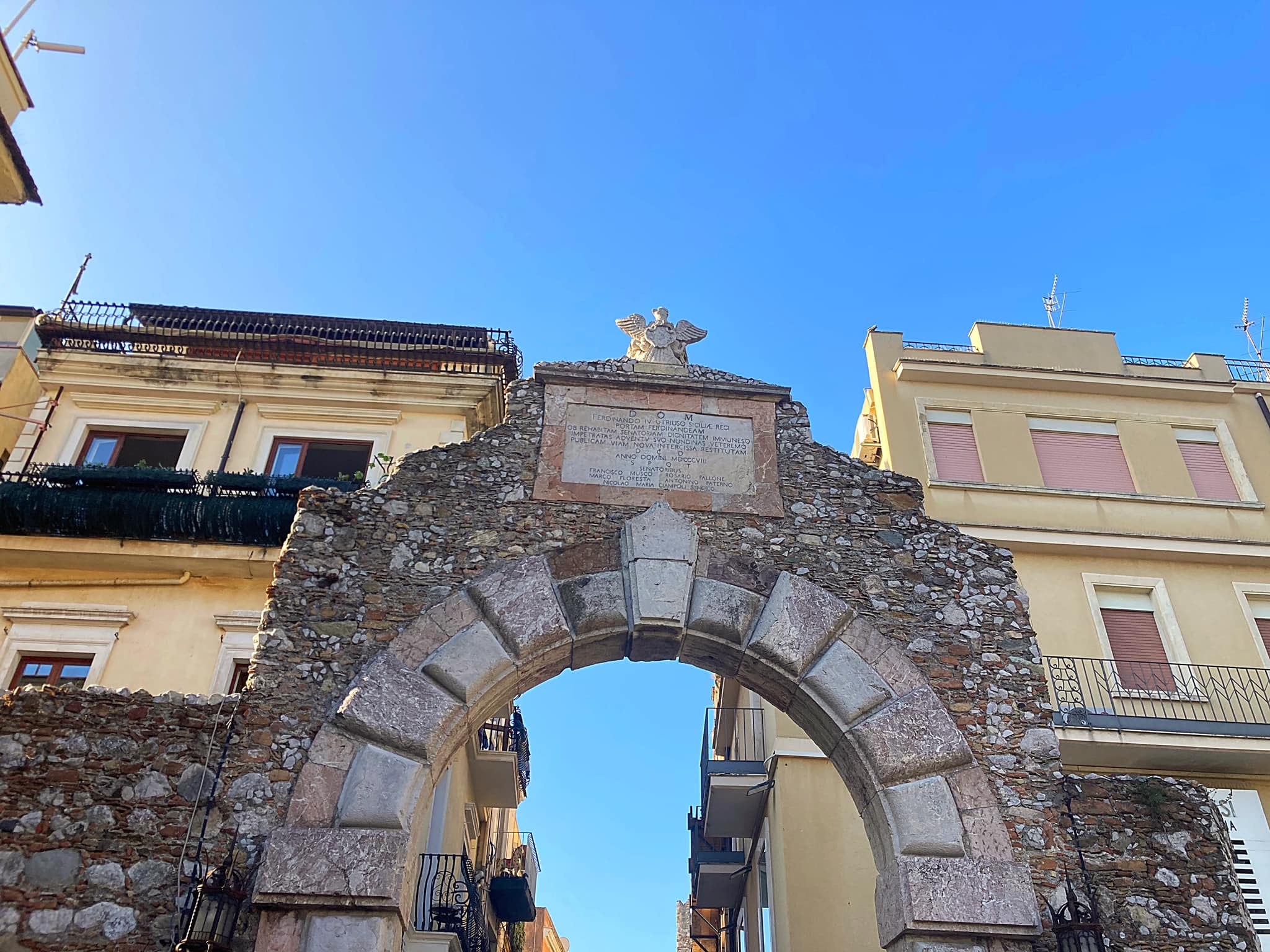
Taormina is a historic town that sits 250 metres above sea level. A cable car connects the historic center of Taormina with its beach area of Mazzarò.
The history of Taormina dates back to before Ancient Greece established its first colony on Sicily in 734 BCE in Magna Graecia and it has been a tourist destination since the 19th century.
Taormina followed the history of Sicily in being ruled by successive foreign monarchs. After the Italian unification, Taormina began to attract well-off tourists from northern Europe, and it became known as a welcoming haven for gay men and artists.
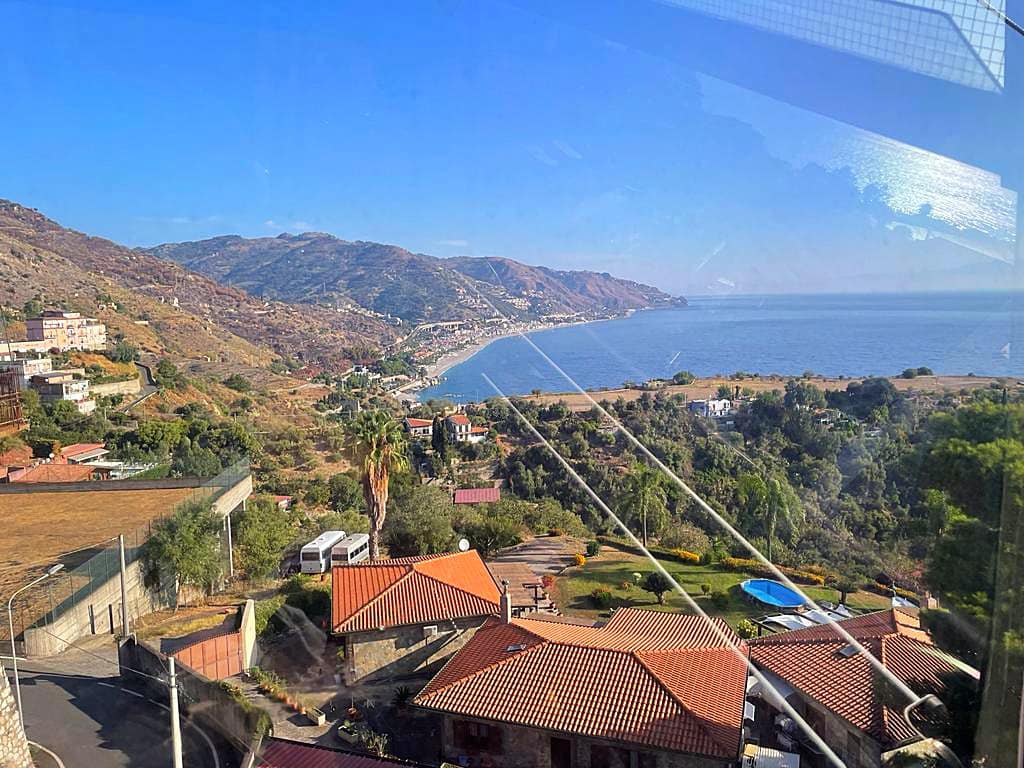
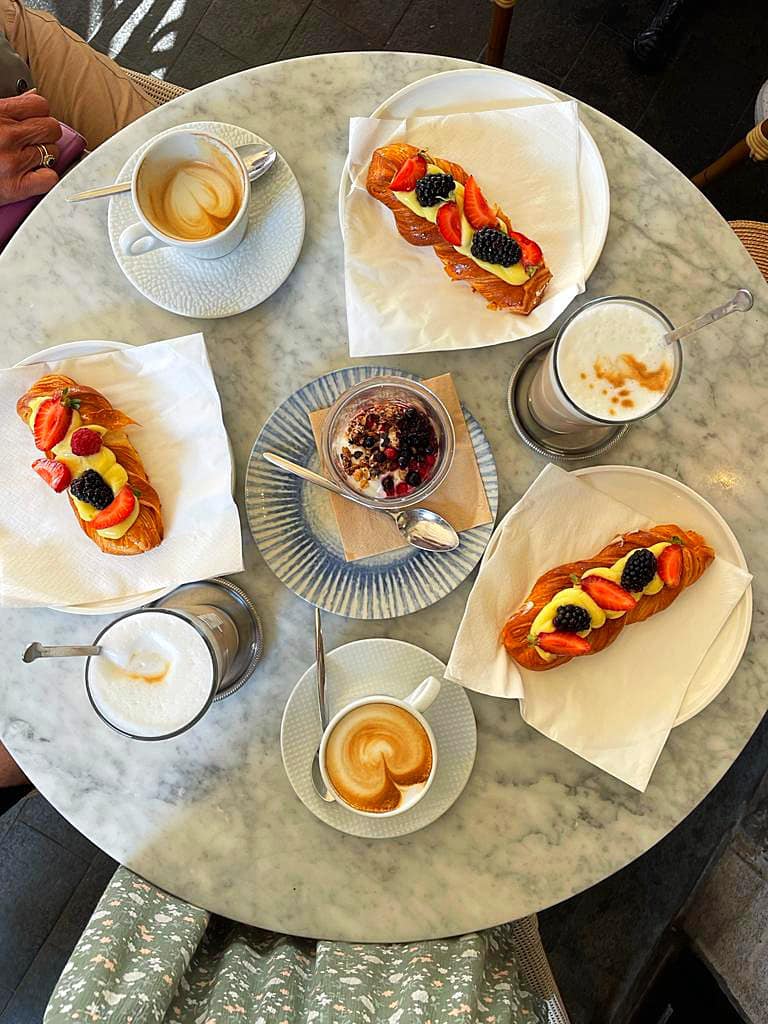
We caught the cable car up to the town and the view on the way up was pretty special. We enjoyed a lovely coffee near the piazza before going exploring. It is a very upmarket town, well kept with lovely shops and greenery.
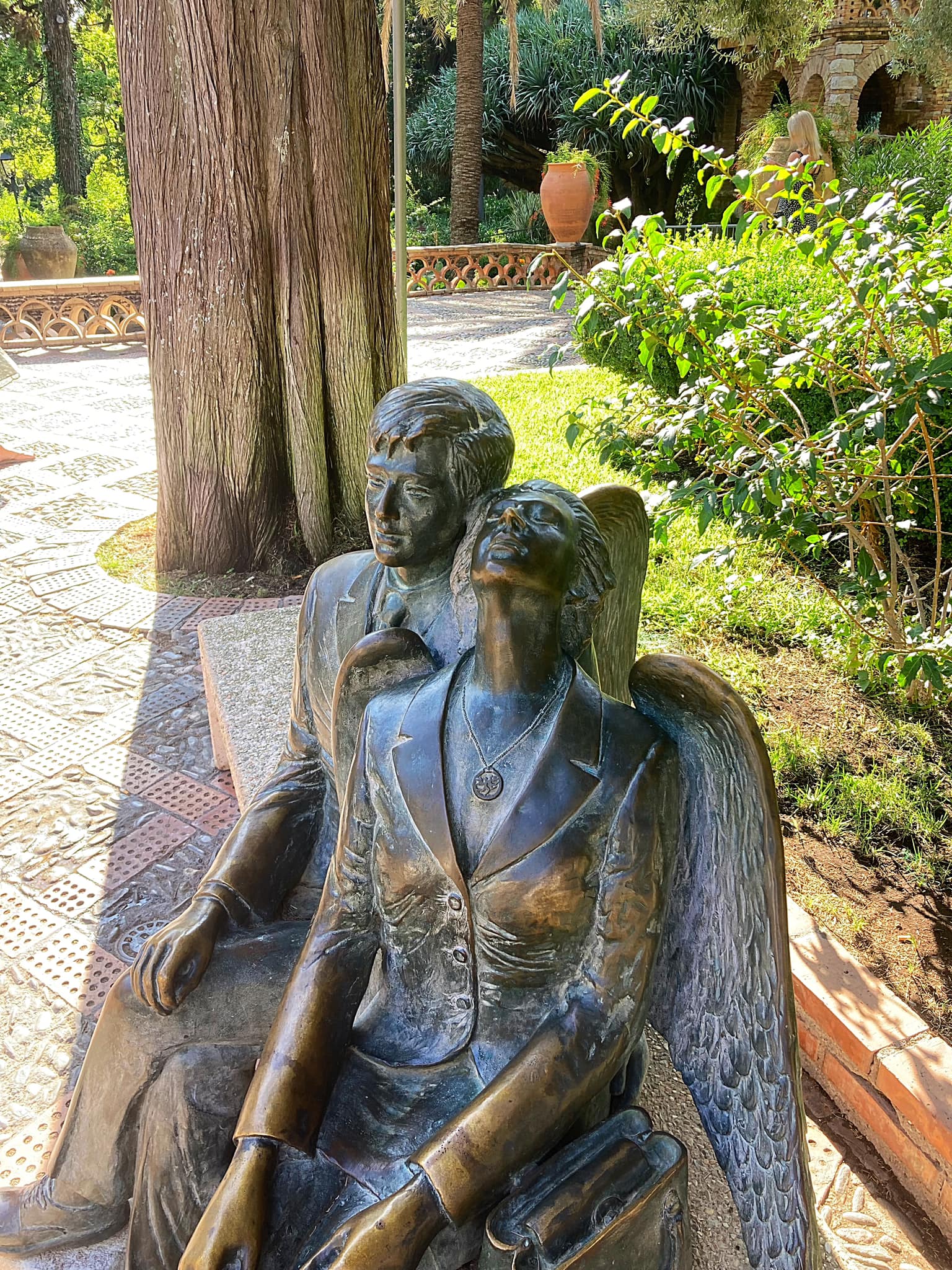
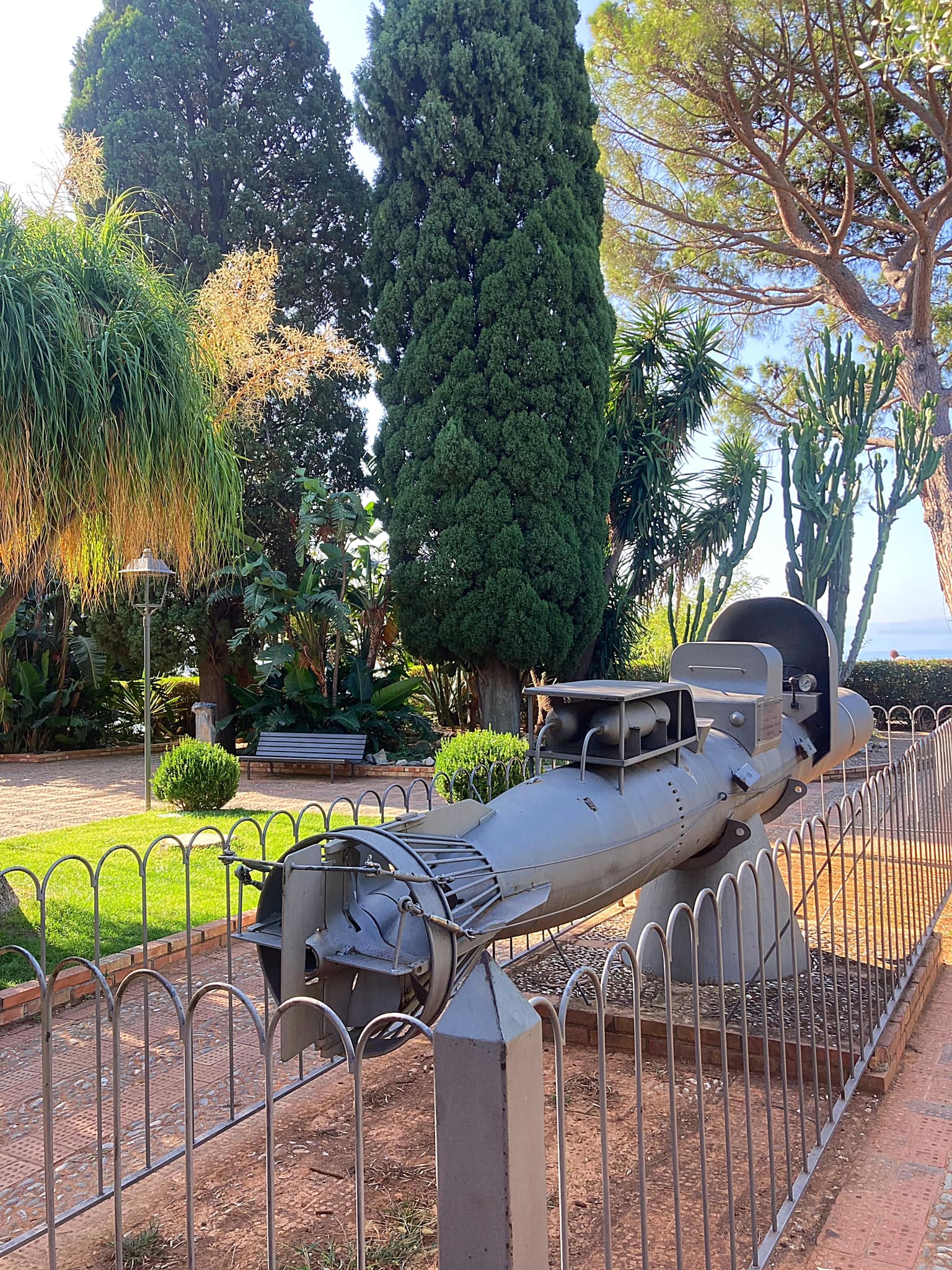
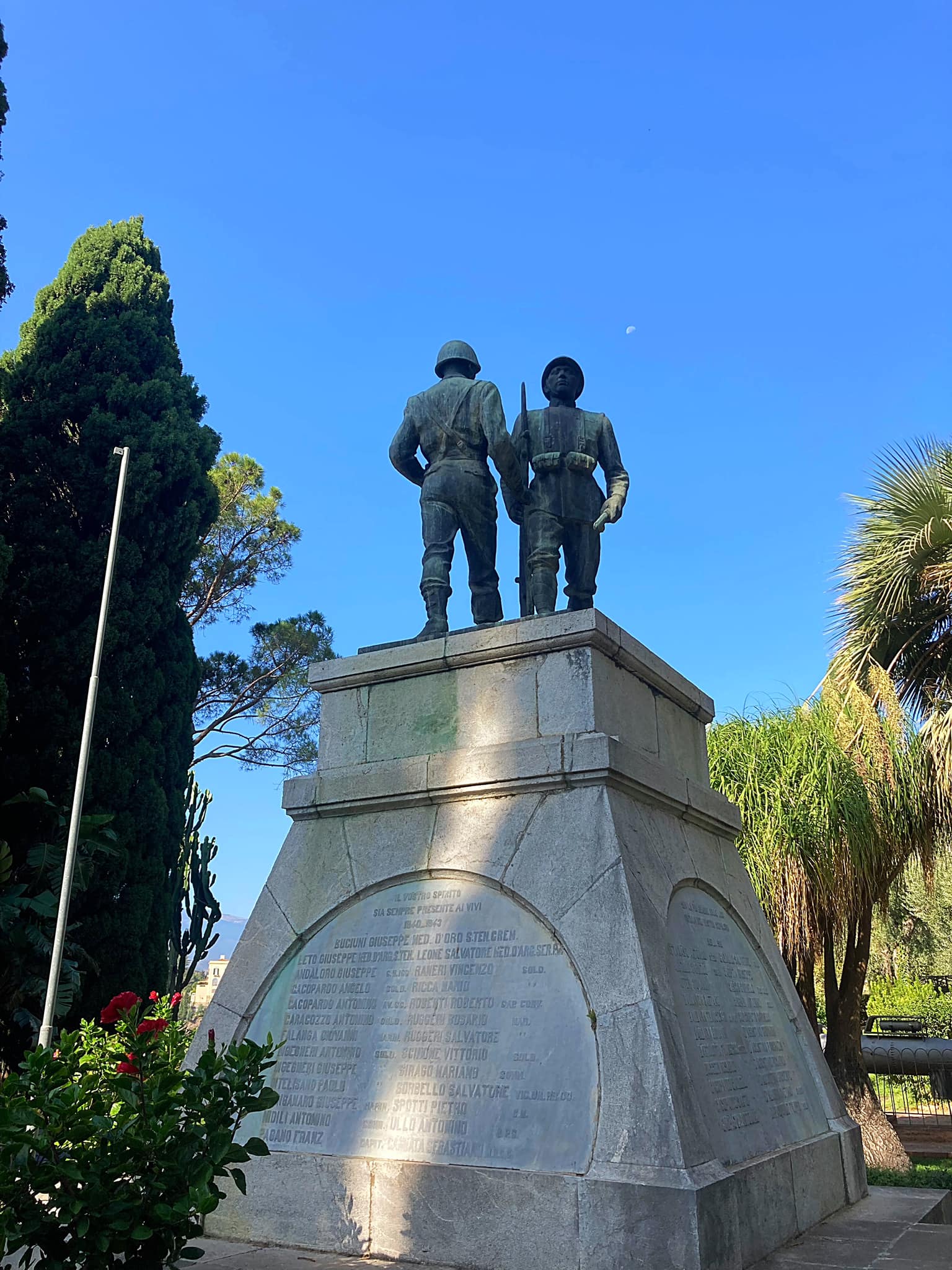
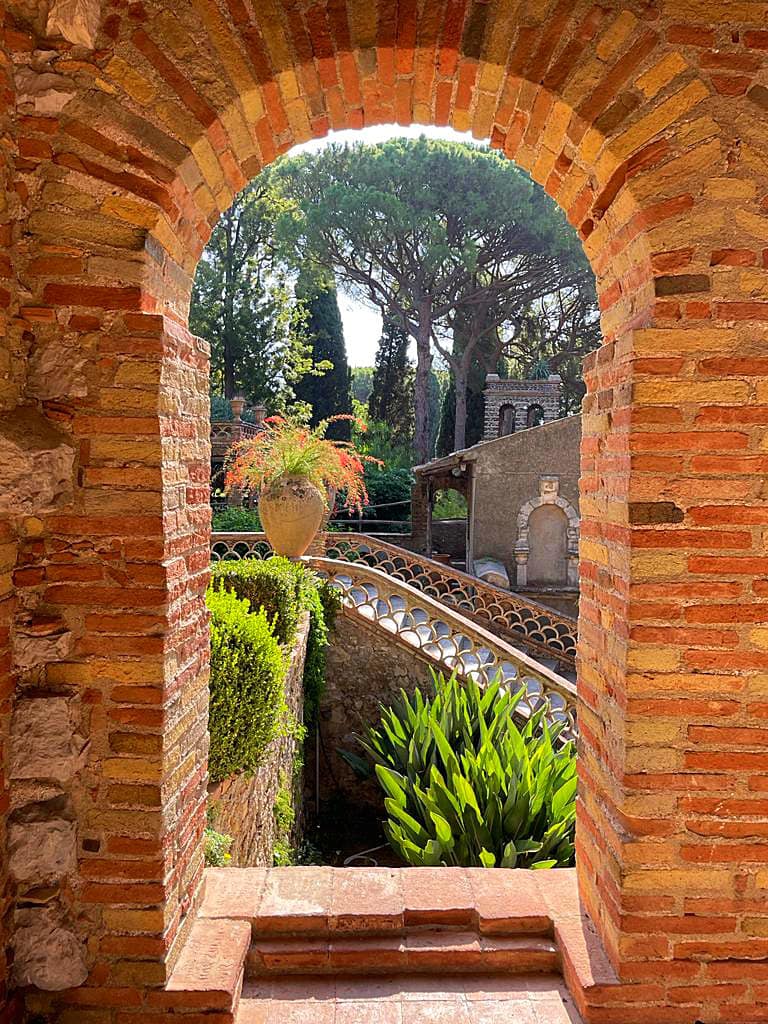
We visited the Villa Communale of Taormina which was originally the garden of the house of an English noblewoman who lived in Taormina in the nineteenth century: Lady Florence Trevelyan. The daughter of a cousin of Queen Victoria, Lady Florence arrived in Taormina in 1884, fleeing from a scandal at court. She was accused of having an affair with the Prince of Wales, the future King Edward VII, who was already married to Alexandra of Denmark. In Taormina, Lady Florence met the doctor Salvatore Cacciola, who was to become the mayor of Taormina and whom she married in 1890. Over the years the couple bought several pieces of land where they built their villa and around which the noblewoman began to create an English-style garden.
Until 1990, Florence Trevelyan also owned Isola Bella (also known as the Pearl of the Ionian Sea), a small island below Taormina, before it was bought by the Region of Sicily, being turned into a nature reserve, administered by the Italian branch of the World Wide Fund for Nature. There is a narrow path that often connects the island to the mainland beach.
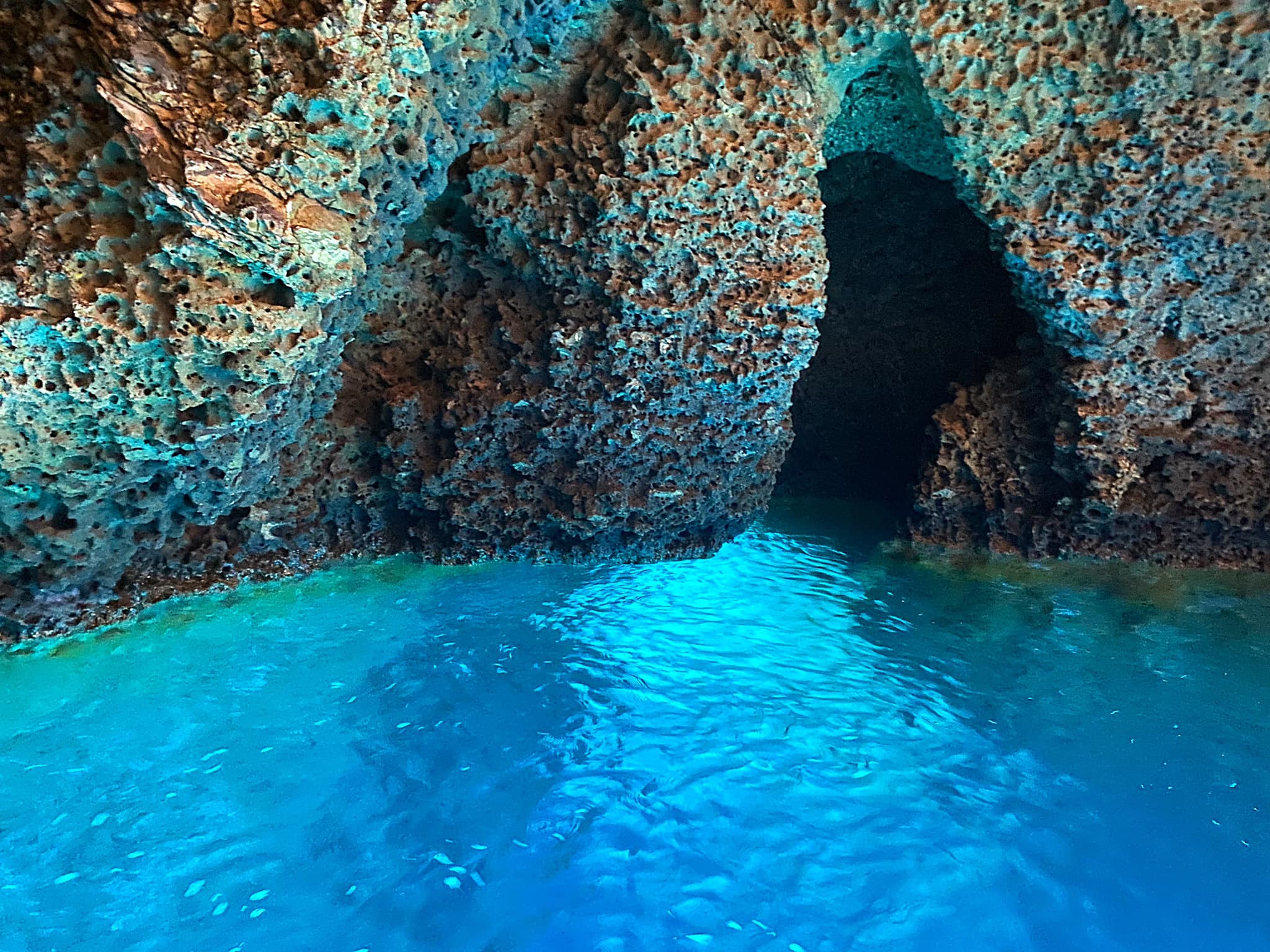
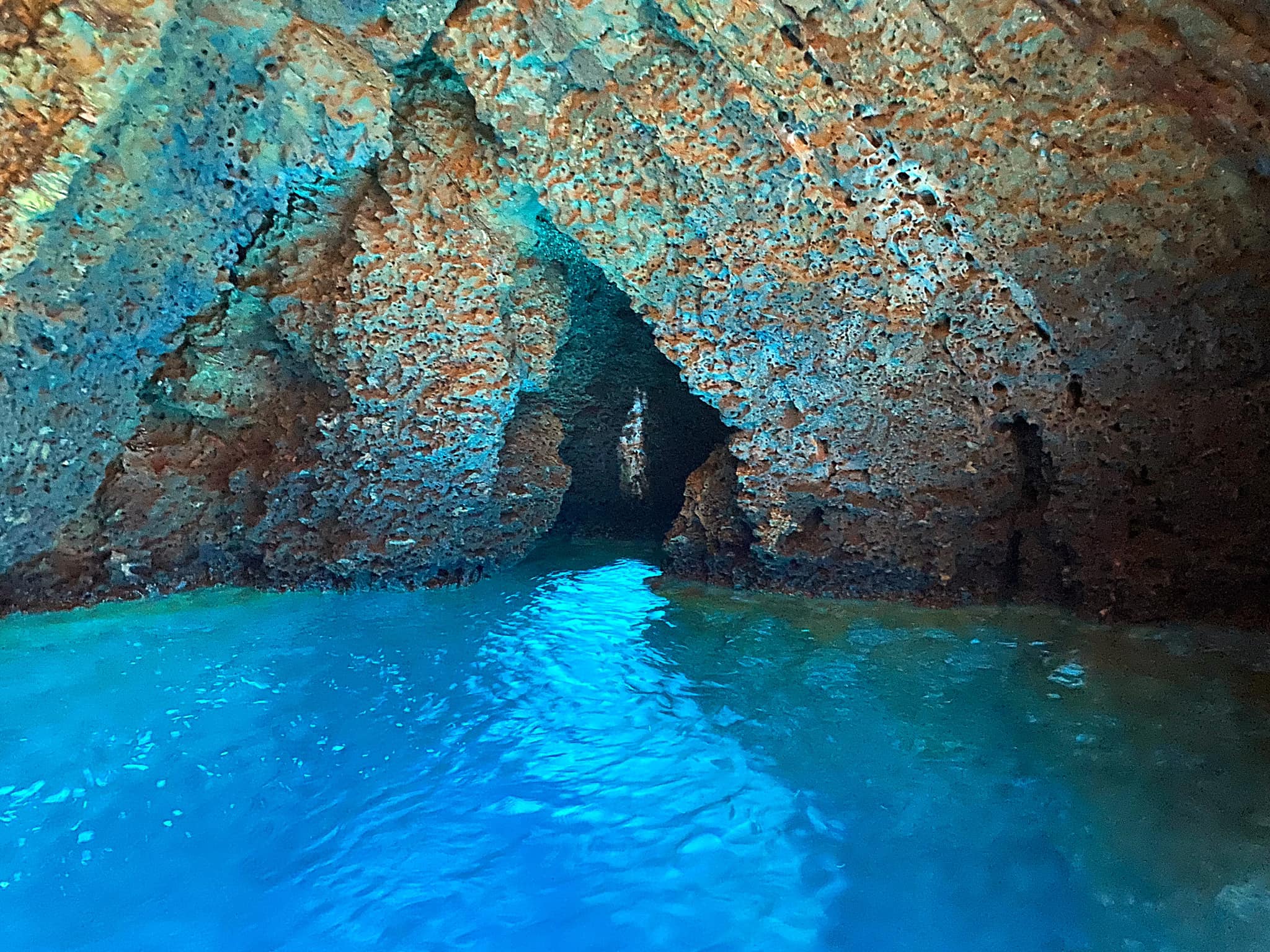
After our explore we caught the cable car down again and drove along the coast to do a two hour boat tour to see Isola Bella and Grotto Azurra which had stunning light reflections creating a contrasting blue pool against the walls of the ancient cave.
Our captain also pointed out San Domenico Palace, A Four Seasons Hotel, which was the hotel used as the setting for season 2 of the hit HBO show The White Lotus. Located on a hillside overlooking the Ionian Sea, the building was once a once a convent back in the 14th century, and has been welcoming guests as a hotel since 1896.
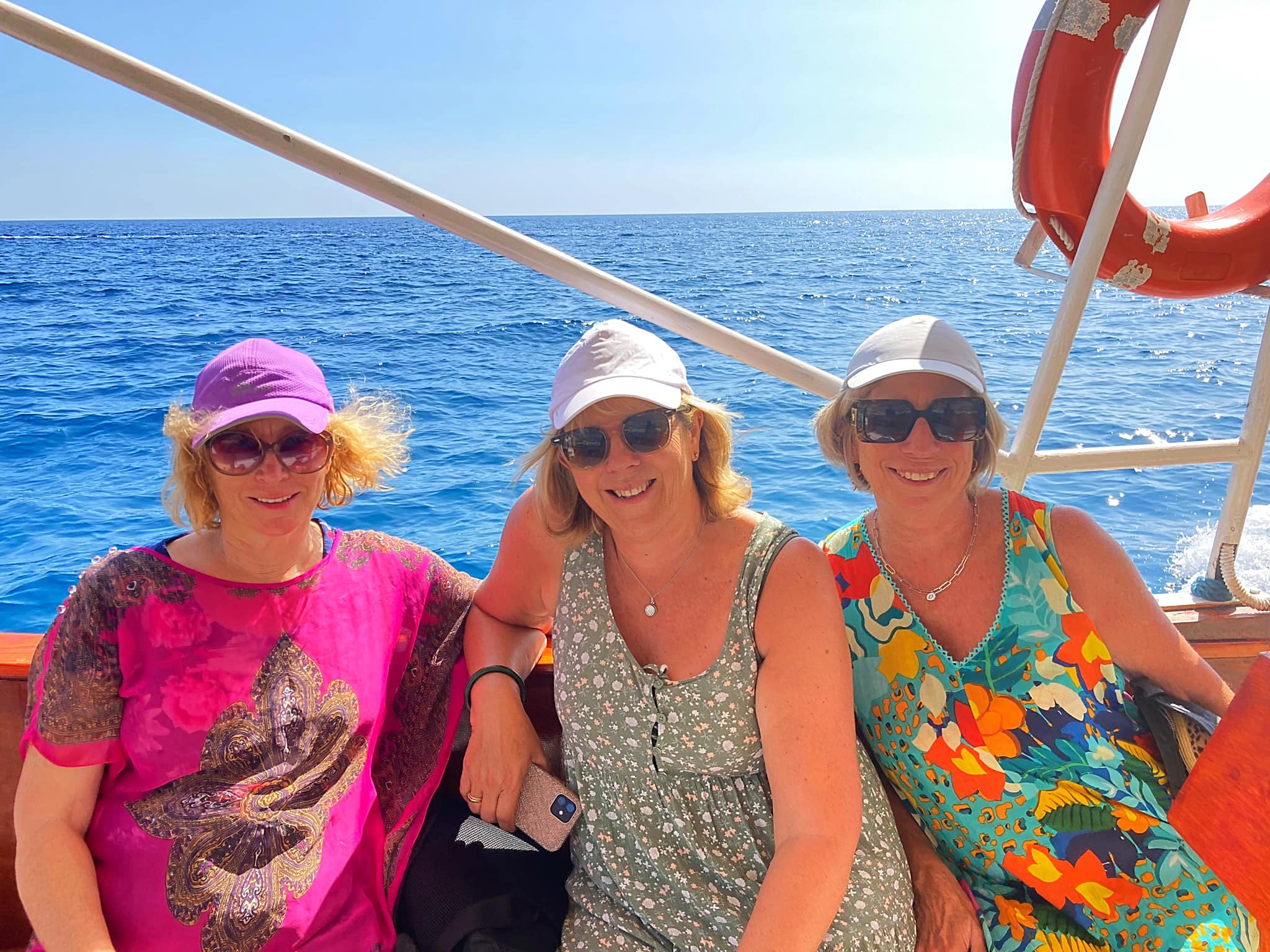
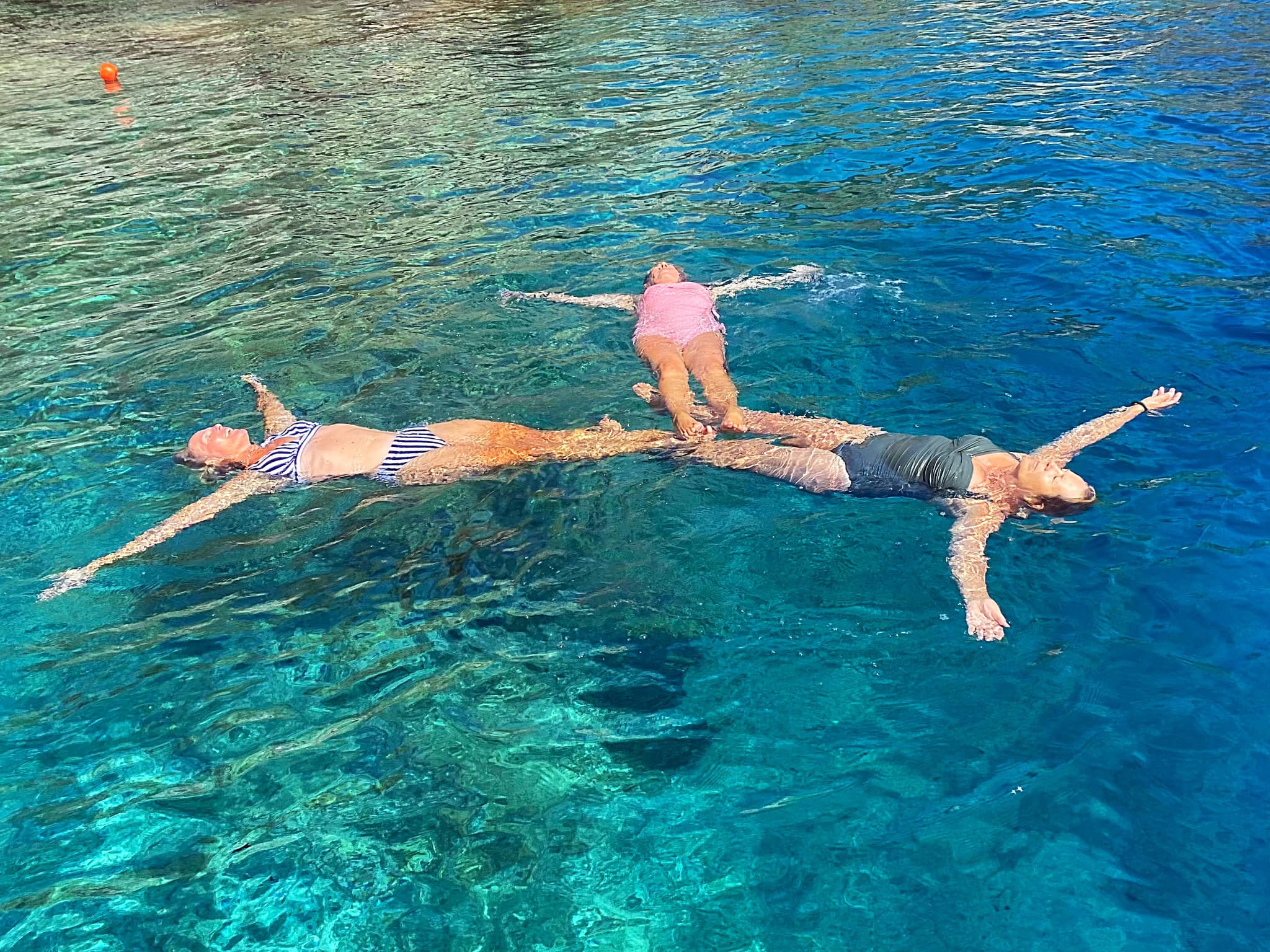
We stopped to have a swim which was amazing – the water is so clear and warm. On the way back to the port the captain cranked up the music and a bit of dancing took place. The captain even put on a bit of a show and may or may not have had a little dance with one of the Bella’s . We met some lovely people on our tour from Wales, the UK, Scotland, Australia, Italy and Israel.
Parking is a bit of an issue in Italy. Most of the time the parking machines don’t work and the parking buildings on Google maps don’t exist or are closed. The Italians just seem to park wherever but we’re a little nervous to do this. Anyway, today we were attempting to use a parking machine when a guy on a push bike came along and told us to follow him to a parking lot. We went down a dusty alley and he told us it was EU5 to park for the day. Jo was suspicious that it was a scam but we were running late for the boat tour so we went with it. We were all a little nervous that either our car would be gone when we got back or they would demand a ransom.
We enjoyed a lovely lunch after the boat trip before nervously heading back to the car. After overshooting the entrance to the dusty alley and some confusion as to whether we were on the right street, we located the parking lot – another guy with his push bike was sitting there this time. Our car was also still there and no ransom was demanded  .
.
On the way home we stopped at the supermarket for Prosecco and tonic supplies as well our first gelato on tour. It has been the best day, topped off by a convincing All Blacks win which we managed to watch on my laptop.















Bella’s on Tour – Sicily – Caltagirone & Valley of the Temples
A big day on the road for the Bella’s today.
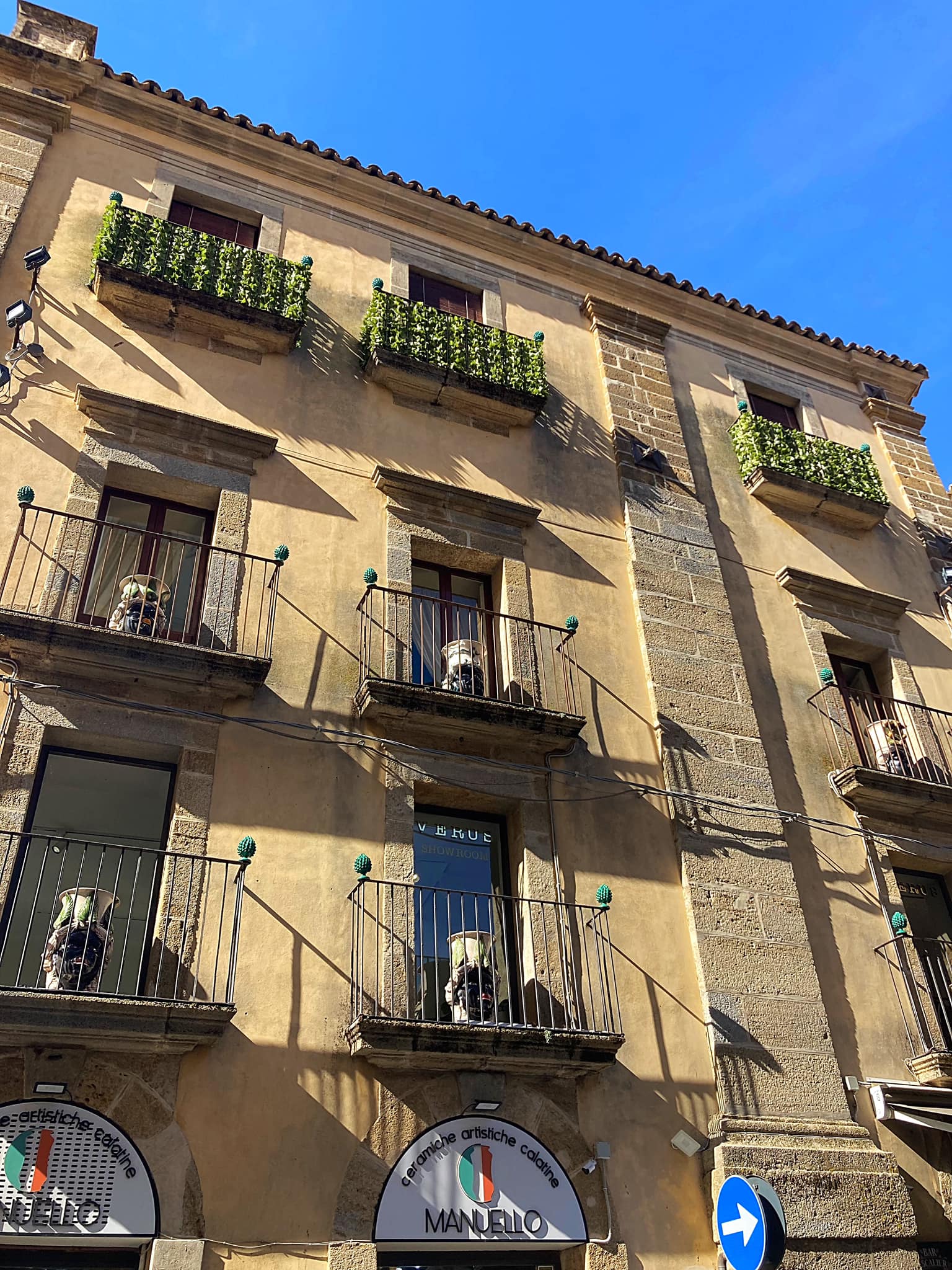
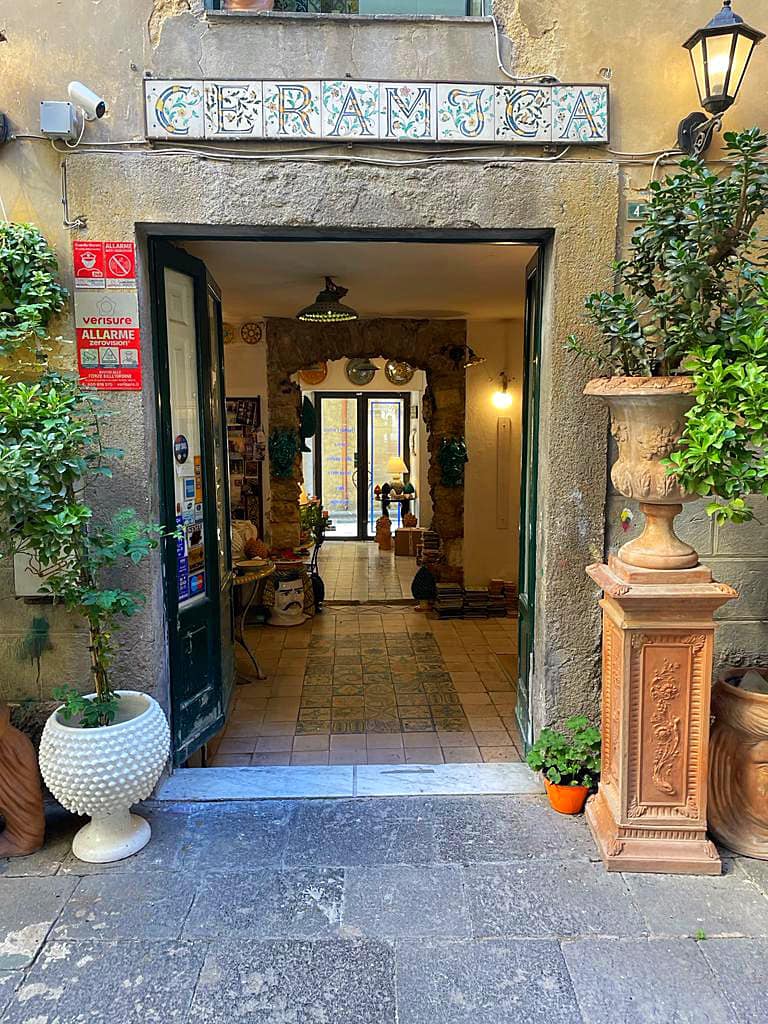
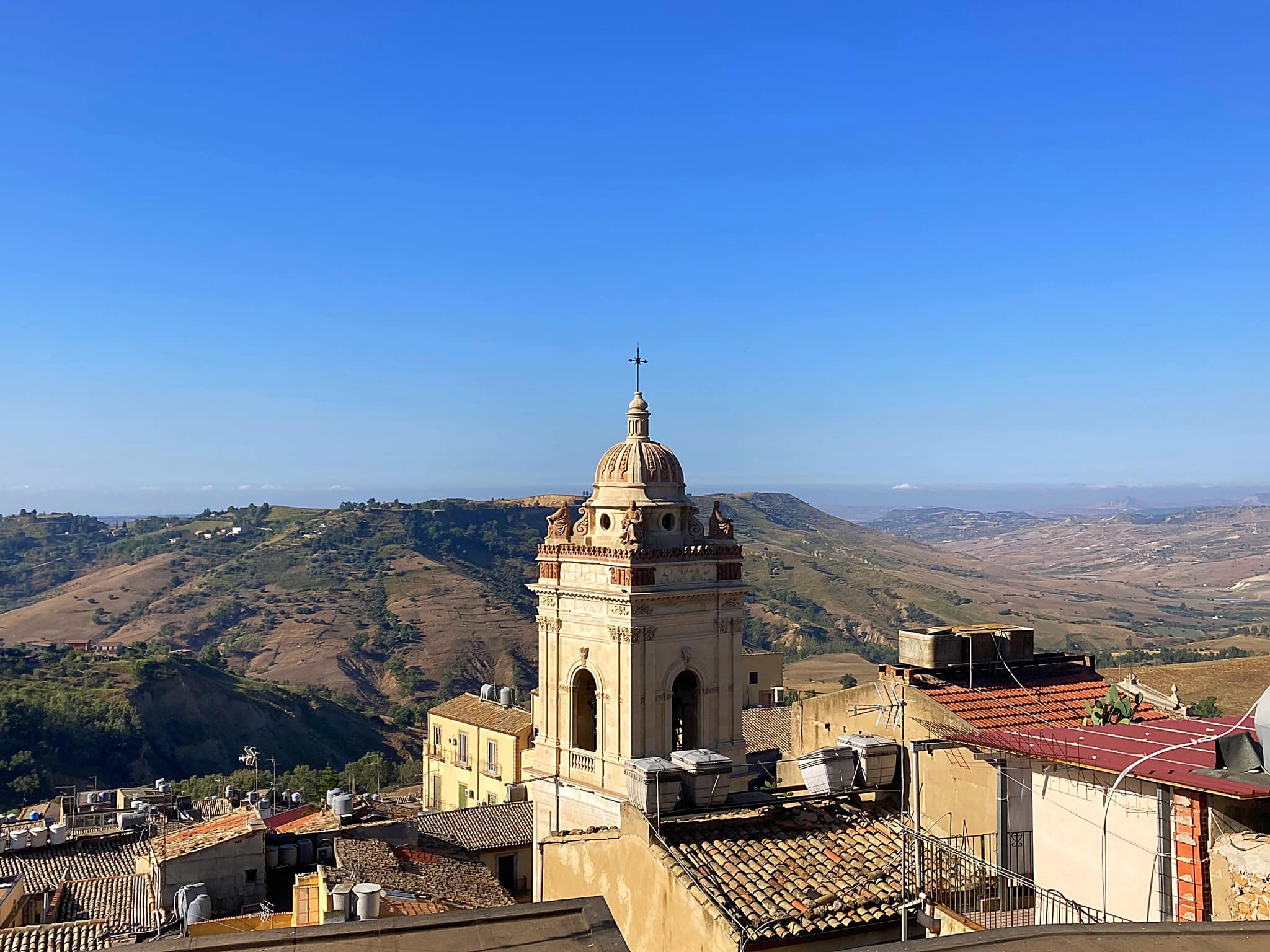
First stop was the village of Caltagirone which is famous for its ceramics. Take one look at the landscape around Caltagirone, and you’ll understand why ceramics became the destiny of this hilltop town. For two millennia, the clay has meant a living for the people of Caltagirone. The word Caltagirone itself derives from the Arabic phrase Qal’at al Ghiran, or Rock of the Vases, which, according to legend, is the name its medieval inhabitants gave it.
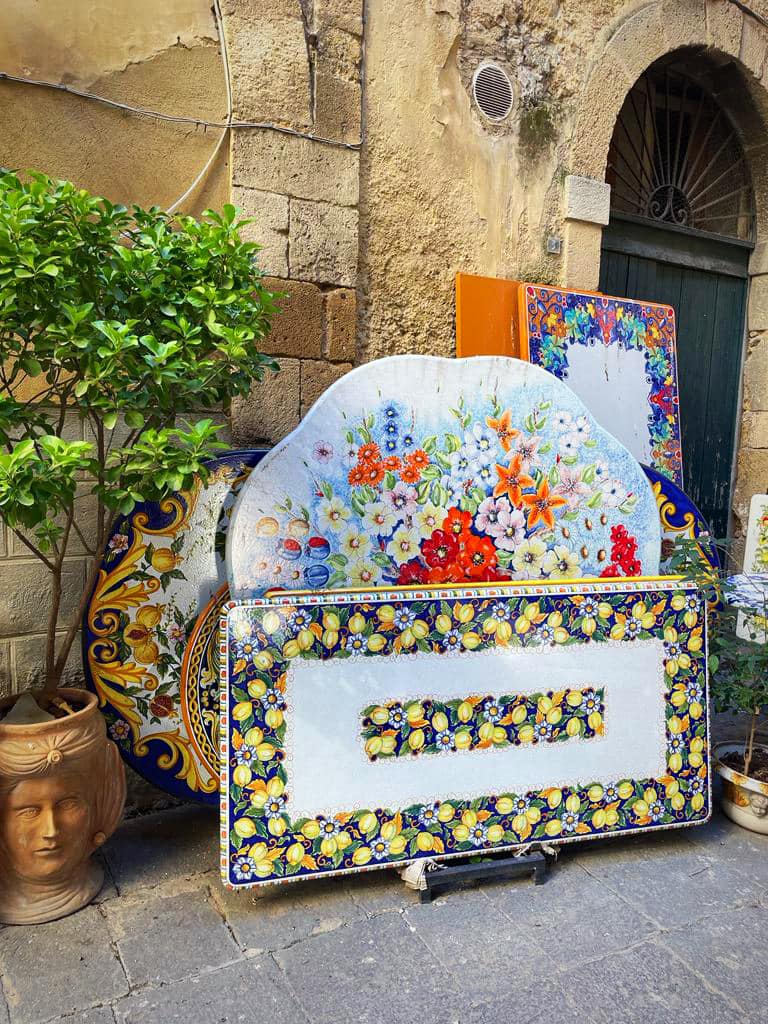
Today, Caltagirone is the center of an uncomplicated, exuberant ceramics tradition. The designs are bold and brash, with a palette dominated by blues, greens and yellows and big, bold designs. This pottery exudes a sense of warmth and cheer that feel as if they could only exist on Sicily.
On Sicily, ceramic art is deeply rooted in time. The ancient Phoenicians and Greeks brought their artisanal traditions to the island, creating amphorae, kraters, kylixes, and other typical ancient wares using the ruddy earth and painted with styled black and red figures. The technique of laying bright, saturated colors against a white tin oxide background developed in the Middle Ages, and may have been introduced into Sicily during the Muslim conquest of the ninth through the eleventh centuries. These early artists left their masterpieces to bake in the hot Sicilian sun, and then left them behind, where they continue to inspire Sicily’s artisans today.
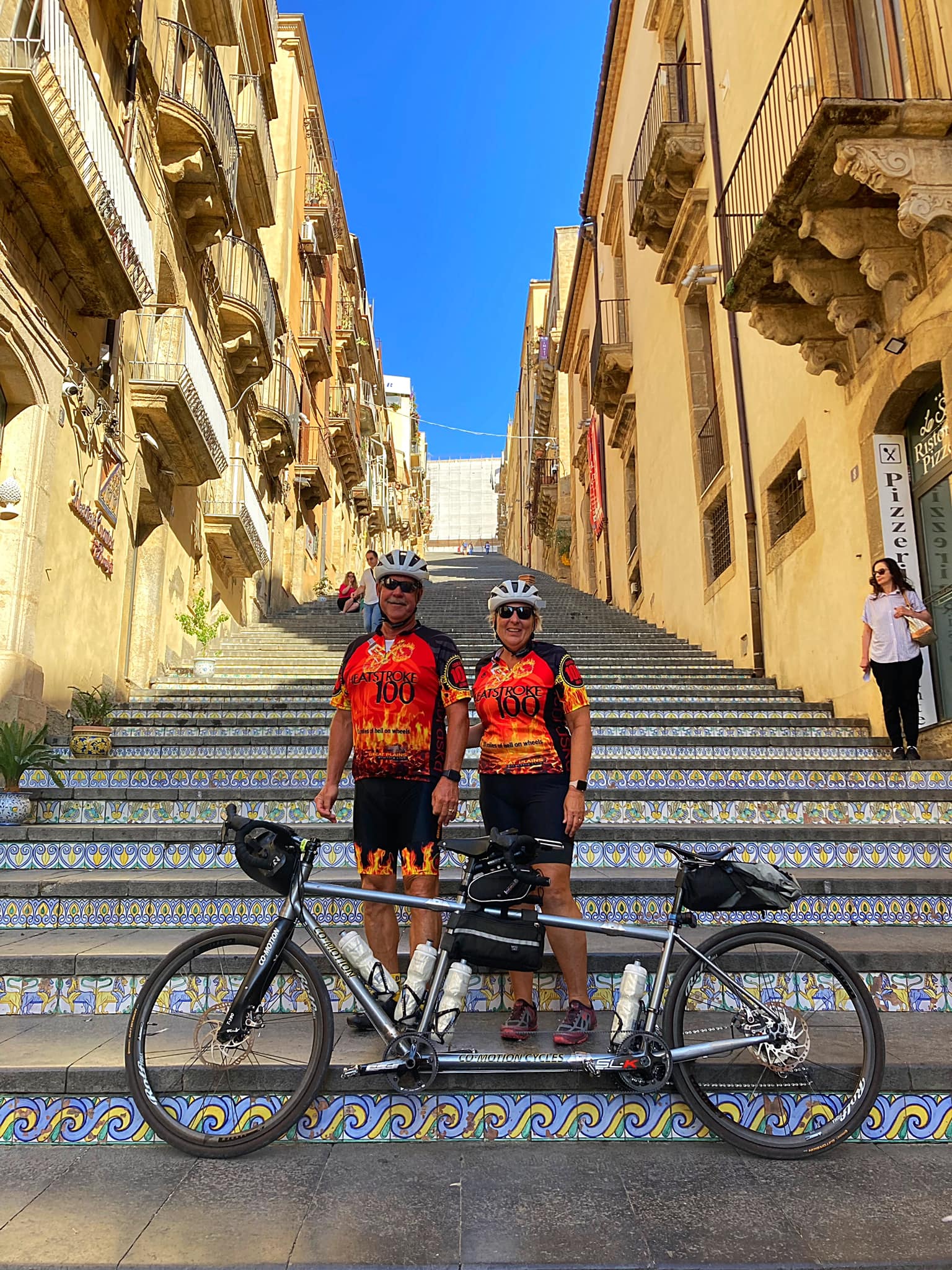
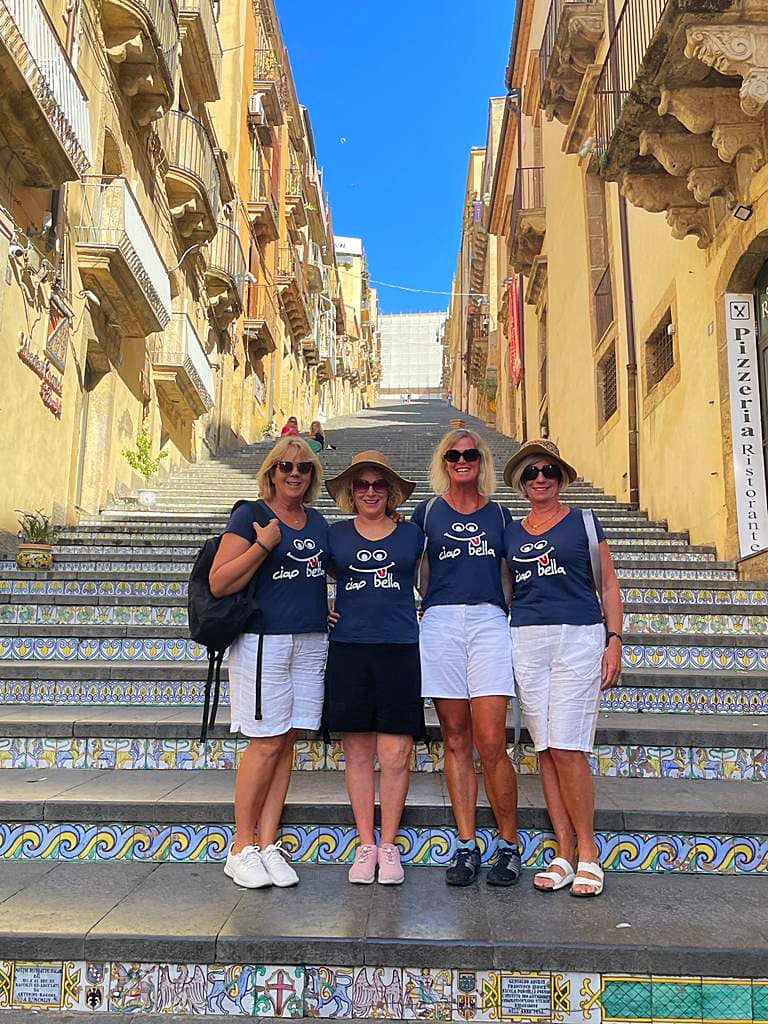
Caltagirone boasts a a set of world famous steps called Scalinata di Santa Maria del Monte which were built in 1606 in order to connect the ancient part of Caltagirone to the new city built in the upper part. The work required 10 years of work and was carried out under the direction of Giuseppe Giacalone. The original staircase had rest areas and a total of 150 steps. Since 1954, the steps leading to the church of Santa Maria del Monte have been entirely decorated with polychrome ceramic tiles, following the ancient local artisan tradition. The figurative themes of the ceramics are floral or geometric, and represent the Arab, Norman, Angevin-Aragonese, Spanish, Renaissance, Baroque, eighteenth-century, nineteenth-century and contemporary styles.
We met this group of cyclists on the stairs. They were all riding tandems and there were 17 of these tandems doing a 12 day cycle tour around Italy. It’s a volcanic island with many hills, crazy Italian drivers and it is very hot. And people thought I was mad cycling across Europe
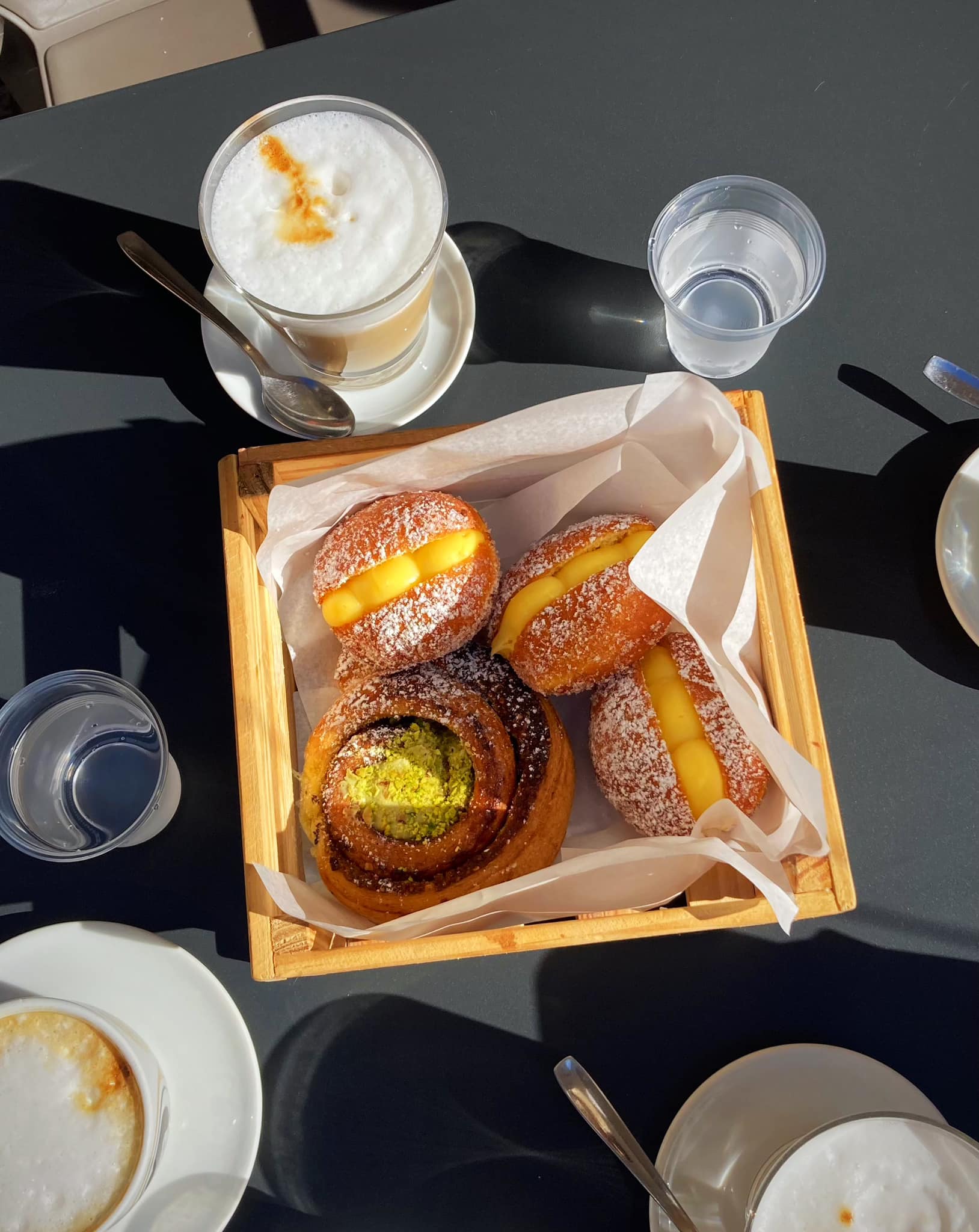
Coffee, treats and a bit of retail therapy were enjoyed before we set off to the Valley of the Temples some two hours away.
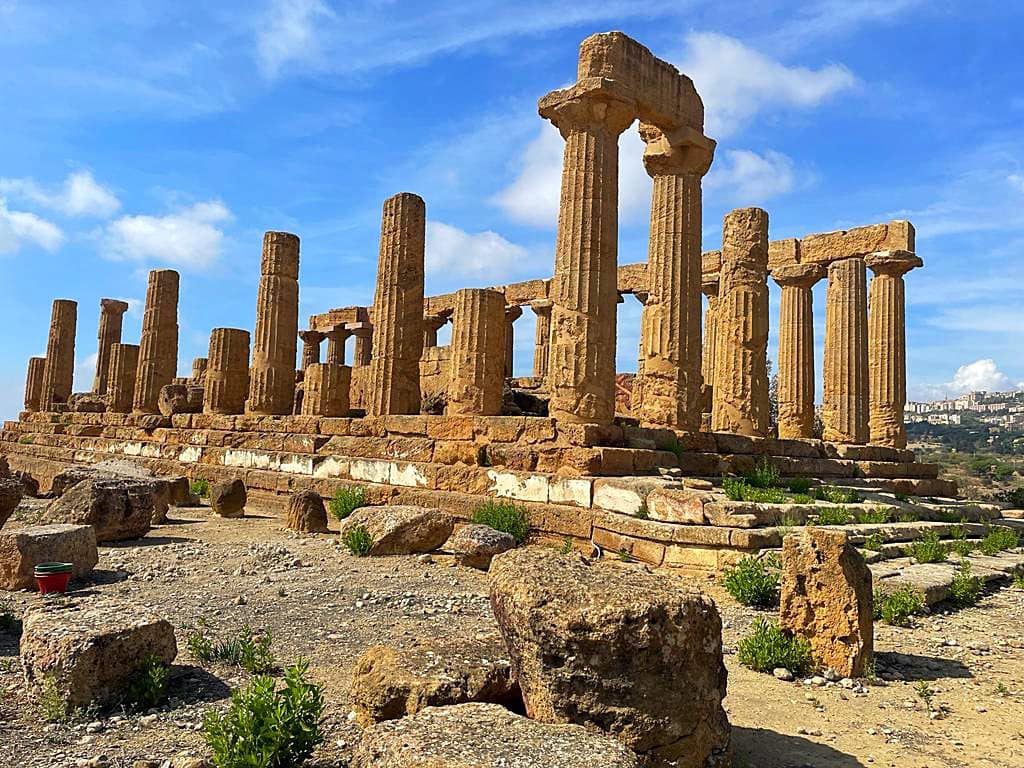
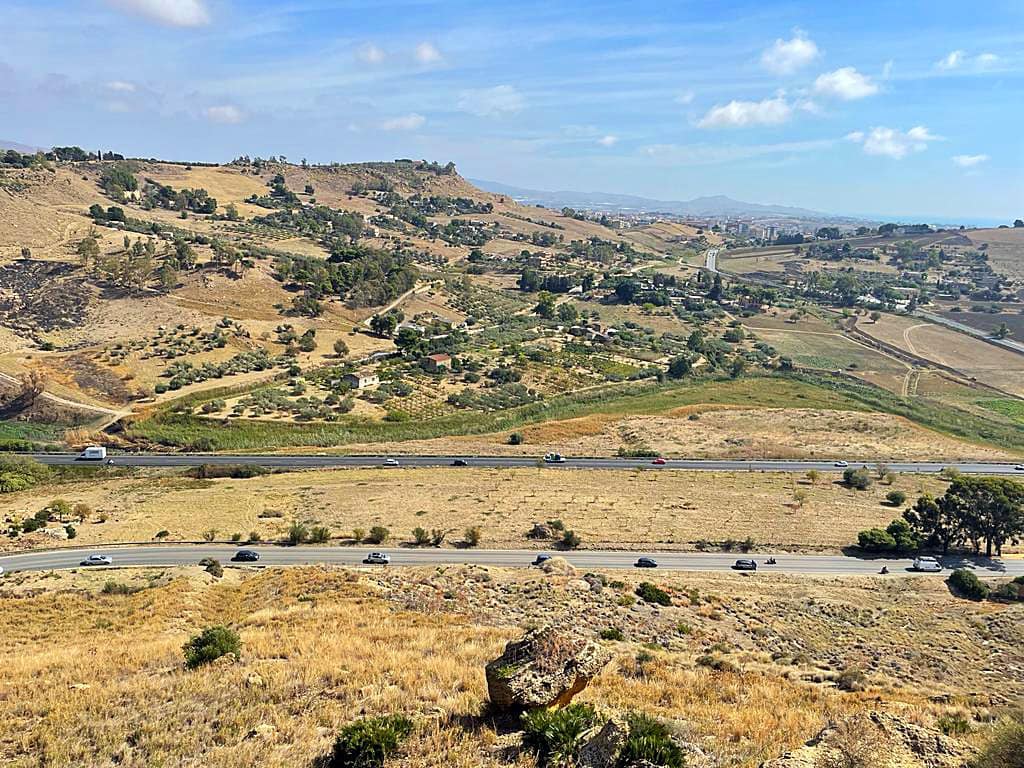
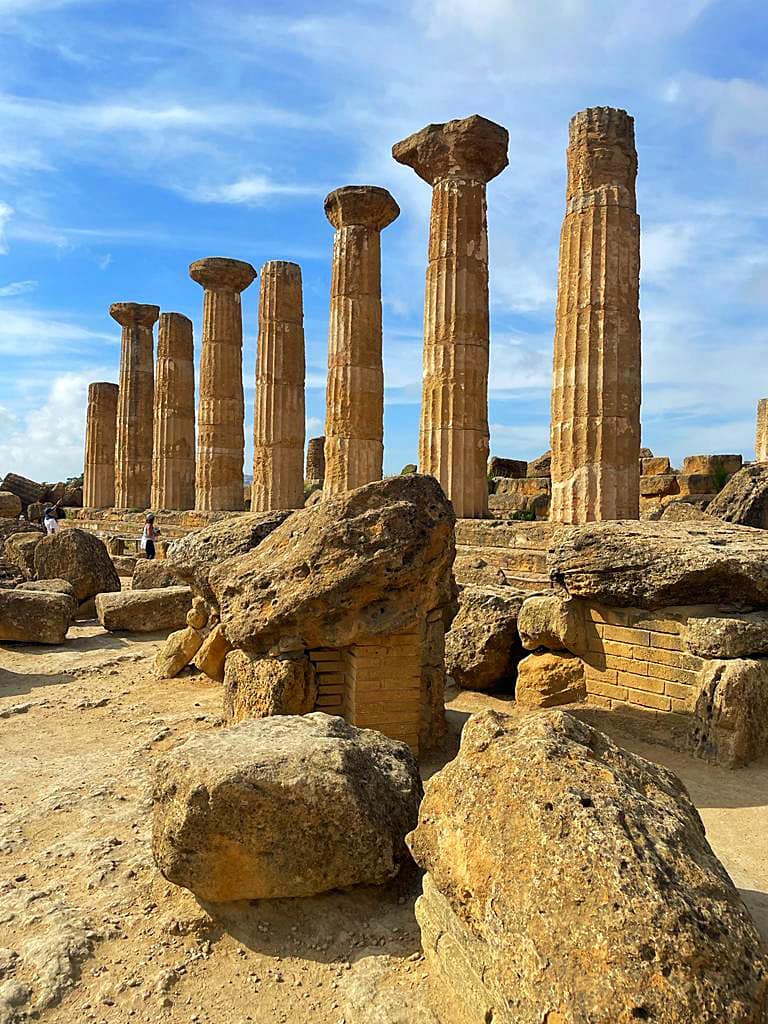
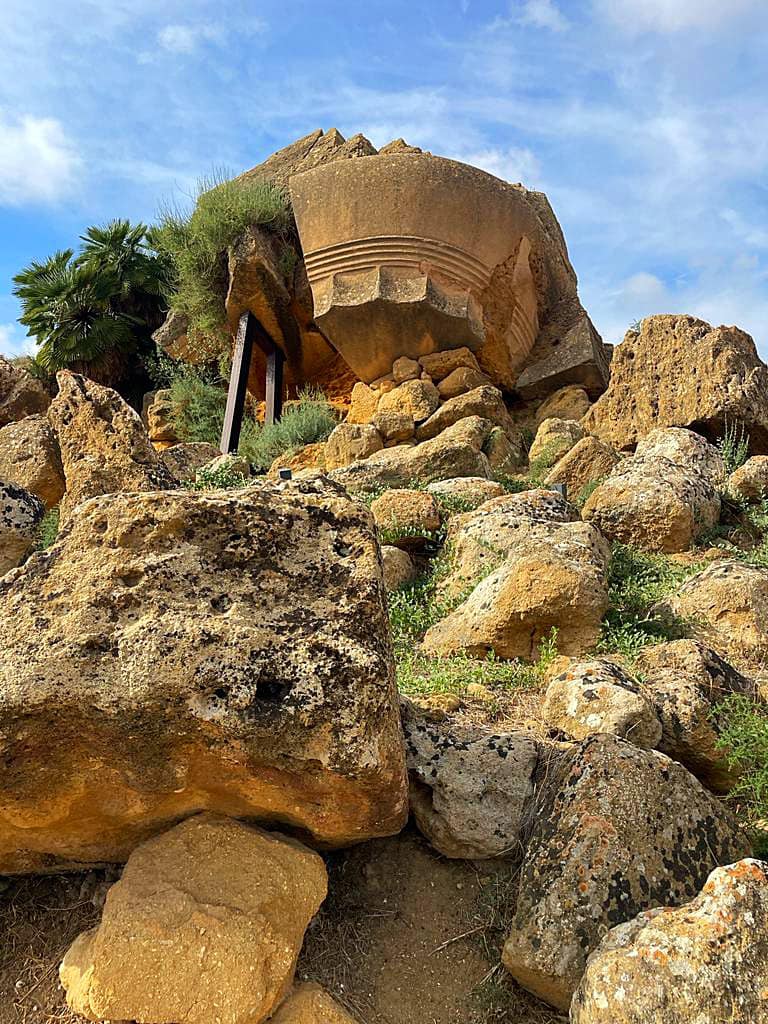
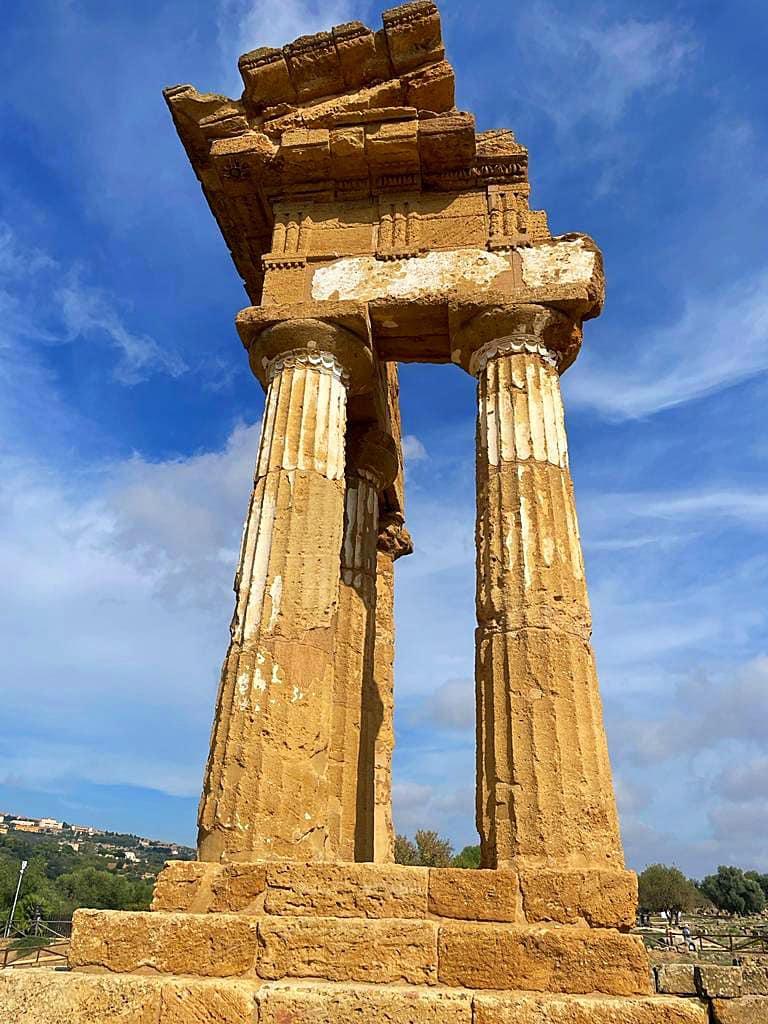
The Valle dei Templi or Valley of the Temples, is an archaeological site in Agrigento (ancient Greek Akragas), Sicily. It is one of the most outstanding examples of ancient Greek art and architecture of Magna Graecia, and is one of the main attractions of Sicily. The term “valley” is a misnomer, the site being located on a ridge outside the town of Agrigento.
Since 1997, the entire area has been included in the UNESCO World Heritage List. The archaeological and landscape park of the Valle dei Templi, with its 1300 hectares, is the largest archaeological park in Europe and the Mediterranean basin.
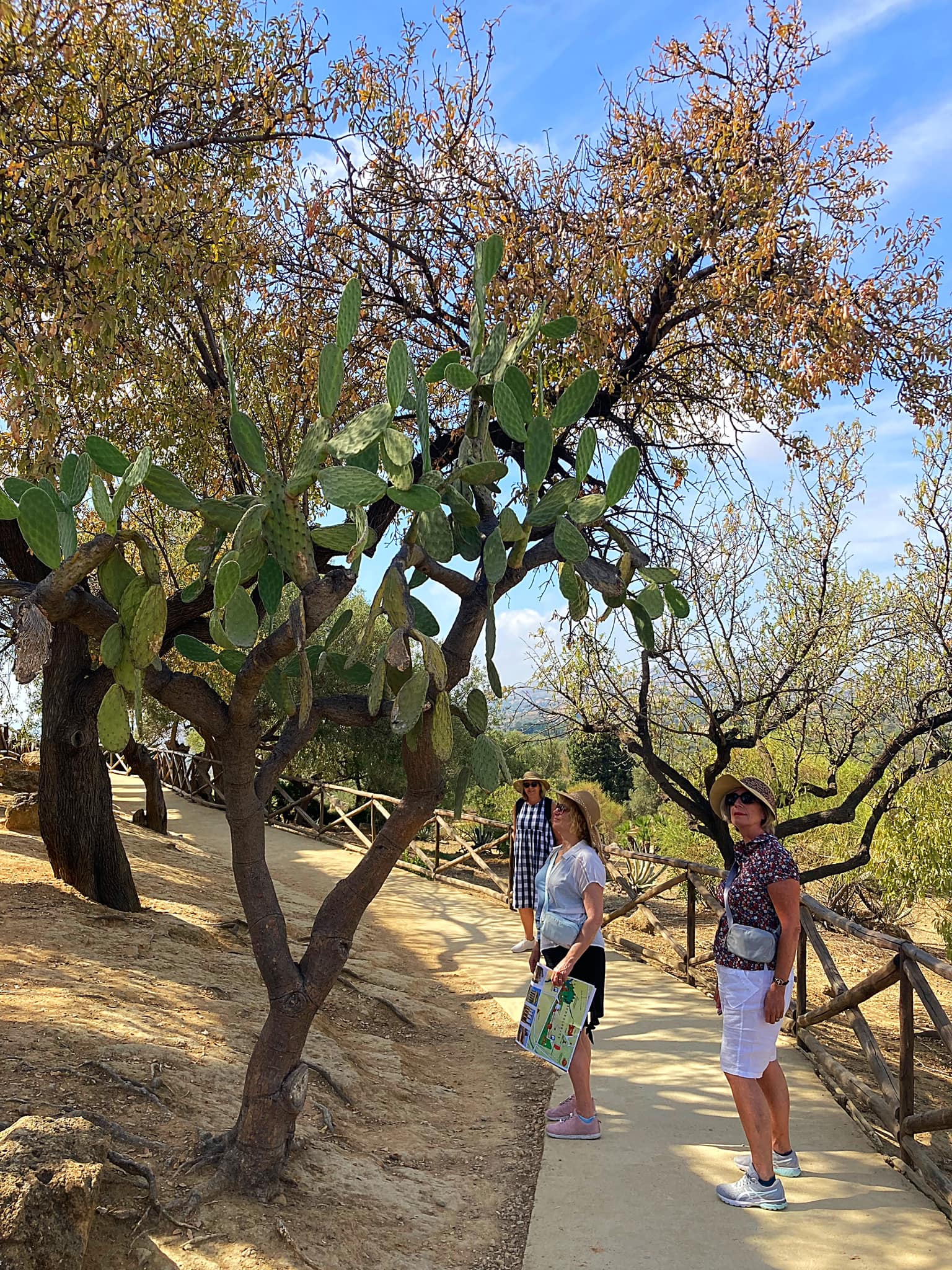
The remains are in such good condition and it was amazing to get so close to them. The Valley includes the remains of seven temples, all in Doric style. Temple of Juno, Concord, Hercules, Olympic-Jupiter, Vulcano, Castor and Pollux.
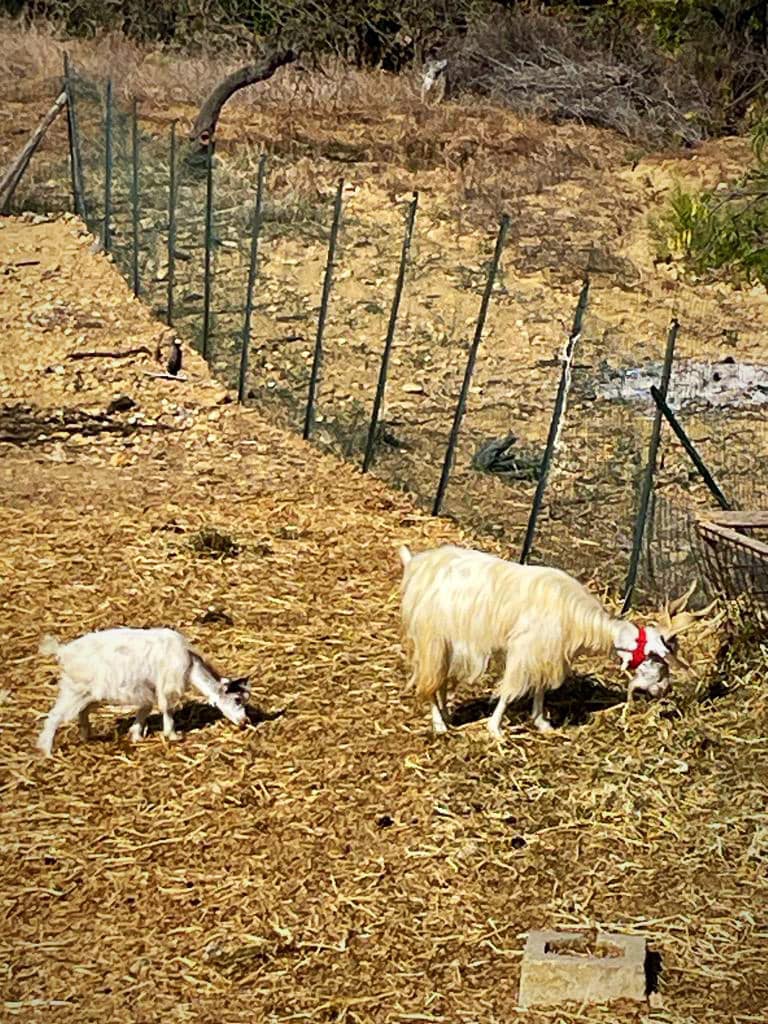
We saw some GIrgentana goats which are endemic to the area. The Girgentana breed has its ancient origins in the Markhor or Falconeri goat (Capra falconeri), from the English naturalist Falconer, who first noticed it in northern Afghanistan and Balochistan. According to some authors the import of the first specimens of the goat is attributed to the Greeks, but other writers attributed it to the Arabs. It was bred and selected in Sicily, particularly in the south western area. Its name derives
from Girgenti (the name of the city Agrigento). It is a middle-sized goat with a long and thick white coat, sometimes with brownish markings. Its milk, renowned for its good ratio of lipids and proteins, is intended for direct consumption. This goat breed is threatened of extinction due to its small number of specimens and breeders.
We then had a two hour drive back to the west coast. We decided to go to a little seaside village called Brucoli for dinner on the way home. Unfortunately the restaurant we were going to go to was closed (although Google said it was open) so we ended up at a pretty fancy place called Al Castello.
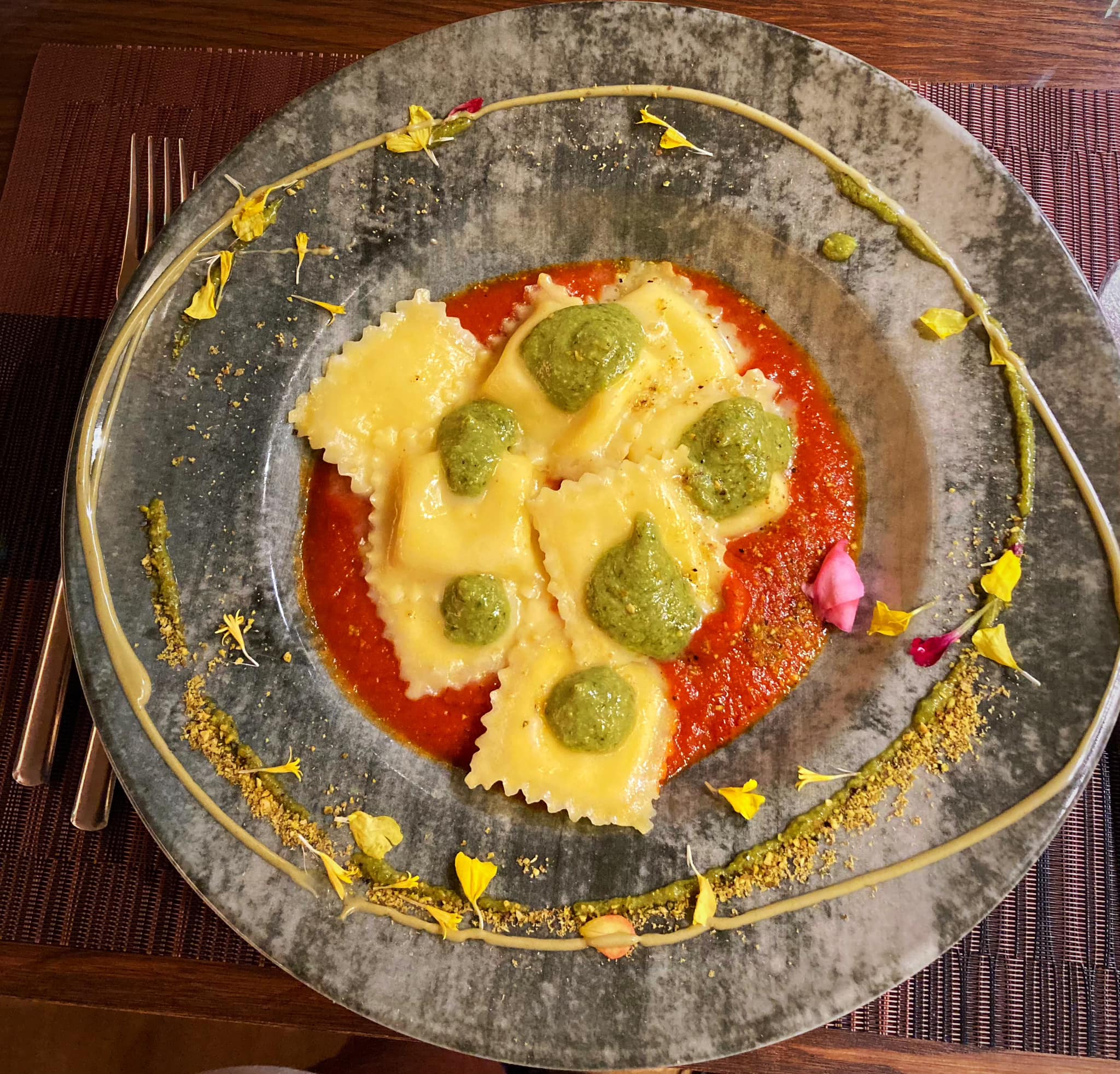
We weren’t really dressed for such a nice restaurant but we were allowed in at 7.30pm and not a minute before, despite the staff sitting around playing cards. Most restaurants in Italy open between 7pm and 8pm. Despite the service being pretty officious the food was amazing – burrata ravioli in a tomato soup (Jo & I) and salmon steak with pistachio crust on cream of sweet potato and caramelised onion (Kaye & Debs).











Bella’s on Tour – Sicily – Serafico Terra Di Oilio e Vino
Our last full day on the beautiful island of Sicily. What an absolute treat it has been.
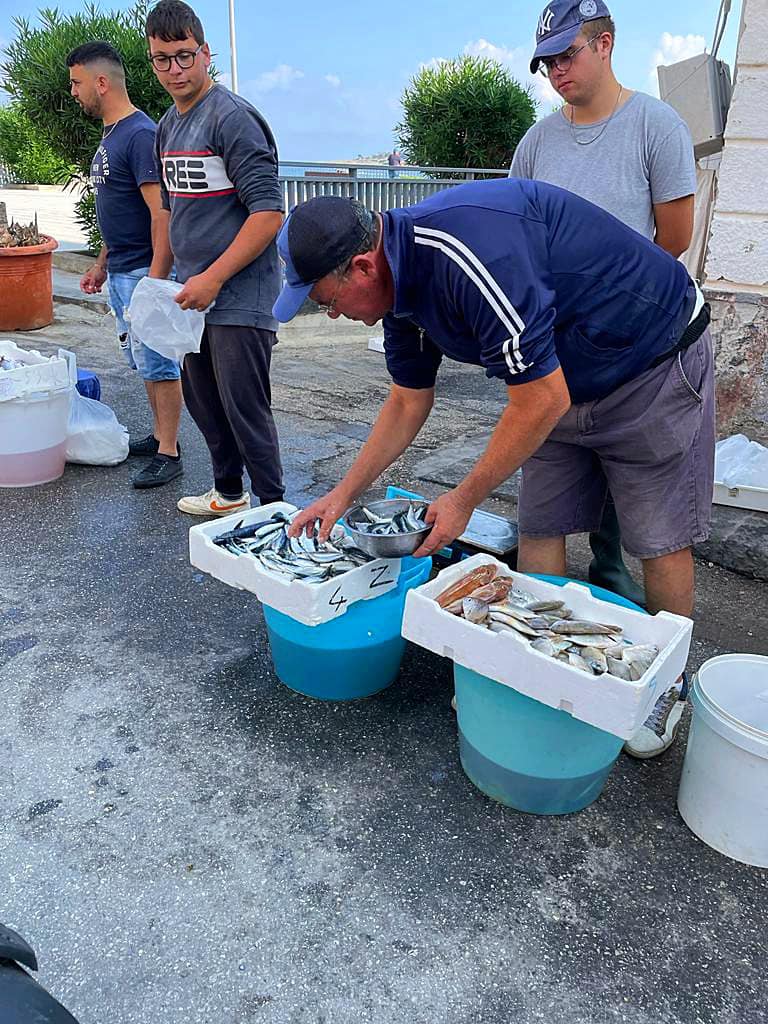
A relaxed start to the day with a return trip to Brucoli for a walk and coffee. It was nice to see it in the daylight and it was a hive of activity with the local fisherman bringing in their catches for the locals to come and buy on the side of the street. One such fisherman took quite a liking to Kaye and insisted on having a photo with her.
It was then back home for a swim before heading to Serafico for a late afternoon olive oil and wine tasting on the slopes of Mount Etna. The Serafico production plant / mill and tasting room / shop sit at about 800 metres above sea level. The company is family owned and has been operating since 1950.
The tradition of the cultivation of olive trees on Etna has its roots in history and legend: the first traces of olive cultivation in Sicily date back to the first millennium thanks to the Phoenicians and later to the Greeks. In this context the presence of the volcano, with its eruptive manifestations, has fed the myth of this crop: the Cyclops Polyphemus, personification of Etna with its only eye injected with the fire, is in fact blinded by Ulysses and companions with an olive trunk.
Overlooking the Gulf of Catania, admiring the Simeto Valley, in the territories of Nicolosi, Ragalna and Santa Maria Di Licodia up to 1,000 metres above sea level, Serafica’s olive groves of Nocellara etnea (olive variety), cultivar queen of the territory, give their extra virgin olive oil an articulated and rich taste.
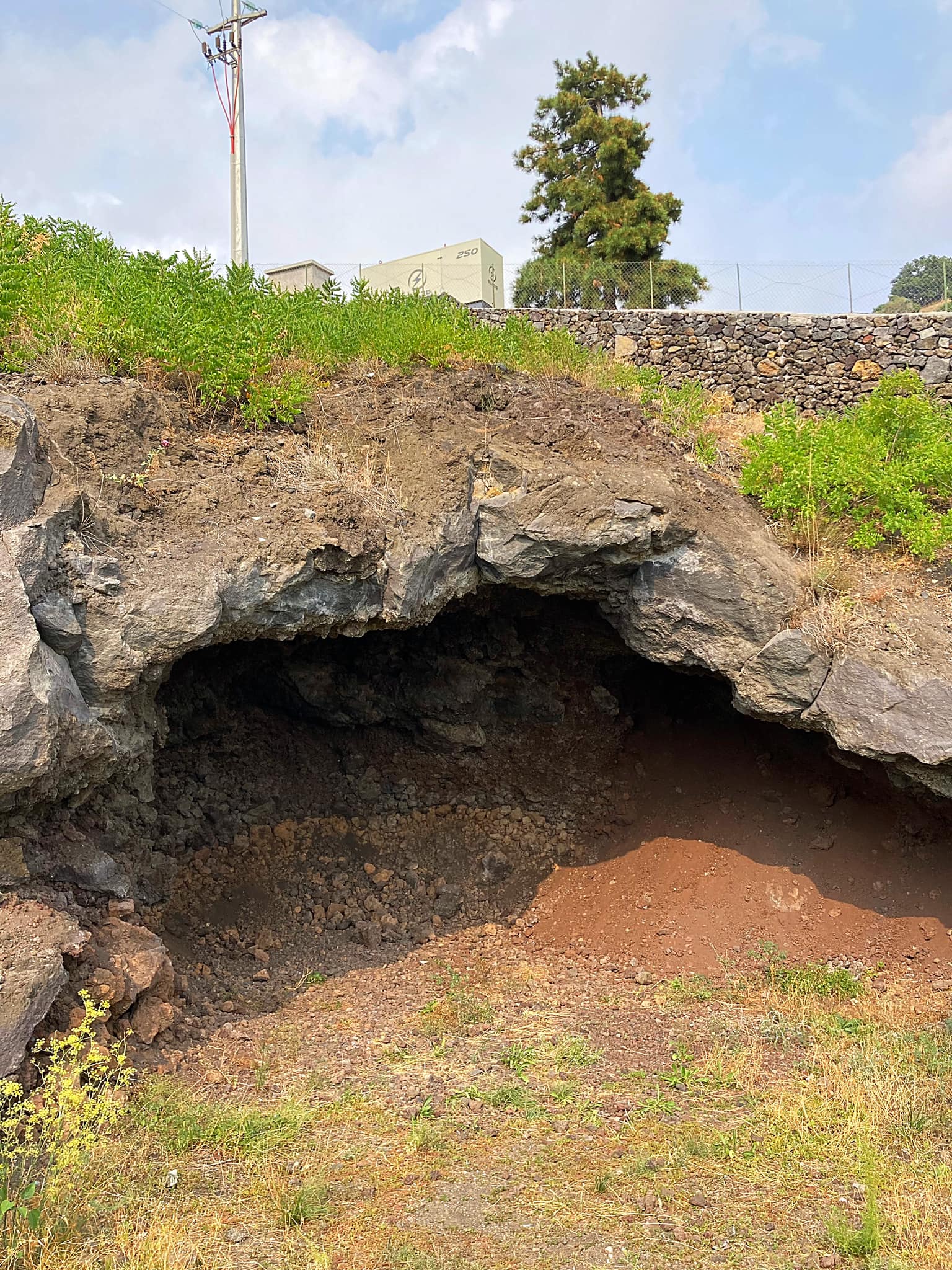
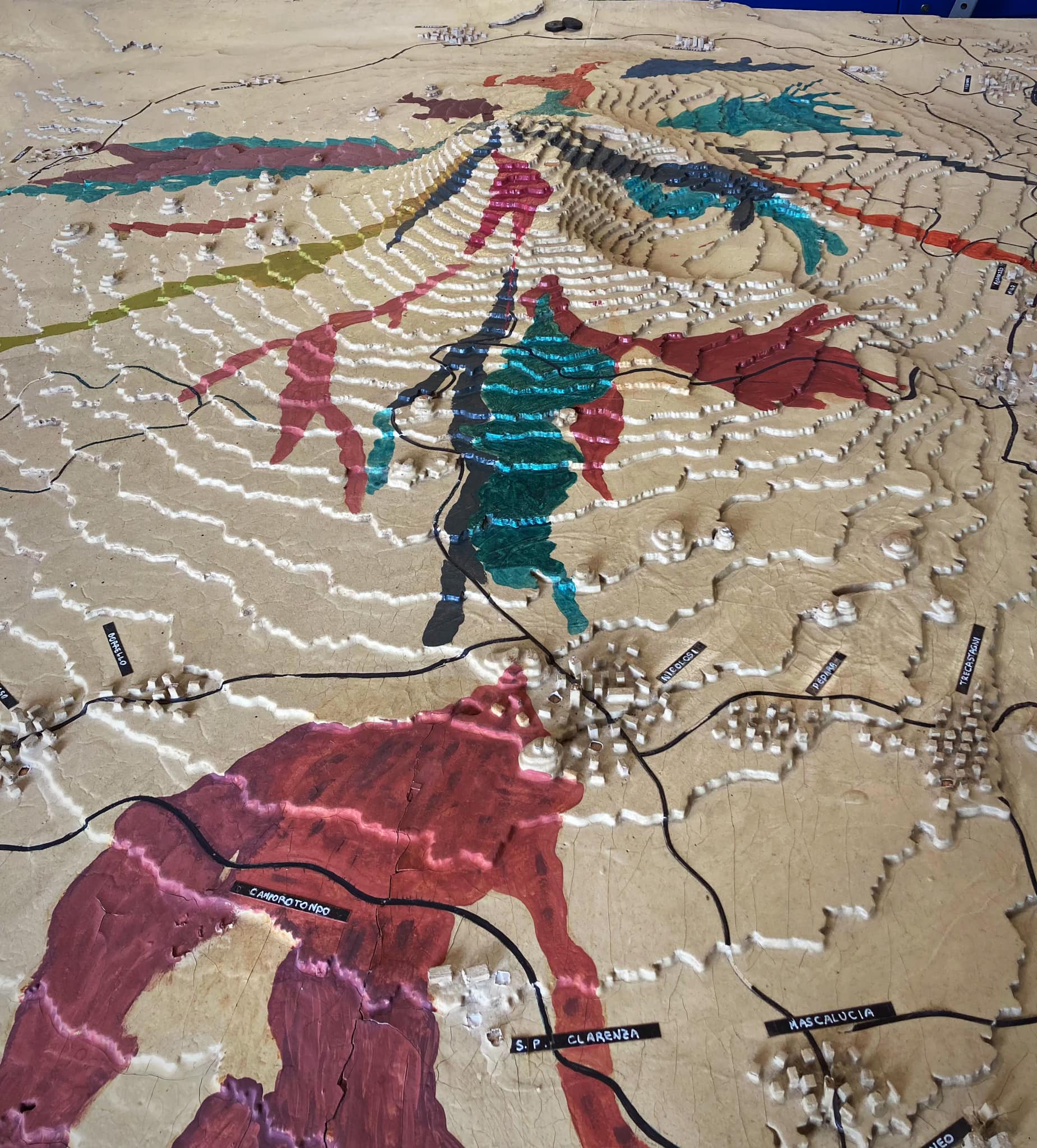
We were met by our host Georgia who first took us to see a cave which showed three distinct layers of soil which were a result of the large eruptions over thousands of years. They have olive trees (40 hectares in total) and vines (15 hectares) at various levels above sea level which influences the taste of both the oil and wine.
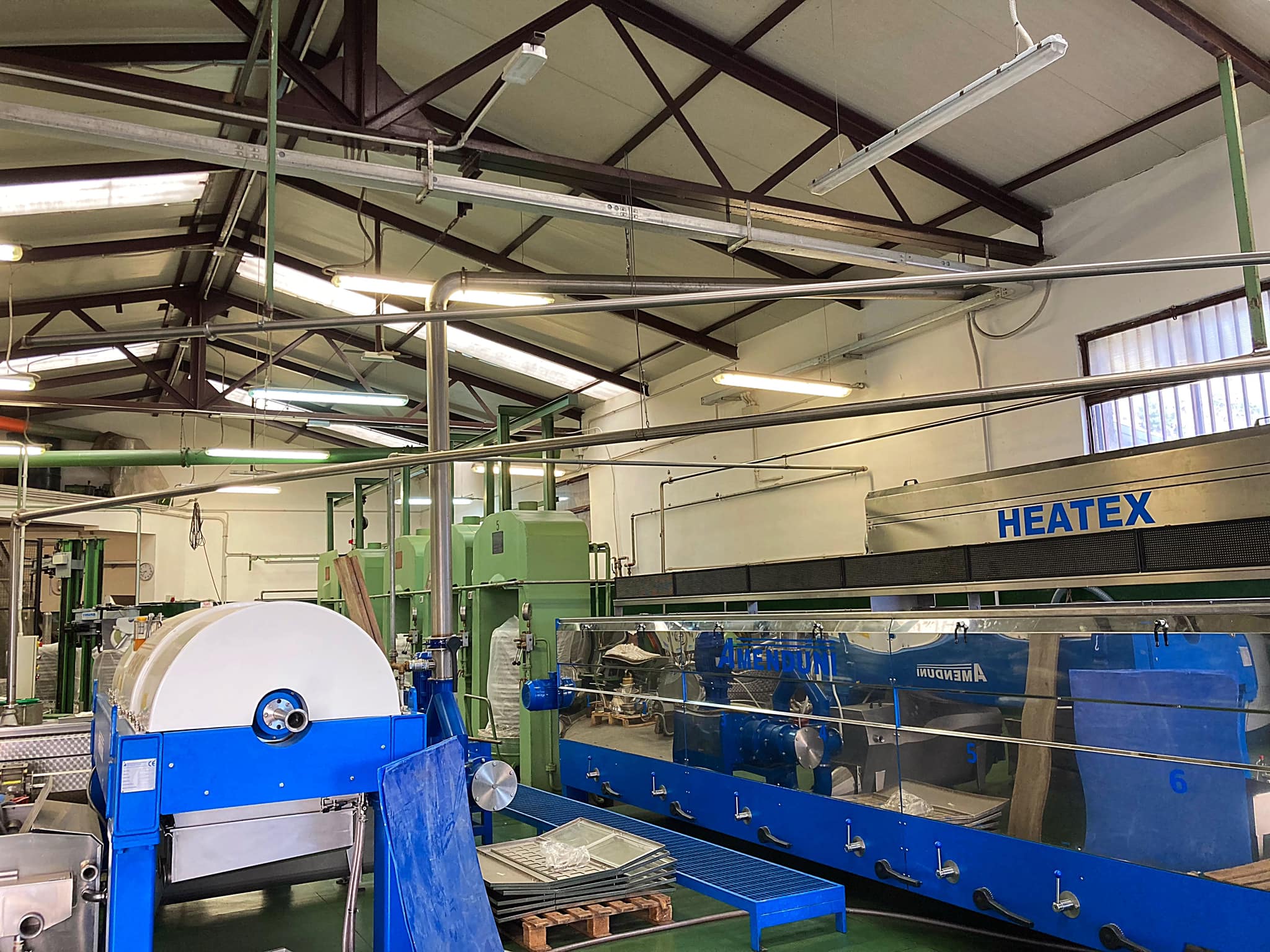
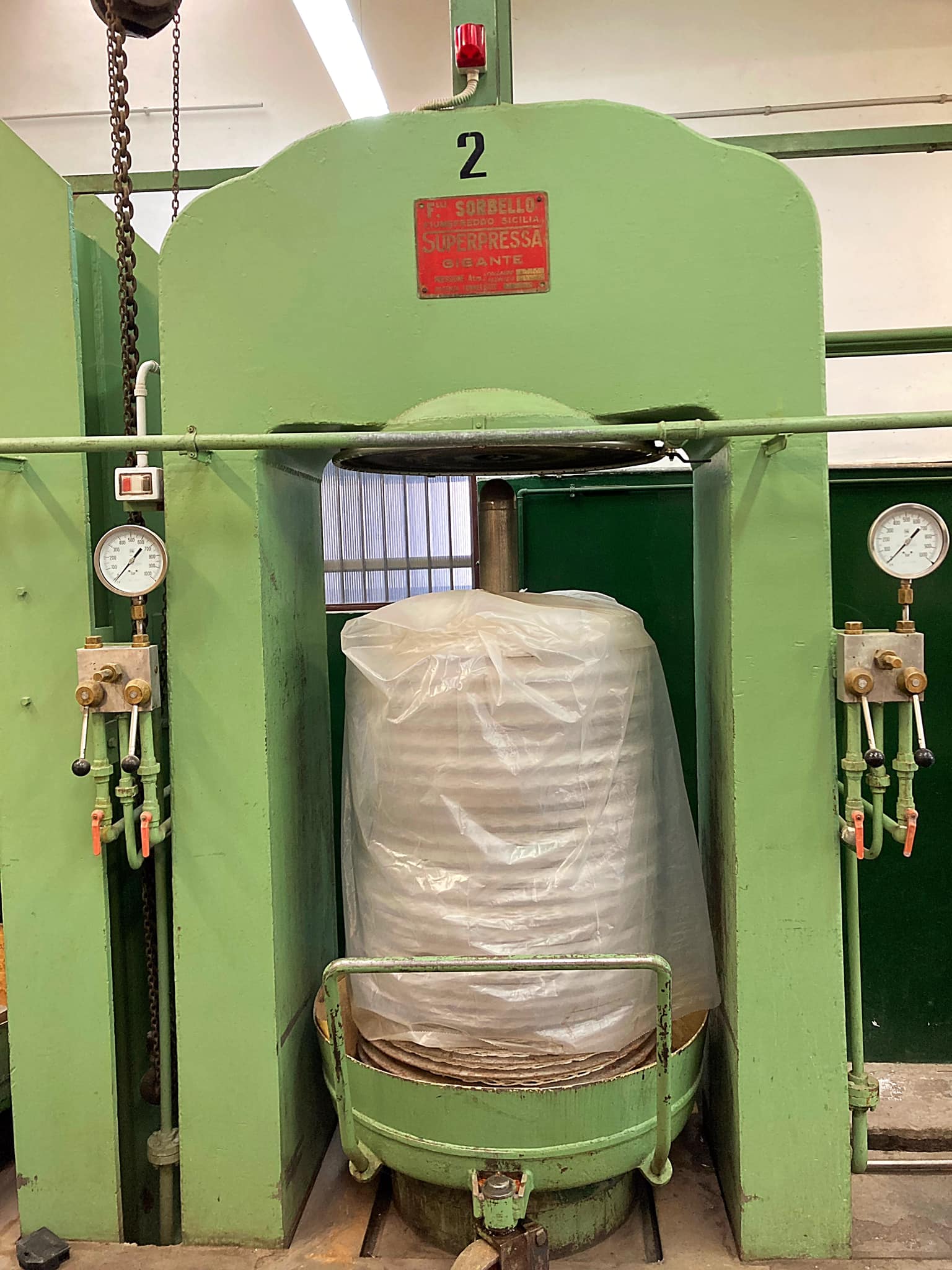
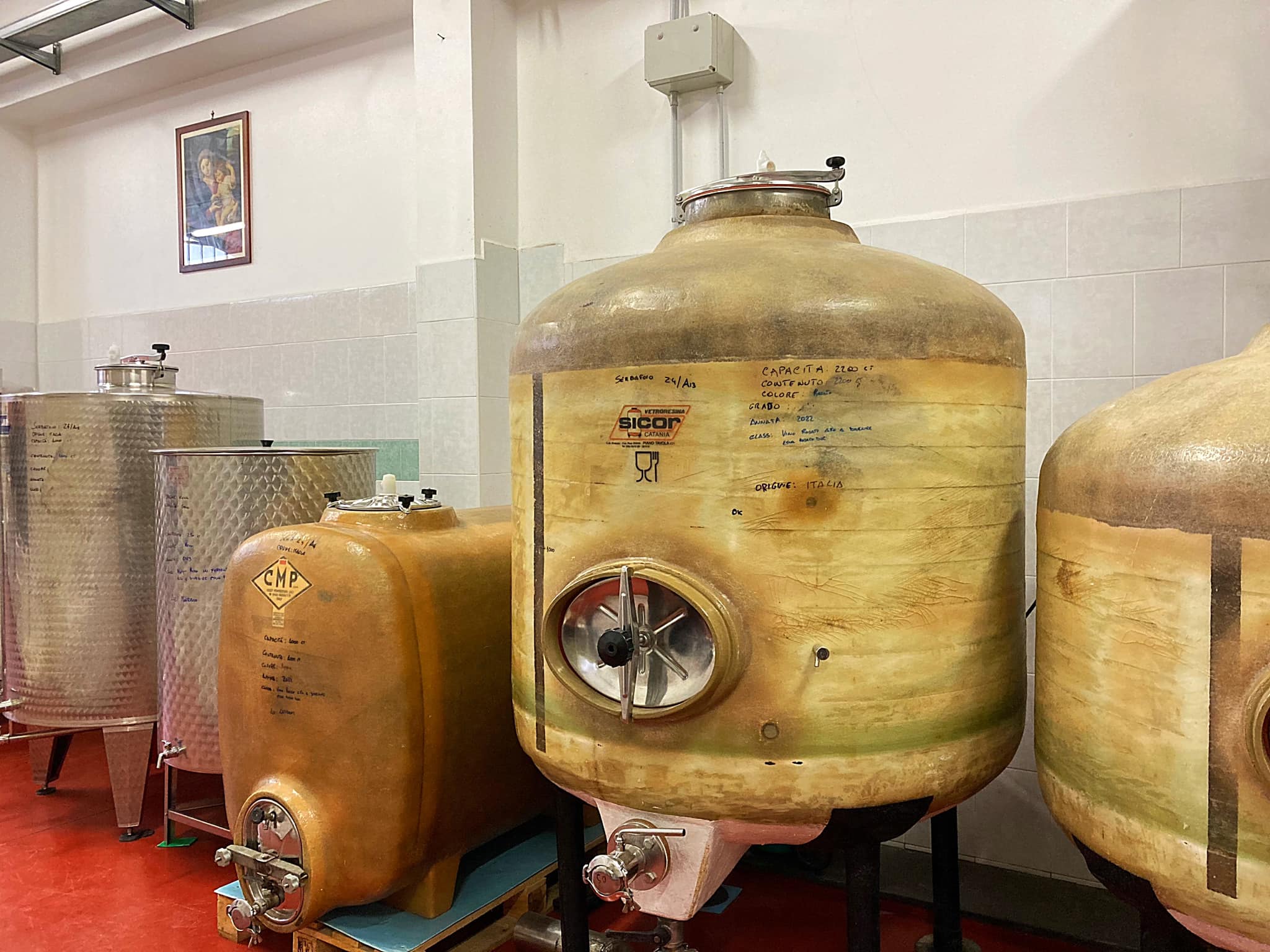
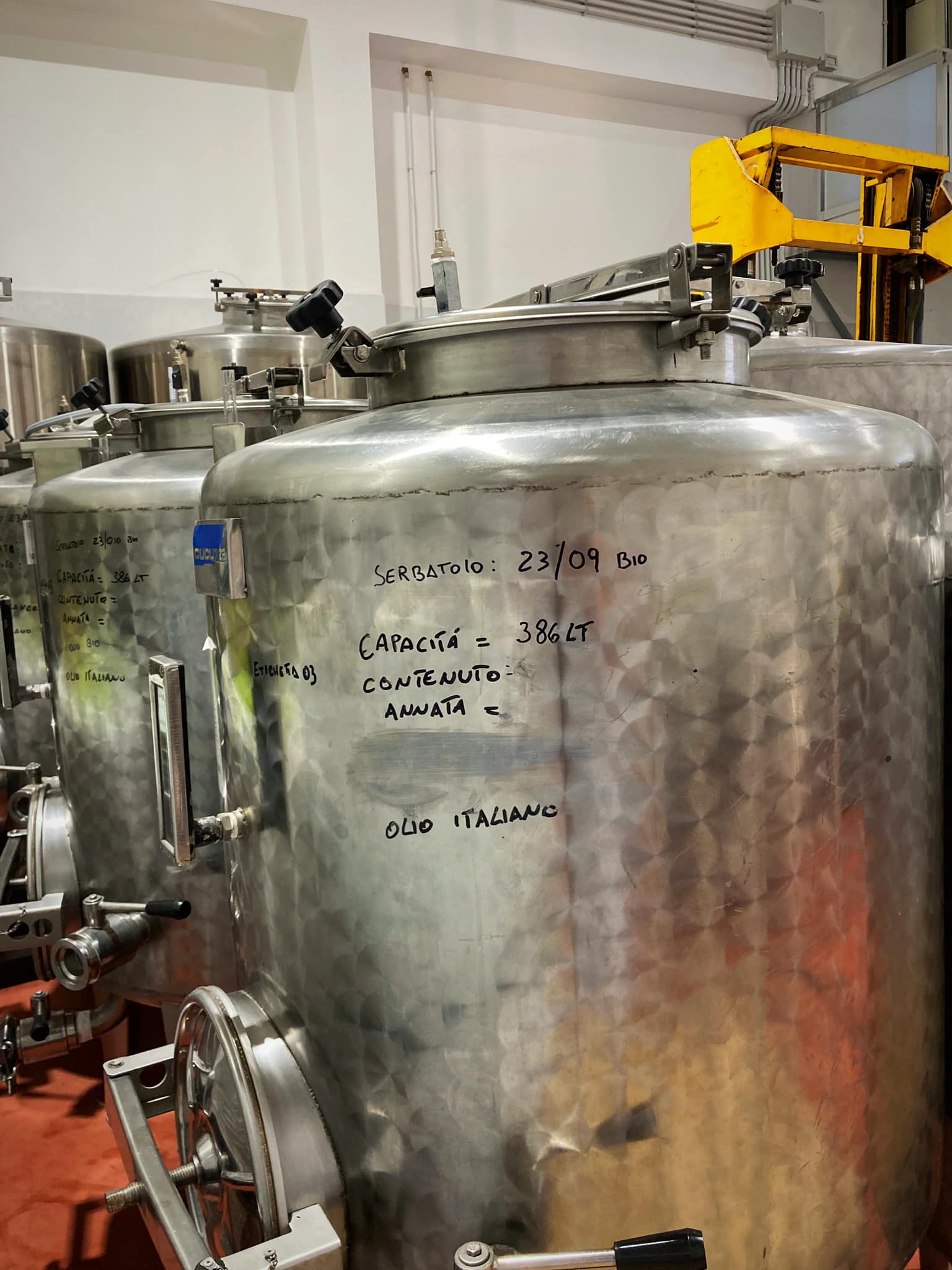
Georgia took us through the olive oil process and showed us the traditional presses versus the new technology. They use both depending on who they are producing the oil for. There are some small growers they contract manufacture for who prefer the traditional press. Interestingly it takes 8 kilograms of olives to make a litre of olive oil. They also leave the nut in through the pressing process – the Nocellara etnea variant of olives are very delicate and the nut adds to the flavour.
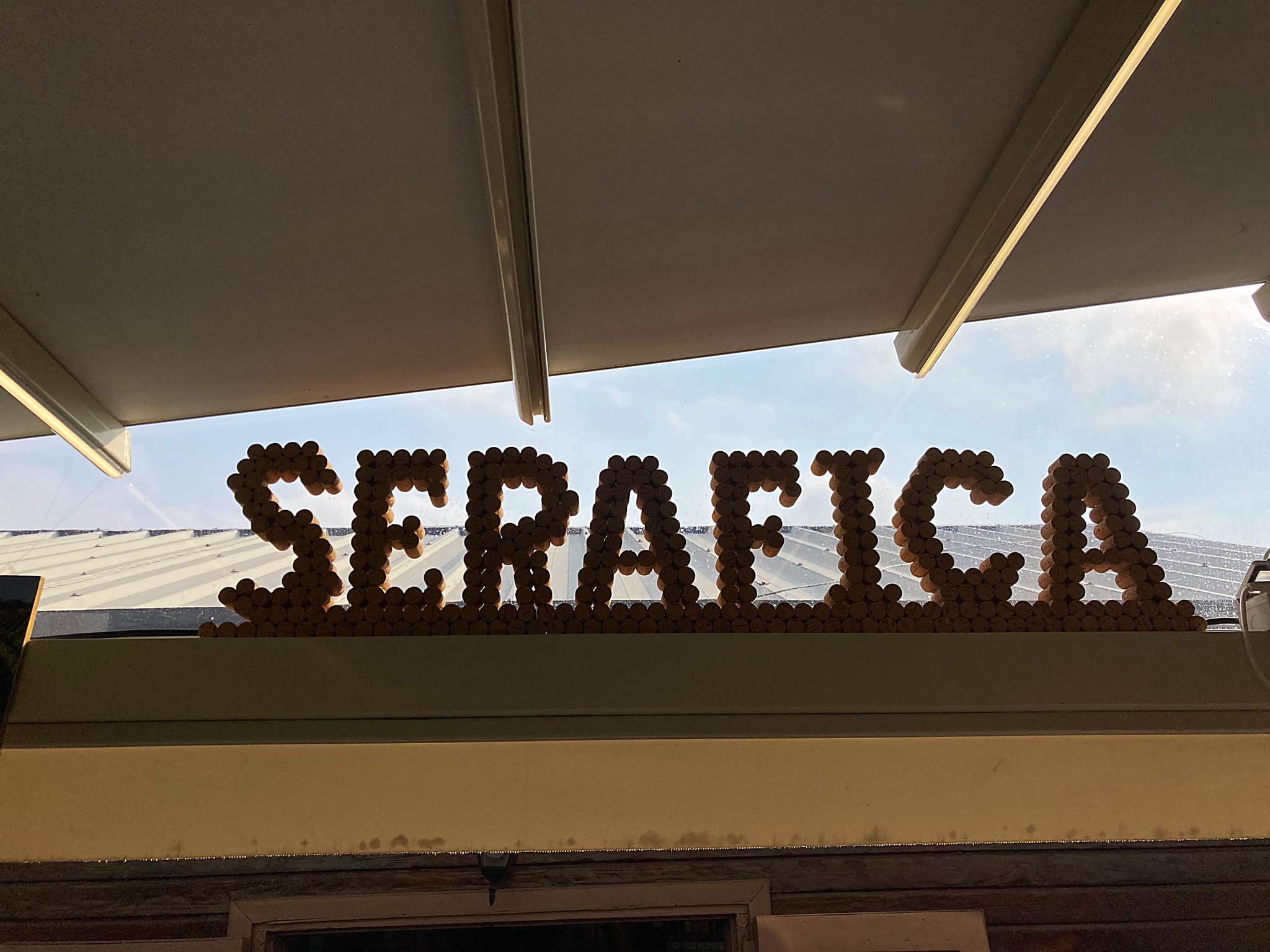
The waste product from the pressing process looks a bit like cork and they sell this to the locals as a source of fuel for their stoves and fires.
The olive harvest period starts about mid October and goes through to December with the higher olive trees being the last to be harvested. They hand harvest the olives and they are pressed straight away to prevent them heating up.
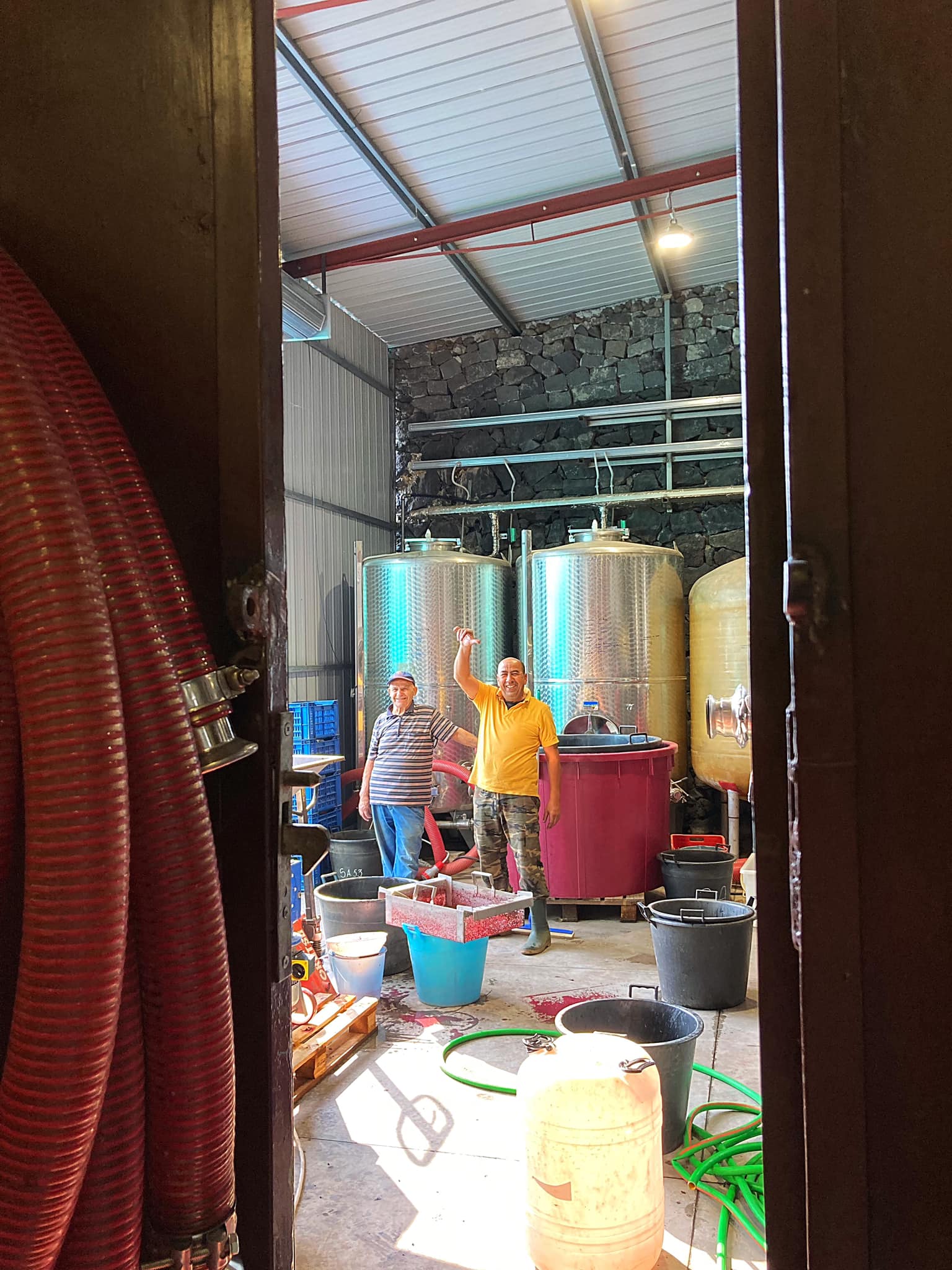
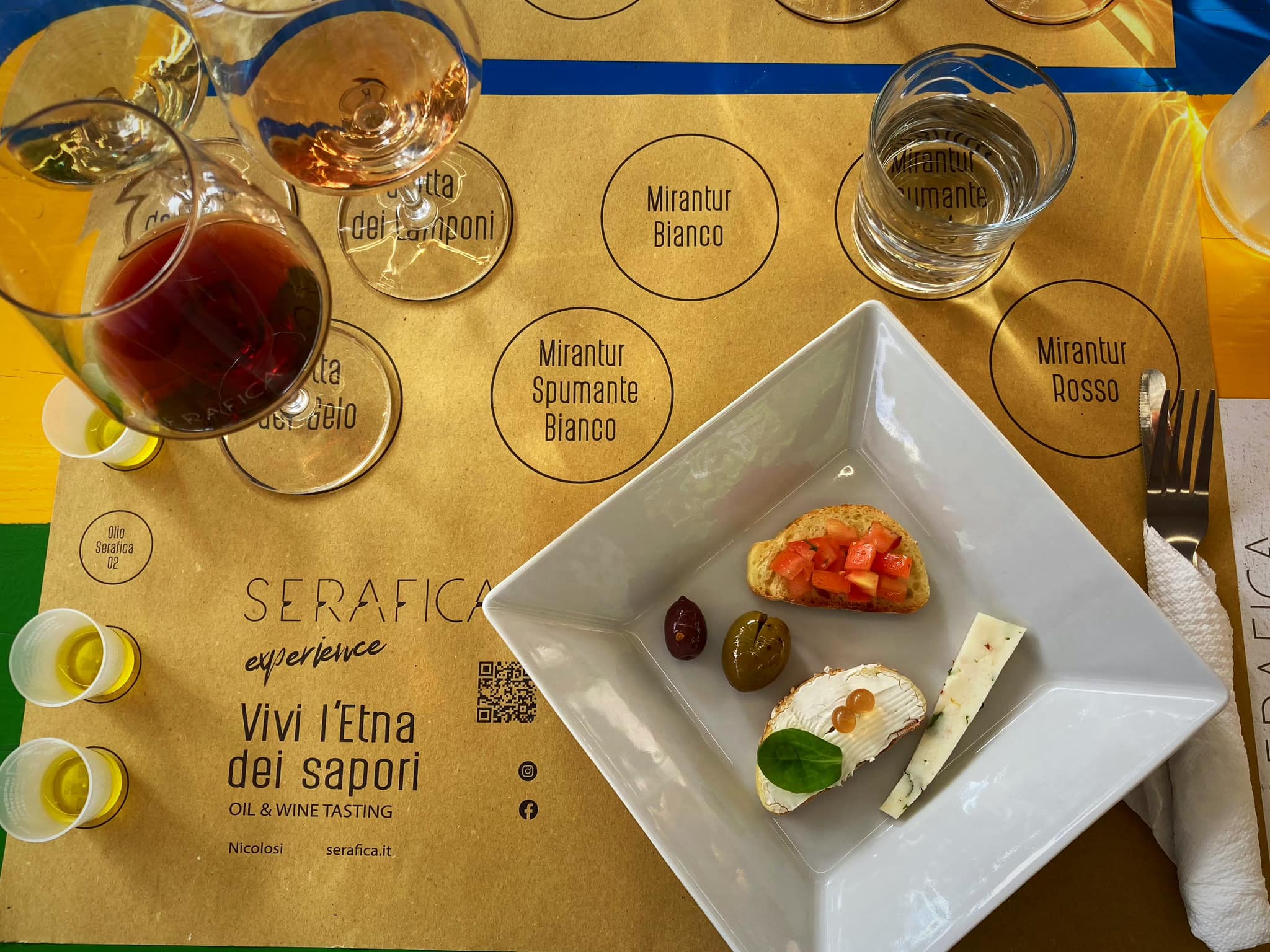
We then went into the wine production area. They have 15 hectares of vines at between 650 and 900 metres above sea level. The grape varieties of Etna are Nerello Mascalese and Nerello Cappuccio (both red) and Carricante and Catarratto (both white). During the tasting we tried the Grotta del Gelo (red), Grotta dei Lamponi (rose made from the Nerello Mascalese) and the Grotta della Neve (white). I really liked them all – the noses on them were quite floral but they weren’t floral to taste. They were all quite dry and the mineral flavours came through. The red was the favorite for everyone.
They do some contract manufacturing for some of the smaller vineyards in the area too. They are just starting their harvest now.
On Sunday they are having a festival for the locals to mark the start of the harvest. They have some vines set aside for them to pick and do the traditional foot stomping. Georgia said they welcome a number of school groups through regularly to learn about what they do. You could see from the tasting area that they had a lot of educational stuff for the kids. As a company they appear very connected and invested in the community.
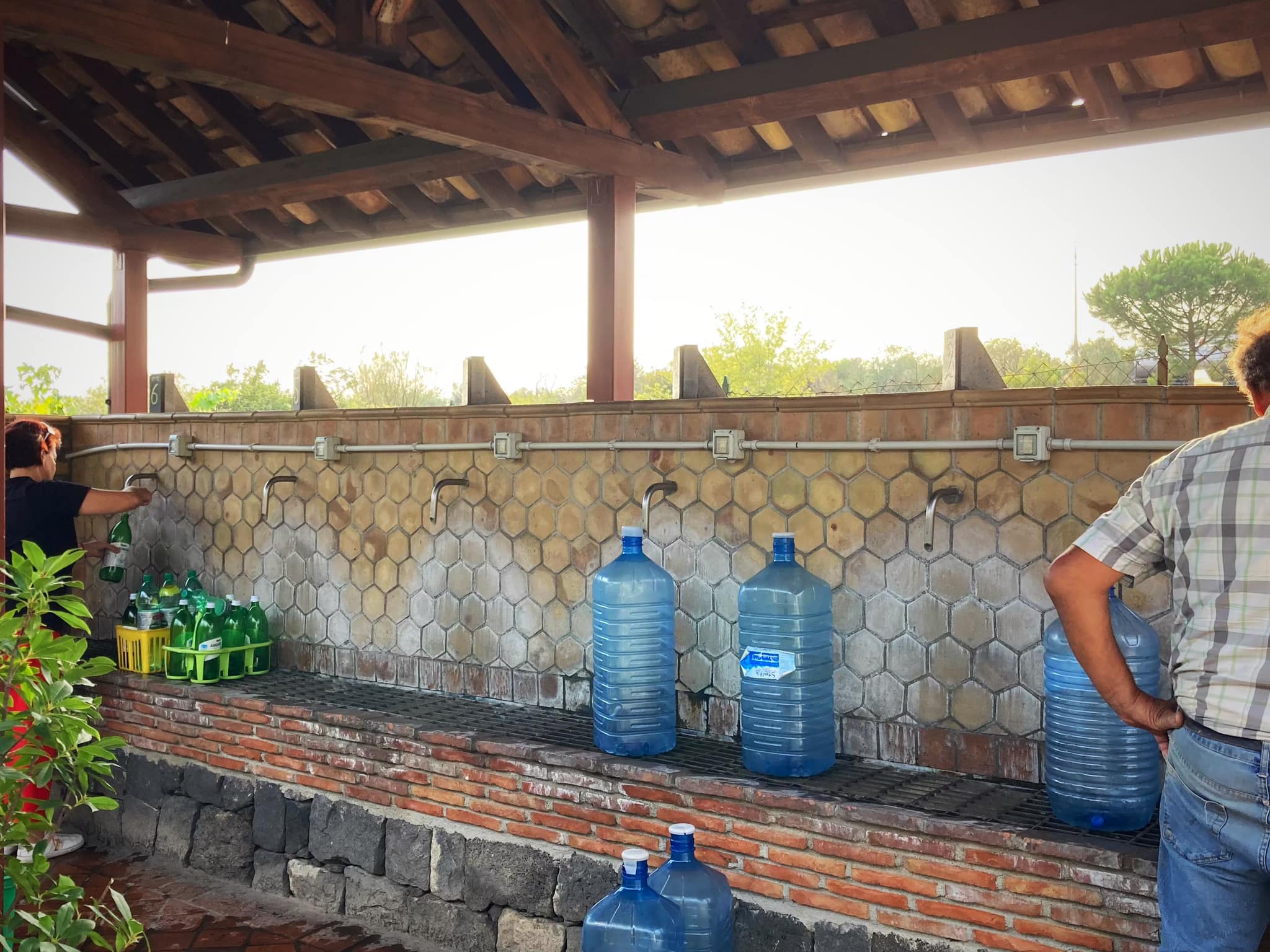
They even have a natural spring two hundred feet below the ground. They have set up a system to bring it up for the locals to come and buy – EU1 for 40 litres. We tried the water and it was good – it was lightly sparkling. It was a busy place with cars and people coming and going filling their bottles.
Georgia explained that the town water is not drinkable due to the state of disrepair of the infrastructure with lots of heavy metals detected in the water.
Georgia taught us how to taste the olive oil. We tried three – one from 400 metres, one from 600 metres and one from 1000 metres above sea level. They were all so delicate and smooth but the level of spiciness at the back of your throat increased the higher up the origin of the olives.
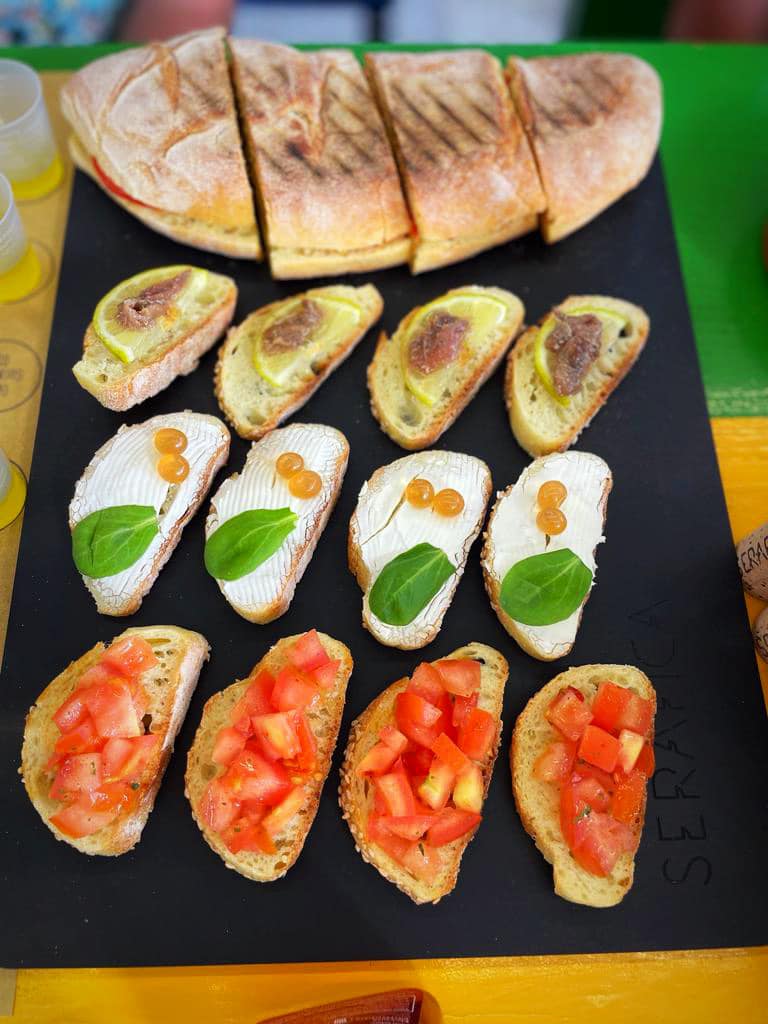
We then enjoyed some snacks where we could try the different oils. They also had some flavour infused ones – I loved the orange one. There was also a range of locally produced relishes / jams all using locally produced saffron. This local saffron producer does a lot of collaborations with other local producers of various products and sounds very innovative. Love these sorts of stories.
More special and informative memories made on the island of Sicily.









 SUNGRL